 |
REMEMBRANCES
Photo: Avatâra Ayuso |
As we come to the end of 2022, I feel as if we're at a watershed moment. Not only for Border Crossings, but for theatre, the arts, and the world. It's been a year lived in the shadow of an apparently receding pandemic, a murderous war in Europe, and the ever-growing threat of climate change. In the UK, it's been the warmest year on record. While the resilience displayed by many arts organisations in their comeback from Covid has been impressive, it's not an adequate response to the current moment simply to revert to "business as usual". There is no "usual" any more. That's why 2022 was the year in which we published THE SLIGO MANIFESTO: and I want to use this review of our activities to explore some of what that statement of intent has come (and is coming) to mean for us.
- This manifesto is our response to an increasingly uncertain world, characterised by pandemic, climate change and warfare. Planning has become hugely challenging, and risk is high. However, this has always been the state in our collaborative, intercultural devising spaces. We embrace uncertainty as a catalyst to creative practice.
The context, of course, is crucial, but it hasn't meant that everything is new. One key project during 2022 has been
CRE-ACTORS, led by Border Crossings (Ireland) in partnership with the Théâtre du Soleil, Teatro dell'Argine and The Fence; and this represented an exploration and consolidation of a hundred years' worth of combined organisational experience in cross-cultural devised performance. The resulting
e-book, which was launched in November and has already been viewed more than 10,000 times, at once documents and questions the partners' practices, enabling us all to develop the ways in which we make theatre in a changing world. We've all been delighted with the process, and are working towards further, deeper collaboration in the coming years.
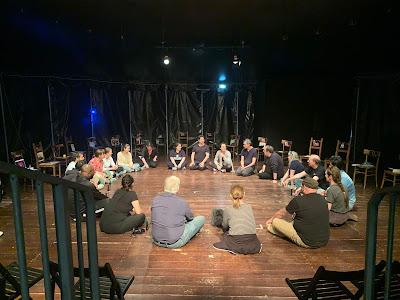 |
CRE-ACTORS in Bologna
Photo: Jessica Bruni |
- Our work - in theatre, in other art forms, in education, in community cultural development and online - is not an attempt to represent the world, but to change it.
As the year ends, we're also finishing our biggest community project yet:
BOTANY BAY. Throughout the year, we've worked with five schools in London and Manchester to create beautiful new gardens, inspired by Indigenous principles of reciprocity and gratitude, complemented by Indigenous artworks and opened through performances inspired by Indigenous practices. This is not just a learning project, but an active intervention that re-configures and re-calibrates the social and environmental space which it inhabits. The way in which we work must, of course, reflect the ideals behind that work, so it's important that for the second year running we've been certified as a Carbon Neutral business.
In the BOTANY BAY booklet (printed just before Christmas, and due to be distributed in January), the Raramuri ethnobotanist Enrique Salmon says: "We are so inundated constantly through social media, television, movies, with one idea after the other that we don’t have time to stop. We don’t have time to sit with a chilli plant, or with a tomato plant or underneath an elm tree or a pine. Of just being with the tree or the plant. Of breathing and just being."
 |
BOTANY BAY: Kawa Huni Kuin with the Tree of Life at Cavendish School
Photo: John Cobb
|
- Our predominantly white artistic leadership and management team will engage honestly and self-critically in evolving, creative, intercultural dialogues with marginalised artists, communities and stories.
BOTANY BAY was part of the 2021-22
ORIGINS Festival, which saw a further full year of participatory and dialogic work, bringing Indigenous ideas and practices into our communities. More than ever, we've been made critically aware of our own position as a non-Indigenous organisation, led mainly by white artists. In the last project of the Festival,
SONGSTREETS, we brought together an Indigenous Australian musician, Jessie Lloyd, with the black community of Brixton, so as to generate a musical, cultural and historical exchange. The resulting installation will be released in January, and promises to be extraordinary.
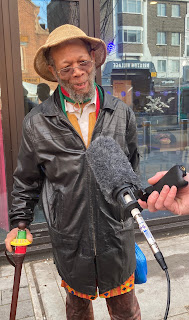 |
| Recording SONGSTREETS |
- We reject the commercial model of theatre as “production”. For us, theatre is a participatory process, all aspects of which need to engage with the communities we serve. Performance is a public ritual, a ceremony that brings our communities together.
We've been thinking a lot about performance as ceremony this year, because humanity is so much in need of renewal, and there are so few spaces and systems within which this can occur. It was very important for us to receive a commission from Birmingham 2022 to create
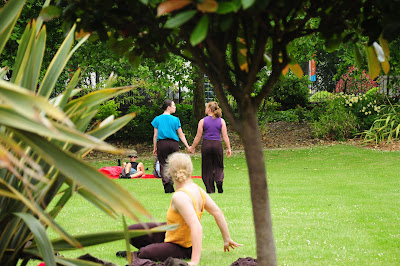
REMEMBRANCES as an alternative welcoming ceremony for the Commonwealth Games. Collaborating with AVA Dance Company, b.solomon//ELECTRIC MOOSE and Matthew James Weigel, we were able to create a performance that asked the crucial questions around post-colonial relationships, and offered genuine potential for healing.
 |
REMEMBRANCES
Photo: Avatâra Ayuso
|
- Our work going forward will therefore focus on “events” rather than “productions”; channelling energies towards generating real impact in terms of social and environmental justice, cultural and spiritual renewal.
I don't know if this distinction between "productions" and "events" is clear or even necessary for a wider public, but it's crucial for us, because it's about what our work is doing in the world. It asks whether it is there for our own satisfaction and profit, or to make a real difference. In the beautiful
ceremonies that opened the BOTANY BAY gardens, in the sharing of space around a fire that ended REMEMBRANCES, in the deeply spiritual music we presented at the British Museum for our joint event
CELEBRATING PERU, and in the potent exchanges around CRE-ACTORS, we felt this shift occur. As I wrote in the CRE-ACTORS e-book: "To conceive of a theatre that is multiform and various, a shared space that yields innovation through the clash of distinct viewpoints and approaches, rooted in ongoing dialogues between artists from different backgrounds, and informed by potent overlaps between friendship and disagreement: this is to propose not only a theatrical and artistic but also a cultural and democratic vision. It is about space that is profoundly shared, whether that be the stage, the auditorium, the street or the parliament house. It is about equity and justice."
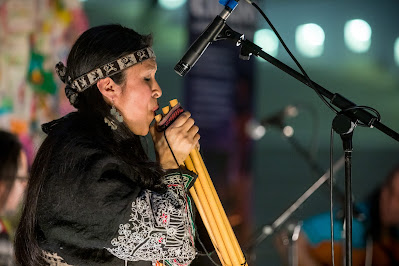 |
CELEBRATING PERU
Photo: Benedict Johnson © The British Museum |
- We now work through two charitable companies, one in the Republic of Ireland and one in the UK: both dedicated to intercultural dialogue through the arts. In furtherance of this international mission, we will engage more substantially with European partnerships and develop a range of key funding relationships, including core funding.
The development of Border Crossings (Ireland) has been a major theme during 2022, both through CRE-ACTORS and a second Erasmus + project on which we are partners:
X-EUROPEAN. This project, exploring the Third Space as a way to generate positive cross-cultural interaction, has taken us to Germany and Finland, and culminated in an invigorating theatre workshop which Lucy Dunkerley and I led at the
Glencree Centre for Peace and Reconciliation in Wicklow a few weeks ago.
Our relationships with funders are, of course, crucial: we've been fortunate this year to benefit from working with the Erasmus + programme of the European Union, Arts Council England, the National Lottery Heritage Fund, the UK-Australia Season, the High Commission of Canada in the UK, and Beyond the Spectacle.
 |
X-EUROPEAN
Photo: Aydin Cam |
- We will deepen the relationship between our live and digital work, recognising the complementary nature of live and virtual experiences, and the different ways in which these inter-related approaches can generate reach and impact. We believe that any art form is regenerated and developed by its interaction with other forms, and so we will enhance our theatre through digital practice and our digital work through our theatre.
2022 began with the release of our film about the 2021 journey of
TOTEM LATAMAT: and an enhanced digital presence has characterised our work throughout the year. REMEMBRANCES had a streamed as well as a live version, which meant that it could be seen far more widely, including by First Nations communities in Canada and beyond. SONGSTREETS will be realised as an app. The plaque which we commissioned for
DOVER BEACH by Wiradjuri-British artist Jasmine Coe was hugely enhanced by the accompanying
film. Similarly, BOTANY BAY included a wide range of
digital learning materials, particularly a series of short films, each of which concentrated on a specific aspect of the project as it developed through the seasons. The
SPRING film, presented by Karuk actor Nathan Woodworth, has proved a great success with his tribe, and has also become part of the permanent display at the
American Museum in Bath. Our online presence has also enabled us to partner with like-minded international organisations in innovative ways, for example the digital partnership between ORIGINS and Canada's
imagineNATIVE Festival, which brought this film festival's online programme to UK audiences. CRE-ACTORS, which could have been a very inward-looking project, benefiting the partners only, has become known to the global theatre community through the e-book. This digital emphasis has also meant that our marketing and communications are no longer just a means to "sell" our work, but have become an integral part of it - a much healthier approach, which we've recognised structurally by bringing Emma Townsend, who had proved herself indispensable on ORIGINS, into the
core team.
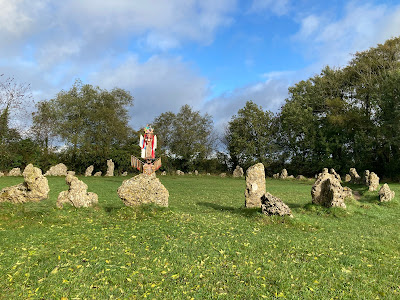 |
TOTEM LATAMAT
Photo: John Cobb |
- We will be more risk aware in our financial management, more conscious of the evolution of projects through their processes, and more sensitive to the need to keep cultural work free of charge or very affordable. We will therefore ensure that contingencies form a larger element in our budgeting.
This sounds like the most mundane clause in the Manifesto, but in a way I think it's the most significant of all. Since the start of the pandemic, we have not sold a single ticket. And I can't say I've missed it. I'm not saying that everything we do in the future will always be free: theatre remains an industry as well as an art form and sometimes it will be necessary to work with a venue that necessitates a paid Box Office. What I am saying is that commercial and financial considerations of this kind can no longer be allowed to determine the value of artistic work. I recently wrote
on this blog about the way in which an MBA-style approach to running arts organisations has fatally undermined the sector: and for us it's a key lesson of the current moment that we have to put our artistic priorities and their cultural significance before the administrative structures which support them.
The year has been rich. In the deepest sense of the term. And I am far from certain what happens next.... Let's embrace that.
Wishing you all the best for 2023.


