Showing posts with label Botany Bay. Show all posts

Friday, December 29, 2023

Looking Back at 2023

Songstreets

When I started to think about reviewing 2023, the logical first step was to look over what I'd written last December about 2022. That was the year when we issued THE SLIGO MANIFESTO, and my account of the year followed its structure, examining how we were moving towards those new ideas about what Border Crossings needs to do and to be in today's shifting world. Much of 2023 has been about laying the foundations for that emerging model.

The year began by consolidating and polishing the work we'd been creating in 2021-22, particularly the final stages in the prolonged and searching ORIGINS Festival we'd made through that time. BOTANY BAY may officially have ended a year ago, but the process of working through what that huge project had actually achieved was in itself a major undertaking, and it wasn't until the start of March that we published Carolyn Defrin's reflective post on this blog. SONGSTREETS, which we'd also been developing through ORIGINS, was launched in the Spring, and remains available to download and experience. It's one of our most exciting ventures yet in digital performance - Thor McIntyre-Burnie's sound world shifts the experience of walking the streets of Brixton, animating them as Tony Cealy shares histories and dialogues with the locals, with the music brought out by Jessie Lloyd becoming manifest as the soundtrack to their lives. It's been fascinating to live with this work over the last few months, watching how the shifting seasons change the experience, how the cold day of the launch emphasised the challenges facing the community, while taking the walk in summer made it a story of resilience and celebration. 

Early 2023 also saw the final phase of X-EUROPEAN: the project exploring Third Space methodologies in which Border Crossings (Ireland) was the theatrical collaborator. It was only days after we held our last project meeting in Aalen (Germany) that the city of Adana, home to our wonderful Turkish partners at Çukurova University, was hit by a devastating earthquake. İlke Şanlıer's deeply impassioned and pained guest blog post came in the immediate aftermath. Somehow, Adana has re-emerged as the vibrant, busy city it was before (although its neighbour Antakya remains a site of devastation): we are now working closely with İlke and her colleagues on SUPPLIANTS OF SYRIA, which promises to be the first of our theatrical creations fully to embody the principles and ideas outlined in THE SLIGO MANIFESTO. We undertook the first phase of development in Turkey during November, and are hugely excited to be starting work with British and Irish actors in January. The next week or so will also tell us whether or not we've been successful in a large funding bid which would enable a second 2024 project - one that would reach performance in the autumn...  

Filming for SUPPLIANTS OF SYRIA

So there are definitely reasons to be hopeful as we begin the New Year, though at the same time the great crises facing the world seem to be coming into sharper, more intense and horrific focus than ever before. Cop 28 has ended with an agreement to phase out fossil fuels, and yet the president of the summit himself intends to continue investing at record levels in the production of gas and oil. The war in Ukraine is heading towards its third year, while in Gaza there are unprecedented levels of civilian and child casualties. In the UK, the government remains determined to send asylum seekers to Rwanda, despite the Supreme Court having ruled that this is illegal; and in Ireland we have seen the radical right unleashed on the streets of Dublin in a frenzy of racially motivated violence.

We need the arts. We need our cultures. We need spaces of exchange, depth and emotional sharing; spaces where, in the face of the reductive, shallow sloganeering that passes for a public discourse, we can encounter one another in the fullness of our common humanity. 

Lucy and I experienced this very deeply during our November in Adana, where we worked with Syrian women on our new theatre and film project, SUPPLIANTS OF SYRIA. We heard stories of horror, and stories of tenderness. We saw tears, and we heard laughter. While we were there, we also had the privilege to present an online reading of THE GAZA MONOLOGUES, created by our partners in Ramallah, ASHTAR Theatre. In these moving stories, written by young people in the aftermath of a previous conflict, we again recognised the vulnerability that makes people loveable, the simple presence that makes them dear.

As we move into the New Year, it is in cultural spaces like these that we retain our hope to turn the page of history. 

Wednesday, March 01, 2023

Reflecting on BOTANY BAY - guest blog by Carolyn Defrin


BOTANY BAY celebration - Manchester
BOTANY BAY was a major Participation and Learning project, which we ran as part of ORIGINS 2021-22 with the support of the National Lottery Heritage Fund.  Here our External Evaluator, Dr. Carolyn Defrin, reflects on the project's journey and impact.

*

The timeline of BOTANY BAY, from its launch in the peak of Omicron to its completion in what now feels like a post-pandemic landscape, speaks to its imperative value. In the last three years the entire globe has been visibly impacted by a health crisis. But Covid’s necessary slowing down of society has created space and time to more clearly witness and experience the long interconnected crises between people and the planet. The entanglement of Covid, the Climate Crisis and Colonialism is deep and complex and a project like BOTANY BAY enters the conversation by creating numerous pathways into understanding our inter-relationships with people and land, illuminating how we might start tending to both with more care, awareness and deliberate action.

With attention on Indigenous practices and principles, BOTANY BAY aimed to address the critical need to look after our world differently. Indigenous inspired growing and gardening practices have a lot to teach us about how interconnected we are and how much care is needed to keep those interconnections alive and thriving. By shining a light on the values and cultural traditions of a range of Indigenous communities across the map, BOTANY BAY platformed looking back as a means to look forward. Drawing out more complete histories of plant origins and the ways in which politics have complicated those stories invited understanding and acknowledgement as a means to grasp at large concepts of Colonialism and Climate Change through a series of experiential activities.

Through museum visits, treasure hunts in heritage gardens, special visits from heritage experts and performances from artists with direct links to Indigenous backgrounds, BOTANY BAY offered a wide set of access points for children to encounter new knowledge. Children became more inquisitive about the environmental repercussions of deforestation in the Amazon as they watched intricate puppet animals created and performed by José Navarro lose critical access to their food and homes. As students acted out a game with the Manchester Museum, where they had to follow butterflies to find specific medicinal plants and flowers, they embodied not only the inter-relationships between humans and animals, and the mutual care needed to sustain such ecologies, but also learned of the detrimental impact of certain types of farming, land ownership and extraction on those relationships as the game began to introduce obstacles for the students to find the butterflies.

BOTANY BAY is not encapsulated through a box ticking exercise of finite learnings and rote memorisations. Rather it is a programme of multi-sensory, embodied learning activities that built skills in attention, care and individual thinking and adaptation. As Manchester Museum's Curator of Indigenous Perspectives Alexandra P Alberda, an institution can be a conversation starter, and BOTANY BAY feels very much about starting conversations, activating ideas, getting one’s hands literally and metaphorically dirty with some messy problems in our current world.

As students created their own gardens- planting, tending, growing and cooking their own food inspired by Indigenous practices and principles- they witnessed acts of visible growth and change. They paid attention to what fruits, flowers and vegetables need to survive, learning how to adjust the plan when survival wasn’t at its optimum. In the final months of the project they considered how to invite others in to appreciate and enjoy their harvest and their learnings.

These essential observations and actions manifest the literal attention and awareness needed in our current climate emergency and the metaphoric care and iteration needed across our inter-personal relationships where social inequities continue to divide us.

Inquiry begets further inquiry. Several questions arose from the partnering schools, museums and heritage experts as BOTANY BAY drew to a close. How do we learn from Indigenous principles? How do we adapt them to a UK context? How do we embed the learning more deeply and continue to grasp large and sprawling concepts like Colonialism and Climate Change that need our attention urgently?

These big ideas underpinning BOTANY BAY are not only conceptual (and in need of translation depending on the audience), they are also in an early phase of becoming more mainstream. Between the pandemic, the building attention around socio-economic disparity deriving from far-reaching impacts of colonialism, and the climate crisis becoming ever more visible, institutions and communities are growing an awareness around the need for systemic change. But this is slow, long-term work. BOTANY BAY and its numerous impacts on several stakeholders, including Border Crossings, offers a huge opportunity to develop and build the kinds of relationships that can contribute significantly to such systemic change.

There are many immediate and long-term positive impacts that have emanated from BOTANY BAY. The practical skills built in gardening, growing, cooking and ceremony making, the strengthening of critical soft skills like confidence, team work, communication, planning and adapting are valuable outcomes– especially coming out of numerous pandemic lockdowns that hampered such skill development. Theses skills will have life-long residual impacts for young people resonant with the Indigenous principle to create sustainability by thinking 7 generations in the future.

Carolyn Defrin

Saturday, December 31, 2022

Review of '22

REMEMBRANCES
Photo: Avatâra Ayuso

As we come to the end of 2022, I feel as if we're at a watershed moment. Not only for Border Crossings, but for theatre, the arts, and the world. It's been a year lived in the shadow of an apparently receding pandemic, a murderous war in Europe, and the ever-growing threat of climate change. In the UK, it's been the warmest year on record. While the resilience displayed by many arts organisations in their comeback from Covid has been impressive, it's not an adequate response to the current moment simply to revert to "business as usual". There is no "usual" any more. That's why 2022 was the year in which we published THE SLIGO MANIFESTO: and I want to use this review of our activities to explore some of what that statement of intent has come (and is coming) to mean for us.

  • This manifesto is our response to an increasingly uncertain world, characterised by pandemic, climate change and warfare. Planning has become hugely challenging, and risk is high. However, this has always been the state in our collaborative, intercultural devising spaces. We embrace uncertainty as a catalyst to creative practice.
The context, of course, is crucial, but it hasn't meant that everything is new. One key project during 2022 has been CRE-ACTORS, led by Border Crossings (Ireland) in partnership with the Théâtre du Soleil, Teatro dell'Argine and The Fence; and this represented an exploration and consolidation of a hundred years' worth of combined organisational experience in cross-cultural devised performance. The resulting e-book, which was launched in November and has already been viewed more than 10,000 times, at once documents and questions the partners' practices, enabling us all to develop the ways in which we make theatre in a changing world. We've all been delighted with the process, and are working towards further, deeper collaboration in the coming years.
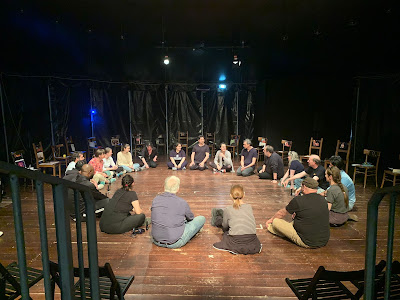
CRE-ACTORS in Bologna
Photo: Jessica Bruni
  • Our work - in theatre, in other art forms, in education, in community cultural development and online - is not an attempt to represent the world, but to change it.
As the year ends, we're also finishing our biggest community project yet: BOTANY BAY. Throughout the year, we've worked with five schools in London and Manchester to create beautiful new gardens, inspired by Indigenous principles of reciprocity and gratitude, complemented by Indigenous artworks and opened through performances inspired by Indigenous practices. This is not just a learning project, but an active intervention that re-configures and re-calibrates the social and environmental space which it inhabits. The way in which we work must, of course, reflect the ideals behind that work, so it's important that for the second year running we've been certified as a Carbon Neutral business.

In the BOTANY BAY booklet (printed just before Christmas, and due to be distributed in January), the Raramuri ethnobotanist Enrique Salmon says: "We are so inundated constantly through social media, television, movies, with one idea after the other that we don’t have time to stop. We don’t have time to sit with a chilli plant, or with a tomato plant or underneath an elm tree or a pine. Of just being with the tree or the plant. Of breathing and just being." 

BOTANY BAY: Kawa Huni Kuin with the Tree of Life at Cavendish School  
Photo: John Cobb
  • Our predominantly white artistic leadership and management team will engage honestly and self-critically in evolving, creative, intercultural dialogues with marginalised artists, communities and stories.
BOTANY BAY was part of the 2021-22 ORIGINS Festival, which saw a further full year of participatory and dialogic work, bringing Indigenous ideas and practices into our communities. More than ever, we've been made critically aware of our own position as a non-Indigenous organisation, led mainly by white artists. In the last project of the Festival, SONGSTREETS, we brought together an Indigenous Australian musician, Jessie Lloyd, with the black community of Brixton, so as to generate a musical, cultural and historical exchange. The resulting installation will be released in January, and promises to be extraordinary.  
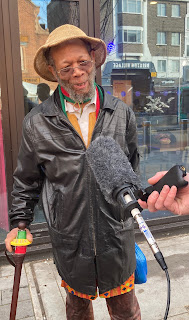
Recording SONGSTREETS
  • We reject the commercial model of theatre as “production”. For us, theatre is a participatory process, all aspects of which need to engage with the communities we serve. Performance is a public ritual, a ceremony that brings our communities together.
We've been thinking a lot about performance as ceremony this year, because humanity is so much in need of renewal, and there are so few spaces and systems within which this can occur. It was very important for us to receive a commission from Birmingham 2022 to create REMEMBRANCES as an alternative welcoming ceremony for the Commonwealth Games. Collaborating with AVA Dance Company, b.solomon//ELECTRIC MOOSE and Matthew James Weigel, we were able to create a performance that asked the crucial questions around post-colonial relationships, and offered genuine potential for healing.

REMEMBRANCES
Photo: 
Avatâra Ayuso
  • Our work going forward will therefore focus on “events” rather than “productions”; channelling energies towards generating real impact in terms of social and environmental justice, cultural and spiritual renewal.
I don't know if this distinction between "productions" and "events" is clear or even necessary for a wider public, but it's crucial for us, because it's about what our work is doing in the world. It asks whether it is there for our own satisfaction and profit, or to make a real difference. In the beautiful ceremonies that opened the BOTANY BAY gardens, in the sharing of space around a fire that ended REMEMBRANCES, in the deeply spiritual music we presented at the British Museum for our joint event CELEBRATING PERU, and in the potent exchanges around CRE-ACTORS, we felt this shift occur. As I wrote in the CRE-ACTORS e-book: "To conceive of a theatre that is multiform and various, a shared space that yields innovation through the clash of distinct viewpoints and approaches, rooted in ongoing dialogues between artists from different backgrounds, and informed by potent overlaps between friendship and disagreement: this is to propose not only a theatrical and artistic but also a cultural and democratic vision. It is about space that is profoundly shared, whether that be the stage, the auditorium, the street or the parliament house. It is about equity and justice."
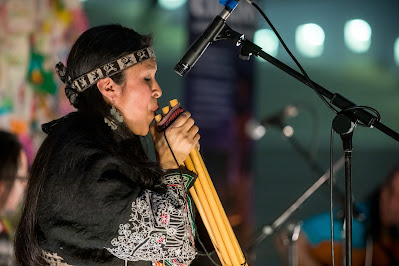
CELEBRATING PERU
Photo: Benedict Johnson © The British Museum
  • We now work through two charitable companies, one in the Republic of Ireland and one in the UK: both dedicated to intercultural dialogue through the arts. In furtherance of this international mission, we will engage more substantially with European partnerships and develop a range of key funding relationships, including core funding.
The development of Border Crossings (Ireland) has been a major theme during 2022, both through CRE-ACTORS and a second Erasmus + project on which we are partners: X-EUROPEAN. This project, exploring the Third Space as a way to generate positive cross-cultural interaction, has taken us to Germany and Finland, and culminated in an invigorating theatre workshop which Lucy Dunkerley and I led at the Glencree Centre for Peace and Reconciliation in Wicklow a few weeks ago. 

Our relationships with funders are, of course, crucial: we've been fortunate this year to benefit from working with the Erasmus + programme of the European Union, Arts Council England, the National Lottery Heritage Fund, the UK-Australia Season, the High Commission of Canada in the UK, and Beyond the Spectacle.  
X-EUROPEAN
Photo: Aydin Cam
  • We will deepen the relationship between our live and digital work, recognising the complementary nature of live and virtual experiences, and the different ways in which these inter-related approaches can generate reach and impact. We believe that any art form is regenerated and developed by its interaction with other forms, and so we will enhance our theatre through digital practice and our digital work through our theatre.
2022 began with the release of our film about the 2021 journey of TOTEM LATAMAT: and an enhanced digital presence has characterised our work throughout the year.  REMEMBRANCES had a streamed as well as a live version, which meant that it could be seen far more widely, including by First Nations communities in Canada and beyond. SONGSTREETS will be realised as an app. The plaque which we commissioned for DOVER BEACH by Wiradjuri-British artist Jasmine Coe was hugely enhanced by the accompanying film. Similarly, BOTANY BAY included a wide range of digital learning materials, particularly a series of short films, each of which concentrated on a specific aspect of the project as it developed through the seasons. The SPRING film, presented by Karuk actor Nathan Woodworth, has proved a great success with his tribe, and has also become part of the permanent display at the American Museum in Bath. Our online presence has also enabled us to partner with like-minded international organisations in innovative ways, for example the digital partnership between ORIGINS and Canada's imagineNATIVE Festival, which brought this film festival's online programme to UK audiences. CRE-ACTORS, which could have been a very inward-looking project, benefiting the partners only, has become known to the global theatre community through the e-book. This digital emphasis has also meant that our marketing and communications are no longer just a means to "sell" our work, but have become an integral part of it - a much healthier approach, which we've recognised structurally by bringing Emma Townsend, who had proved herself indispensable on ORIGINS, into the core team

TOTEM LATAMAT
Photo: John Cobb
  • We will be more risk aware in our financial management, more conscious of the evolution of projects through their processes, and more sensitive to the need to keep cultural work free of charge or very affordable. We will therefore ensure that contingencies form a larger element in our budgeting.
This sounds like the most mundane clause in the Manifesto, but in a way I think it's the most significant of all. Since the start of the pandemic, we have not sold a single ticket.  And I can't say I've missed it. I'm not saying that everything we do in the future will always be free: theatre remains an industry as well as an art form and sometimes it will be necessary to work with a venue that necessitates a paid Box Office.  What I am saying is that commercial and financial considerations of this kind can no longer be allowed to determine the value of artistic work. I recently wrote on this blog about the way in which an MBA-style approach to running arts organisations has fatally undermined the sector: and for us it's a key lesson of the current moment that we have to put our artistic priorities and their cultural significance before the administrative structures which support them.

The year has been rich.  In the deepest sense of the term.  And I am far from certain what happens next.... Let's embrace that. 

Wishing you all the best for 2023.

Friday, April 01, 2022

The Strange Case of Kew


Banksias at Kew Gardens

When we started the BOTANY BAY project towards the end of last year, one of the most obvious partners to engage with seemed to be Kew Gardens. We'd had some initial discussions with them before we applied to the Heritage Fund and, while these didn't lead to official "partner" status, there was a clear sense that they liked what we were doing, and that they would be open to help with expertise, filming opportunities and the like. Earlier this year, we contacted them again - and everything seemed different. It's now very clear that Kew will not be part of the project.  

This was a particular surprise to us, given that Kew had been quite vocal in its response to the #BlackLivesMatter movement in 2020, and that our conversations with them had given the impression they were keen to set up exchanges with Indigenous ethnobotanists and environmentalists, whose insights could help them think differently about their botanical and historical collections. Their Director of Science, Professor Alexandre Antonelli, had clearly acknowledged Kew's "legacy that is deeply rooted in colonialism"; and their Manifesto for Change, published in March 2021, had stated that "We will move quickly to ‘de-colonise’ our collections, re-examining them to acknowledge and address any exploitative or racist legacies, and develop new narratives around them". None of this should really be surprising, given that Kew's first de facto Director was Joseph Banks, the botanist who sailed with Captain Cook, collecting plants from Australasia and the Pacific, and establishing what would become global networks of economic botany, underpinning the workings of Empire. The most striking example, which we've been discussing with young visitors to the Garden Museum in the last couple of months, is the breadfruit. Banks discovered that this Tahitian plant was cheap, nutritious and easy to grow: as a result of which he despatched William Bligh to arrange its transportation to the Caribbean, where it served to feed enslaved people. In its Manifesto, Kew was simply acknowledging the basis of its wealth and status. As the Director Richard Deverell wrote there: "We shouldn’t forget that plants were central to the running of the British Empire."

So what happened to make the management of Kew step back from this important process?  The answer seems to be a report, published at the end of 2021, by the right-wing Think Tank Policy Exchange. This report, entitled Politicising Plants, directly attacked Kew's decolonising agenda. It's important to note that this was not done by generating any counter-argument to the historical narrative I've summarised above, but through a more legalistic approach. Kew, argued the report's authors, exists "to provide scientific knowledge rather than a historical narrative". They base this assertion on the statutory functions outlined in the 1983 National Heritage Act, which does indeed emphasise "the science of plants and related subjects". The Manifesto for Change, they suggest, outlines a plan that is ultra vires, because it moves beyond "science" into a politicised realm. "Politics", they say "has nothing to do with the science of plants and Kew has no business providing a platform for political views. Doing so falls outside Kew’s statutory scientific responsibilities and, as such, using Kew’s funds for these sorts of exercises is illegitimate."

A mere fortnight after the publication of this report, Kew dropped its decolonisation project. This was also the time when they stopped engaging with our work. Policy Exchange was triumphant.

It's astonishing that a conservative Think Tank should seem so powerful that a major national institution should simply submit when it clicks its fingers, but Policy Exchange is more than just a talking shop. As George Monbiot has shown, it is part of a shift in the way our country is run: a shift that is dismantling the constitutional structures of the civil service and the judiciary, replacing them with "advisors" who report to the Prime Minister's office and are answerable to no-one. Monbiot also highlights the way Policy Exchange attacks academic freedom (on the specious grounds that it indoctrinates students with "wokery"), and whips up media fury against environmental groups like Extinction Rebellion. He points out that the funding of Policy Exchange is opaque to say the least, but that its known donors include "the power company Drax, the trade association Energy UK, and the gas companies EON and Cadent, whose fossil-fuel investments are threatened by environmental activism." An anti-colonial agenda in relation to plant sciences is also, of course, an environmentally active stance.

It's a shame that Kew gave in so easily. After all, Policy Exchange's report is nonsense. It assumes that "science" is an objective truth, and so cannot be part of a colonial legacy. This is always the way in which the right constructs the narrative around its own opinions - that they are not opinions, but facts. What we are discovering in the BOTANY BAY project is that this objectifying culture, which regards the natural world as something other to ourselves, something to be explored and exploited, is an expression of an aggressive imperial mindset. Indigenous cultures, which regard plants as non-human persons to whom we relate within a ecosystem, tend to be dismissed as fanciful, but are in fact telling us truths in ways that are just as "scientific": they are simply couched in different language. Trees do talk to each other. Crops do grow better when they can fertilise one another. What Policy Exchange was actually saying was not that the political was legally distinct from science, but that they refused to acknowledge the political nature of science itself, and indeed of all other knowledge systems. Very convenient for their funders' agenda.

Our recent project film Winter looks at the racist structures inherent in botanical classification systems and languages. It isn't actually "objective fact" to classify plants using Latin names as Linnaeus did: it's a reflection of how he viewed and wanted to order the world. True science (the word actually means "knowledge") engages with its own context, recognising the contingent nature of all human attempts to understand and interact with the world. We need dynamism and development, not stasis and decay.

Thursday, January 13, 2022

Botany Bay: Manchester Museum visits Schools

 Guest blog by Marine Begault

Back in December, two schools in Manchester received their first visitors as part of the Botany Bay project: the Manchester Museum. 

As the Manchester Museum is currently closed for refurbishment the Learning team, as well as their newly appointed Curator of Indigenous Perspectives (Alexandra P. Alberda),
visited the schools in person. 

Marine Begault is the Project Manager on Botany Bay.  Here she reflects on some of the themes and questions addressed through this first interaction with the museum and the schools.

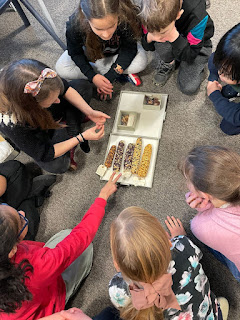
Pupils explore the different varieties of maize

Alexandra Alberda and the team developed a session especially for this project. The learning team were extremely excited to be part of the session and learn from Alex, as this is an important part of the Museum’s journey towards decolonising their collections and practice. 

Alexandra introduced herself in her native tongue and as Blue Corn, which immediately set the tone to the session. 

The museum brought some pieces from their Botany and Entomology collections. Most children knew what Botany meant (‘investigating plants’ as one child put it) but Entomology was a new word for most.

The children were given a few minutes to circulate around each of the objects brought by the museum. In small groups they were asked to discuss whether they recognised them, if they had seen them before and where, and whether they had any stories or feelings associated with them.

The Butterfly Station (a glass case of 10 different butterflies) led to some interesting conversations around why we don’t see that many butterflies (some saw them on holiday or in some cases in their garden), which led to an understanding that we live in cities and that butterflies need flowers. I was really interested in hearing some conversations around ‘are they real?’ or ‘are they dead?’, which made me think about the ways younger children might struggle with the idea of something being dead and real at the same time. Being dead but visible and conserved. Dead but existing in the world. There were also some conversations around the ethics of killing the butterflies (it turns out they were trapped in a jar and put to sleep with a gas in Victorian times as a way to study them).

The Blue corn and dried chilli station was interesting in that most children thought that the blue corn was rotten ‘normal corn’ and few recognised the chillies, or again thought they were rotten or old.  

The plant station included dried Yaupon leaves and an Echinacea plant in a class case as well as botanical drawings of medicinal plants. Again a conversation around the plants being ‘real’ or not came about, but also the children enjoyed trying to read the labels of these items: ‘black tea’ being used to describe the Yaupon. A conversation around drinking tea, when they drink tea, what tea they are allowed to drink etc. ensued. When I asked one student the type of tea he normally drinks he answered ‘normal English tea.’ When I asked him about what he meant by that, he wasn’t really sure what I was asking. Unpicking responses like these is exactly why I find this project so fascinating.

The children were brought back into a circle, and Alex told everyone about the significance of the circle in her culture. She began the story by introducing her relative, corn, who like herself is the eldest sister. She told story of the Three Sisters, and how they revealed themselves to the villagers to thank them for their kindness and generosity on a cold winter evening. The children really responded to this story. Some asked if it was real, if Alex was real, if she was magical. It brought about a certain level of mysticism. I think there is something really interesting in bringing this magic, this mysticism into the classroom (and valuing it) as a different way of knowing. I am interested to explore its role in how we learn, particularly in the context of this project and the intention to create a space where children can connect with ‘the more than human’ and build a relationship that is based on reciprocity. 

The session concluded with a game, which explored relationship and kinship as well as some of the harmful effects of colonialism. The group were separated into humans, butterflies and medicinal plants. Alex explained that as plants and animals came long before humans, Indigenous people had learned to survive by listening and observing. Rather than forage for hours on end for medicinal plants hidden in the shrub, they followed butterflies in the meadows to the correct plant. 

The humans were told that a fever has broken out in their village and that they needed to find a particular flower to help them heal their families. They came to the butterflies for help. Human’s one gift, Alex reminded them, is gratitude; and in order for this relationship to be reciprocal the human had to say please and thank you to the butterfly.      

Each layer of the game brought another disease, which the butterflies needed to help the humans with, and each layer brought further obstacles. For example, farmland got rid of a number of wild flower meadows and therefore butterflies, while private property made it impossible for the villagers to follow their butterflies to pick the plants. Each obstacle broke down the relationships further. 

I really enjoyed hearing about the different properties of these plants. A lot of children did not know that medicine is in fact (mostly) plant based. I definitely found that hearing about all of their properties and the ways in which they help us made me admire, respect and love them more. The feeling of being in awe of nature and all its gifts might be a good starting point for shifting this relationship of domination and destruction. 


Thursday, December 30, 2021

Looking Back on 2021

CRE-ACTORS:
Participants on the stage of the Cartoucherie in July

In my post looking back on 2020, I speculated that our work (and perhaps the whole form of theatre) would not simply go back to the way it had been prior to the Covid-19 pandemic, but would continue that year's exploration of new forms more suited to our rapidly changing world. What I had not expected then was that 2021 would pass without us being able to present any actual 'theatre' at all - or that I would find myself at the end of this year putting the very word 'theatre' into inverted commas. The form itself seems questionable, unstable. Some companies have, of course, been able to perform in 2021, but they have done so under constant threat of closure, and they have usually been able to do so because they were building-based. For us, there remains very little point trying to plan a production in a conventional performance space, while access to those spaces remains so unpredictable. And so we continue the process of enquiry begun last year, examining how our work can and should evolve in the capricious context of our troubled times. This isn't just about the pandemic, either. Covid has brought into sharper focus two major issues which were already informing our art, and which are now emerging as its core themes. One of these is the existential threat posed to the planet by climate change. The other is the ongoing prevalence of colonial structures, both politically and culturally, which stand in the way of equity, justice and democracy. For the foreseeable future, our work will centre on these three themes:

  • Covid
  • Climate Change
  • Colonialism
On one level, these are all the same theme. They are all to do with the choking dominance of capitalist structures across the world, and they are all to do with loss of breath. Covid-19 attacks the breath; Climate change contaminates the air we breathe; Colonialism cuts off the breath of life from those whose humanity it denies. As George Floyd was choking to death, he managed to say "I can't breathe".


Thinking through these key themes has enabled us to create a very different version of the ORIGINS Festival for 2021-22. It was clear from the beginning that we would not be able to programme our usual two weeks of visiting performances in the summer, and so instead we looked to a full year of programming which would bring Indigenous cultures into a direct dialogue with our own society in Britain. We began with online events, building on what we'd achieved in THE LOCKDOWN DIALOGUES of 2020. The Opening Event was online, and included a performance of Yvette Nolan's KATHARSIS - a play written in response to the pandemic and the closure of the theatres, performed in the deserted auditorium of Winnipeg's Prairie Theatre Exchange by Tracey Nepinak. 


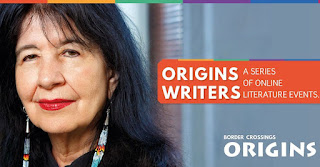
During the spring, we worked with our friends at Beyond the Spectacle to present ORIGINS WRITERS: a series of online literary events, using dialogues with leading Indigenous writers like Joy Harjo (the US Poet Laureate), Natalie Diaz and climate change expert Kyle Whyte to locate ourselves in relation to our themes and to the importance of Indigenous voices to all three. Many of the talks are still available as recordings. This online presence grew with film screenings, including ETCHED IN BONE and UNDERMINED with the Menzies Institute, VAI with Aya Films, and a fantastic evening of short films relating to Animism. We also presented our first online exhibition, featuring Indigenous Taiwanese Women's Art, and partnered with Woolly Mammoth in Washington DC to show an online version of Madeline Sayet's WHERE WE BELONG, which had been such a success at the Globe in ORIGINS 2019. Never shy of controversy, we set up a debate around the film LEPAGE AU SOLEIL, confronting questions around representation and engagement between European and Indigenous cultures.


All this online activity provided the cultural and political context, the vital Indigenous presence, that enabled us to undertake live work in new forms. So far, the most significant of these has been TOTEM LATAMAT: carved from a cedar tree in Mexico by Totonac artist Jun Tiburcio, shipped across the Atlantic and journeying through the UK to Glasgow for Cop26, the Totem became a focus for ceremonies and performances they responded to its ecological message wherever it went. Some of these were quite formal: like the Indigenous Fire Ceremony in Glasgow or the Return to Earth in Dumfries. Others were more spontaneous, arising from local communities, like Chiswick School in London or the Milton Keynes Interfaith group.  Early in the New Year, we'll be releasing a film that documents this extraordinary journey - so I won't say more here, except to emphasise that this was every bit as much a performance project as it was a visual art commission. 2022 will see more work like this, engaging directly with communities through Indigenous cultural forms that catalyse their own responses to our key themes, and to the need for change. As our Patron Peter Sellars said in his LOCKDOWN DIALOGUE, we need to think more specifically about the local, partly because the pandemic requires it, and partly because that is where regeneration, both cultural and ecological, can and will occur. One such project that is already underway is BOTANY BAY: a 14-month programme working with schools and heritage partners to explore the Indigenous heritage of horticulture and food production, creating new gardens which will offer healthy and sustainable models of reciprocal exchange between our communities and their environments.


We were already beginning to undertake work of this kind before the pandemic, of course, and its enhanced significance does not mean that we are abandoning theatre. Not a bit of it. As with TOTEM LATAMAT, performance will actually be central to BOTANY BAY, and to the other forthcoming ORIGINS work. I am very hopeful that the Festival will climax with a visiting theatre production, and that the different strands around ceremony, ecology and rebalancing after colonialism will come together in a new piece we're developing with the support of Birmingham's Commonwealth Games Festival 2022. What it does mean is that we are questioning the form more profoundly, developing how it can work in relation to shifting ecologies and histories, balancing our community and international remits. It's therefore really helpful that, through Border Crossings (Ireland) we are undertaking two European strategic partnerships that allow us to exchange good practice with extraordinary partners overseas.  One of these looks at the Third Space as a model for community engagement: the other, CRE-ACTORS, is an exploration of intercultural devising processes.  

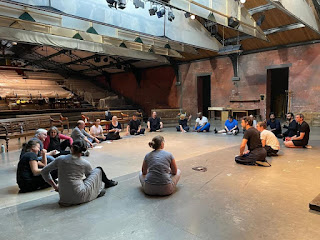
It was CRE-ACTORS that found us, in July, working for a week in Paris on the stage of the Théâtre du Soleil, at the Cartoucherie de Vincennes. As our colleague from the Teatro dell'Argine in Bologna, Micaela Casalboni wrote: "Being on the sacred stage and spaces of Théâtre du Soleil was the dream of many years in my life as an actress and as a theatre maker interested in arts for change – individual, cultural, social change. Admiring the painted walls, the paper lanterns, the costumes, the scenes, the behind-the-scenes, the spaces for theatre and the spaces for the group (the kitchen, the courtyard, the space for the kids…) was not only exciting but moving. Especially after the toughest years that we may remember in our life of individuals and theatre makers, years of closed theatres, years of distances, years with no bodies sharing the same physical space." This celebratory, creative week really did seem to offer a way forward - and we were all incredibly excited to return to Paris in December so as to see the Soleil's new devised piece: L'ILE D'OR. And then Covid swept through the company, causing the shows to be cancelled, and through our different countries, with new travel restrictions. As the year ended, there was still no stability to be found, least of all for theatre.

This year dominated by disease has seen many sad losses to the world of performance - not all from Covid, of course. Helen McCrory, Antony Sher and David Gulpilil are three that particularly hit me: all truly great actors whose presence on stage or screen was an object lesson in what we do and why we do it. Our own circle was not exempt, so let me end this year with tributes to three great friends, each of whom contributed profoundly to the story of Border Crossings:
  • Seun Shote passed away last March, aged only 47. He was an extraordinary actor and a very warm human being, whose performance as Ato in THE DILEMMA OF A GHOST combined great humour with a compassionate understanding of what it means to be caught between worlds. 

  • David Kerr, who died in the autumn, was from the same part of Coventry where I spent my childhood, but lived most of his adult life in sub-Saharan Africa, where he taught at the Universities of Malawi and Botswana. He and his wife Adela were my hosts on a wonderful trip to Gabaronne, where I led a workshop with local performers. We became very close very quickly: he was full of wise and modest counsel.

  • Alaknanda Samarth died on 6th December. For almost a quarter of a century, she had been one of my most  important interlocutors in the exploration of theatre and the intercultural. It was Alak who introduced me to Rustom Bharucha, and Rustom has written a very fine obituary for her. Although we were constantly looking for something we might work on together, it only finally happened in 2020, as a response to lockdown. Alak's recording of Artaud's THEATRE AND THE PLAGUE as a Border Crossings podcast now serves as a sort of memorial, I suppose - emphatically her, emphatically of its moment, brutal in its demands and searing in its spirituality. A few nights ago, I was privileged to share it with a group of her friends and colleagues from India as a tribute. We gathered - as so often these days - on Zoom. We listened to her voice speaking this unique text for 45 minutes. And then we sat in silence - because sometimes that is all you can do.