Monday, July 14, 2025

Culture and the New Imperialism

THIS FLESH IS MINE
Andrew French and Tariq Jordan. Photo: Richard Davenport

A few months ago, I had the chance to spend an evening chatting with Ken Livingstone. It was wonderful. Ken is 80 now, and his short-term memory isn't perfect, but his long-term memory absolutely is and his political understanding seems as sharp as ever. He also displayed a rare generosity of spirit, telling me how much he admired John Major, who had been his predecessor as Leader of Lambeth Council back in the 70s, and who "got things done". He was, it's fair to say, much less generous in his assessment of Boris Johnson, who "just didn't do the job" as Mayor of London (or anything else); but his only real bitterness was reserved for the tabloid press, who had caused him great personal pain and political turmoil by labelling him an anti-Semite. The same, of course, happened to Jeremy Corbyn. You've got to hand it to the Tory tabloids: only they could so manipulate the media as to convince the bulk of the population that men like these, who have dedicated much of their life to campaigning against racism, are actually themselves racists.

I've had some experience of this myself. Back in 2014, when we presented THIS FLESH IS MINE in a co-production with ASHTAR Theatre from Ramallah, I received quite a number of emails which accused me, and the company, of being anti-Semitic. There were no explicit references to Jewishness or Israel (or even Palestine) in the play, which deliberately used a mythological framing to distance its exploration of the cyclical nature of violence and its manipulation by global power blocs from the detailed specifics of the ongoing occupation. It seemed that the simple action of collaborating with Palestinian artists, which I absolutely agree in itself does come to constitute a political statement, was also regarded as inherently anti-Semitic. Where is the racism in that equation? In the artists who reach out to one another with the aim of furthering dialogue and understanding, or in the person who regards anything and anyone Palestinian as by definition expressing hatred towards Jewish people?

The ongoing genocide in Gaza has brought these issues to the fore again. Our online reading of THE GAZA MONOLOGUES in late 2023 attracted Zoom-bombers, who were determined that the stories of Gazan youth should not be heard. We did all we could to make sure they were heard, and to avoid making the Zoom-bombing itself into "the story". This is a real problem in the current debate (and I feel very conscious that in some ways this post is itself contributing to that problem). I have every sympathy with the people who have been calling on the media to stop making Bob Vylan's Glastonbury performance "the story", as this only distracts from the reality of what is happening in the Occupied Territories. Chanting “Death, death to the IDF” does not represent any sort of humanitarian or nuanced approach: but neither does the (nominally Labour) UK government's response, which has been to condemn the BBC for allowing its live stream of the concert to continue. The Culture Secretary, Lisa Nandy, has been taking an ever-more aggressive stance towards the public broadcaster over its coverage of Gaza, most recently demanding "Why has nobody been fired?" in relation to the BBC's showing of the exceptional and very moving documentary Gaza: How to Survive a Warzone, which was pulled from iPlayer when it emerged that the 13 year old narrator was the son of a Hamas official. 

Let's pause there for a moment. Does the identity of the boy's father actually make the film inherently biased or inaccurate? I don't think so. The statistics around casualties issued by the Gaza health ministry are actually lower than most estimates, and that's because they are carefully verified. The BBC always states that these statistics come from "the Hamas-run Health Ministry", which is the equivalent of saying that we have "the Labour-run Health Ministry". Hamas is the elected government of Gaza. Yes, the UK government (and many others) regards it as a terrorist organisation, but this is a matter of semantics and positionality. The activist group Palestine Action is also now a proscribed terrorist organisation in the UK, even though its actions could easily and more appropriately be prosecuted as criminal damage. South Africa's ANC was also a proscribed terrorist organisation before that narrative underwent a complete turnaround. The Hamas attack on Israel was undoubtedly brutal and indiscriminate: but is it really justified to describe this action by an elected government as a simple (and mindlessly evil) "terror attack", if the actions of the elected (if decidely insecure six-party coalition) government of Israel are always called acts of "war", or even of "self-defence"? Why do we not call the actions of Israel "terrorism", or the actions of Hamas "war"? Isn't the difference only in the viewpoint? The documentary was as objective (and as subjective) as any other film made by and about young people going through constant bombardment and daily trauma. The only justification for its effective banning is the sense that this is somehow the work of "the enemy": a sense that also implies a view of Israel as being on "our side", the "good guys" in a Manichean, black and white world. The language and the discourse, the cultural dimension, really matter; particularly in this conflict which has such huge implications for the entire world.

The kind of censorship and prejudice that Nandy is exercising is not confined to the UK. America has a long-standing commitment to stamping out any criticism of Israel: Trump's attacks on students who protest against the genocide are only a logical development of the unwavering support shown by the US towards what is essentially its client state in a geopolitically vital region. Mainland Europe, and particularly Germany, is moving ever further to the right, which includes increasing its support for Israel, both economically and culturally. To give a few examples:

- Last month my friend Elli Papakonstantinou was presenting her theatre piece Holy Bitch at the Neuköllner Oper in Berlin. It's an angry, feminist work, and at one point there was a brief reference to the genocide in Gaza. The management asked her to remove this from the show, and, when she did not, greatly reduced the publicity they gave to the work. Journalists refused to cover it. The subtitles went blank when the dreaded word "genocide" was spoken.

- Lina Majdalanie & Rabih Mroué are Lebanese artists living in Berlin, whose most recent work Four Walls and a Roof used Brecht's 1947 appearance before the "Un-American Activities Committee" of Congress to delve into questions of artistic freedom. At one point, they mention that when they first came to Germany, people used to ask them about censorship in Lebanon. Now people in Lebanon are asking them about censorship in Germany. 

- Back in 2022, before the latest overwhelming attacks on Palestinian populations, the great playwright Caryl Churchill had an award for her lifetime's achievement rescinded by a German-appointed jury because of her support for Palestinian causes. As Lina Majdalanie puts it: "Cancellation of invitations, awards, conferences, theatrical  pieces, exhibitions... Public accusation and condemnation of this writer or that artist, or anyone else... Dismissal of journalists, academics... Public funding subject to political obedience... The list goes on."

- In April 2020, the German government’s anti-Semitism commissioner, Felix Klein, decided that the Cameroonian historian Achille Mbembe was "not suitable" to deliver the keynote at the Ruhrtriennale because of his supposed anti-Semitism. The root of this accusation turned out to be Mbembe's 2016 essay The Society of Enmity, in which he applies post-colonial ideas, examining Israel as a settler-colony, and pointing out how the treatment of Palestinians in the Occupied Territories "recall the reviled model of apartheid". 

Mbembe's argument seems decidedly mild and understated in the light of what has happened since. It wasn't even a particularly unusual point to make. As long ago as 1951, Hannah Arendt had pointed out links between Germany's history as a colonial power and the development of the systematic murder machines of the Nazis' Holocaust against the Jews and other perceived "enemies". Mbembe's point was that European (and by extension, North American) societies have a need for a racialised "Other" - "a Negro, a Jew, an Arab, a foreigner" - to provide a justification for their acquisitive and rapacious colonisation of territories beyond their own. The "resettlement of the world" he explained, "often took the shape of innumerable atrocities and massacres, unprecedented instances of 'ethnic cleansing', expulsions, transfers, and concentrations of entire populations in camps, and indeed of genocides." The first genocide of the 20th century was not the Third Reich's Holocaust but the massacre of Herero and Nama people in Namibia by the German Second Reich. The mindless racism that it betrayed serves to underline Mbembe's point that Nazism cannot be regarded as uniquely evil, but should be understood as an extreme maifestation of the cultural mindset that underpinned imperialism, and continues to be present in neo-colonialism today. 

The reason Mbembe's argument was deemed anti-Semitic was not simply that he compared Israel's policy towards Palestine with settler colonialism and apartheid, but also that his placing of the Holocaust in an historical and cultural perspective undermined the prevailing belief that this event was uniquely evil in the history of the world. It suits the state of Israel to construct the Holocaust as exceptional and evil rather than historical, because that can be regarded as a justification for the total paranoia with which it segregates its populations, militarises its borders and attacks its neighbours. It also suits Germany, and the wider constructs of "Europe" and "the West" in which that state plays such a leading role. "Vergangenheitsbewältigung", the "struggle of overcoming the past", has come over time to elide into a strangely self-congratulaory position, whereby unquestioning German support for Israel and a delusional imagining of anti-Semitism in every critique of Israeli policy represents a fundamental break with the past. Paradoxically, it also permits other forms of racism to take hold, as the current drift to the right bears witness. If something is "Evil" then it ceases to be historically and culturally explicable: it becomes simply an enemy to be fought perpetually and incessantly. This is how fascism comes to beget more fascism.

The moment we look at the Holocaust as an historical event, then both its deep roots in European culture and colonialism and its current repercussions in global geopolitics make much more sense. "Reich" means "Empire": Nazism was a logical development of the 1492 project - the process whereby a self-satisfiedly "Christian" and "civilised" Europe imposed its hegemony on much of the world, with racist ideology as its justification. Israel's unbridled aggression is a similar continuation of what Columbus began: Western economic interests and a religion of the Book are being used to wipe out an indigenous population. It is through a nation's relationship to colonial histories that its stance on Palestine can most clearly be understood. The United States is an Empire founded on genocide: of course it supports the state of Israel. Great Britain ran the largest Empire the world has ever seen: it too, supports Israel. Germany is in a weird space of denial about its Imperial past: and it supports Israel. On the other hand, a country like Ireland (which we are proud to call Border Crossings' second homebase) has a colonised people's understanding of land grabs, of the use of religion to mask political incursions, of hunger as a weapon, of partition and the militarization of the streets. Ireland has a strong affinity with the Palestinian cause: as this current exhibition in London attests. The vast majority of the Global South - the nations that understand what it is to be colonised - stand with the Palestinian people too. It is deeply depressing to see that humanity is still locked in to the colonial paradigm. 

We need to re-think how post-coloniality is applied. The "post-" doesn't just mean "after": it means "in relation to". Culture and the academy have made much of post-colonialism in relation to cultures and peoples that once were colonised, to the extent that the approach has come to seem a bit tired, and rather patronising, as if (say) Gikuyu society in Kenya can only be understood in relation to the former (and current) British presence there. But if we turn the post-colonial mirror back on the former colonisers, it becomes altogether more illuminating. Let us start to recognise that we still behave as we do on the world stage because of the deep-seated assumptions and prejudices that made our societies into colonial powers. Let us recognise that the crass sloganeering of the right ("Take Back Control", "Make America Great Again") evokes a colonial policy of agression, acquisition and oppression, grotesquely misrepresented as "greatness". Once we have dared to look properly at ourselves, perhaps then we will be able to stop supporting genocide, and cease to brand as racist the very people who are standing against the scourge of racism. 

The views expressed in this post are personal to the author and do not represent an official position of Border Crossings.


Friday, July 04, 2025

PERFORMING POSSIBILITY - Guest blog by Niamh McGrath

Niamh McGrath in the
PERFORMING POSSIBILITY workshop in Cork

Alongside THE LEGEND OF EUROPA, Border Crossings and Teatro dell’Argine are also collaborating on a Youth project under the Erasmus + programme, called PERFORMING POSSIBILITY, together with the YMCA in Cork and Opera di Padre Marella in Bologna.  Although this is a self-contained project in its own right, PERFORMING POSSIBILITY is also proving hugely helpful in researching material for the professional theatre work.  

The young people in Cork, many of whom live in very remote rural areas of the county, have little experience of European travel, and few opportunities to encounter people their own age who live in different countries and diverse communities, particularly migrants and refugees. The young people at Opera di Padre Marella have often faced huge challenges in their journeys to Italy, and continue to encounter prejudice and bureaucratic difficulties as they attempt to forge new lives in Europe. The encounter between these very different groups is hugely valuable in and of itself: for that encounter to be creative, playful, exploratory and dialogic makes it deeply significant for them all.  

At the heart of the EUROPA myth is the story of the Athenian youth - seven young men and seven young women - who were regularly offered as food for the Minotaur: a tribute to appease the Cretan King Minos, who would otherwise invade Athens. This myth of young people being sacrificed to preserve the status quo feels horribly close to our contemporary situation, particularly when working with young people who have already given up and suffered so much in the hope of finding peaceful, comfortable lives in Europe, only to face suspicion, prejudice and stereotyping.  

What follows is an account by Niamh McGrath, one of the participants in the first workshop in Cork, of her experiences around encounter, art and advocacy.  

*
PERFORMING POSSIBILITY was a workshop that explored the themes of immigration, stay versus leave and connectivity through theatre and other forms of media. 

I’m writing this on June 8th, which marks World Ocean Day. On this day one can reflect on all the positives of the ocean: a source of food, a recreational area and a means of transportation and connectivity. But living on the island of Ireland, one has to acknowledge that while oceans, seas and other bodies of water can facilitate transport, they also lead to isolation. 

Ireland is on the edge of the European Union. This means that the young people in Ireland are not as connected with the rest of our EU peers to the extent we should be. Therefore the cultural exchange that PERFORMING POSSIBILITY offered is one that is so valued. For myself and 20 other young people in Cork, we had to opportunity to talk to other young people living in the EU. These young people are living in Bologna in Italy, another edge of the EU. These young people were immigrants, who had come from places such as Tunisia, Ukraine and Afghanistan. We were able to talk over Zoom. We talked about our dreams for the future, our music tastes and parts of our cultures (e.g. food). I hope that this cultural exchange will only be the beginning. 

One of the main themes we explored over the week was the idea of staying or going. On the Wednesday, our group wrote reasons to stay and reasons to go on two different pieces of paper. Then on Thursday, in pairs, we picked out words and phrases that appealed to us and wrote something about it. After we would write something, our partners would then respond with something else. My partner Pádraig and I circled around a reason to stay: to walk down the same streets as one’s ancestors. Pádraig came up with the phrase “to walk in the worn down comfortable footprints”. This line has stuck with me. The idea that if I were to leave Ireland, I would be leaving the comfort, the familiar and my own history. 

After writing pieces and answering each other, Pádraig and I had created a piece of theatrical writing that debated the idea of immigration. Then we practised performing the piece. This for me was the tricky bit, as I would not be an actor. But from this experience I have gained a greater understanding of the weight words can carry and how important and thought provoking a few well placed pauses can be. 

The thing that I believe will always stick with me from this experience is the realisation of the links between advocacy and art. There are many was to advocate for change - lobbying policy makers, running campaigns, protesting - but also through the arts. Theatre and drama can tell a story, prove a point and provoke a thought. The power in the delivery of what you say is priceless. 

In my opinion the best part of the workshop was the new perspective I left with. The workshop not only opened my eyes to the power of theatre but also showed me a snapshot into the lives of other young people who are living on another edge of Europe. This experience is something I would one hundred percent recommend. 


Tuesday, April 22, 2025

THE MOUTH OF THE GODS - a view from the Chiqutania

This is a guest post by Ximena Purita Banegas Zallio, one of the dancers from THE MOUTH OF THE GODS, who herself comes from the Chiqutania in Bolivia. Ximena delivered this speech at the premier screening of the project film, at Hoxton Hall on April 12th.

Ximena in THE MOUTH OF THE GODS

Good evening, everyone.

Tonight, we will experience the documentary of THE MOUTH OF THE GODS—a project by Border Crossings that took us deep into the soul of Latin America, weaving ancestral dance, embroidery, shamanic ritual, and the extraordinary fusion of Baroque music and Indigenous tradition. At the heart of this experience was a rediscovered opera: San Francisco Xavier, written in the Chiquitano language by an unknown Indigenous composer. This performance was not only a tribute to the past—it was a call to recognize the living, breathing cultures that continue to shape our world today.

Tonight, I come to you not just to reflect, but to connect—to give voice to a region where this music, culture, and history are still very much alive. I want to take you to this place, my home, one that many have never heard of before, but that holds a piece of the world's soul—the Chiqutania and the Chiquitano Dry Forest, in the heart of eastern Bolivia.

Es un honor hoy representar a mi país y, en especial, a Santa Cruz, para compartirles sobre el secreto y tesoro mejor guardado y custodiado que tenemos: las Misiones Jesuíticas de Chiquitos y Moxos.

Imagine a nearly utopian route of over 3,000 kilometers, where more than 300 years ago, Jesuit missionaries established missions deep in the plains and forests of Beni and Santa Cruz—in the heart of the Chiquitania and the Amazon. It was here that one of the greatest cultural discoveries of the 20th century occurred: the recovery of over 10,000 sheets of Baroque music—written more than 300 years ago, and still played today by local children and youth in music schools. These aren’t just notes on paper—they are threads of memory and identity, carried forward with pride and dedication.

The Chiquitania is a region where the threads of history, music, and nature are woven together in a harmony as intricate as the Baroque compositions that echo through its Jesuit missions. This is not just a forest. It is home to the chiquitano people whose heritage is preserved through centuries-old traditions. It is a living archive of sacred music—compositions passed down orally, preserved by communities who have made music not just an art, but a way of life.

Imagine a place where history is not locked in a museum, but lives in every carved log, every child’s violin, every note sung at dusk. That is Chiquitos and Moxos. These are not ruins. These are living cultures. Seven UNESCO World Heritage churches still stand—not as silent witnesses, but as vibrant stages where the largest collection of Baroque sheet music in the Americas continues to echo through the hands and hearts of its people.

But this harmony is under threat.

In recent years, devastating fires—driven by deforestation, commercial interests, and climate inaction—have scorched millions of hectares of the Chiquitano Dry Forest. In 2024, Bolivia experienced its most catastrophic wildfire season on record. Over 10 million hectares—an area larger than Portugal—were consumed by flames, with the eastern department of Santa Cruz suffering the most, losing nearly 7 million hectares. The Chiquitano Dry Forest, one of the largest intact tropical dry forests on Earth, was among the hardest hit. These fires are not only destroying a unique and biodiverse ecosystem—one of the largest and best-conserved tropical dry forests in the world—but also silencing the voices of communities who have protected it for generations.

These fires were not merely natural disasters—they were the result of deliberate policy decisions and political agendas. The use of land in Bolivia has become a tool for political gain. Forests are cleared under the guise of "development," often in exchange for short-term economic or electoral favors. Protected areas are sacrificed to satisfy powerful agricultural interests. Land is handed out, not with the intention of sustainability, but as a political currency—fueling deforestation, deepening inequality, and placing Indigenous territories in jeopardy. Large-scale slash-and-burn agricultural practices—tolerated, and at times even encouraged by government decrees—have made the land more vulnerable than ever. The consequences are devastating: critical ecosystems destroyed, thousands of families displaced, and the loss of biodiversity that affects not just Bolivia, but the planet.

When we lose forests like the Chiquitano, we don’t just lose trees—we lose memory, culture, and connection. We lose medicinal plants unknown to science, we lose wildlife that exists nowhere else, and we lose a vital shield against the climate crisis. 

But the Bolivian people have not given up—and that’s why there is still hope and sharing their stories is as important now than ever. In the Chiquitania, local communities have risen. Musicians, elders, farmers, and youth have come together to protect their land, their music, and their future. And it’s time the world stood with them—not out of charity, but out of recognition. Because what is at stake is not just Bolivia’s heritage, but humanity’s.

So tonight, as we celebrate culture and representation, let us remember that true representation means listening to the voices at the margins. It means honouring Indigenous knowledge, protecting ancestral lands, and valuing the music, language, and lives of the people who have long been guardians of our planet’s most sacred places.

It is a deep honour to speak to you tonight on behalf of the Bolivian people—a people whose voices, culture, and land deserve to be seen, heard, and cherished on a more global stage.

Thank you Border Crossings for this opportunity.

Thursday, April 03, 2025

Alastair in Athens


This photo was taken in Athens, on an August evening in 2021. The three people are sitting just outside the entrance to the Theatre of Dionysus, and beyond the theatre is the Acropolis. It's a space that is sacred to our organisation and our profession: the cradle of European drama, and of European democracy. The space where both of these things were invented. Even today, this is the model that we strive to follow. In 5th century Athens, the theatre was an integral part of the city's political and spiritual practice. At the sacred festival, the citizens gathered, and they watched plays. The performances worked through mythology to address the present moment. They tackled the great themes of war, migration, plague and justice. The stage offered the citizens (who were all adult, male and Greek) an insight into the minds of others. So often the protagonist was female. So often the Chorus represented foreigners, migrants, children, older people, even frogs and flies. Always the theatre was about including those who were excluded, and the citizens watched and absorbed these performances as they prepared to act as legislators and jurors.

On that August evening, these three people walked into the sacred auditorium, and were meaningfully together in spite of all their apparent differences. The young woman in the yellow dress is Alicia Wiseman, and she was 17 at the time. She's a very talented violinist, and has a highly developed social consciousness. The other young woman is Aisha Tambajang, who worked with a Danish organisation that was partnering with us on a European project: it's called Crossing Borders - you can see there might be synergy! Her role was to assist young people, particularly Muslim women and girls, who had migrated to Denmark.

What I love about this picture is how deeply these two young women are engaged in conversation with the older man. He's British, from the generation that grew up straight after the war. To look at him in another context, you might think he was someone with a rather conservative view of the world, someone suspicious of change, wary of the perceived other. But, as this photo shows so clearly, he was actually incredibly open to everyone, to the cultures they carry and the ideas they bring. In old age, he was eager to learn, forward-thinking and positive in his outlook. This warm and hopeful man, who was the first Chair of the Border Crossings board, embodied the spirit of the great Athenian theatre and democracy in his work and in his life.

Alastair Niven passed away on March 26th, aged 81. I will miss him more than I can say.

Monday, January 27, 2025

Border Crossings at 30

The Times: 30th January 1995

The front page of The Times for 30th January 1995 seems strangely familiar, with its headlines about Tory splits over the EU, tensions in Peru and concerns about climate. But the truth is, the world was actually very different then: on the day when Border Crossings was officially registered at Companies House. Charitable Registration followed in August of the same year, so by any reckoning 2025 marks 30 years of this organisation, and we're wanting to mark that anniversary through a number of initiatives that will reveal themselves across the year. On our birthday, let's begin by kicking off the series of 30 social media posts, #BorderCrossings30, each of which will look back at a significant moment in the company's story.

Choosing those 30 highlights has actually been very challenging. It's partly because there are so many great moments we want to remember, but it's also because not everything is as clear and simple as anniversary projects can make them seem. Border Crossings did not emerge fully formed into the world in 1995. It took several years before the company's intercultural identity was properly established - despite the name - and, as will become apparent over the year, just what that intercultural identity really means has kept evolving and shifting in response to cultural and political changes. The first few projects that the company mounted were responses to invitations and commissions, particularly from the British Council (now, shockingly, in serious danger of collapse). Nevertheless, it's possible to discern in some of these early performances the first shapings of what Border Crossings would become. I think that's especially true of FAITH HEALER, which toured to Brazil, Egypt, France and Hungary, and which I've chosen as the first of our 30 posts for 30 years.

Watching Rachel O’Riordan’s very moving production of Brian Friel's play at the Lyric Hammersmith last year, I was reminded just what a complex and compelling text it is, as well as sensing just how many seeds were planted for us in working with it. This is all the more striking, given that the director wasn't myself, but Richard Allen Cave, who worked very closely with me to establish the company. Richard was Professor of Drama and Theatre Arts at Royal Holloway, and that in itself suggests some important aspects of Border Crossings. We're not scared or dismissive of academia: actually, we embrace it and like our performance work to operate in dialogue with a wider discourse. Royal Holloway has been a crucial partner on many occasions, particularly through Helen Gilbert's collaboration around work with Indigenous artists. Helen's new research project, CoastARTS, will again involve us in an exchange between research and creativity. 

CoastARTS includes Irish partners, and of course FAITH HEALER is an Irish play. The Irish dimension of Border Crossings was there from the very beginning, even though the Irish company was only formally established in 2019. My own (rather brief) formal theatre training was at Trinity Dublin in the later 1980s, and that time spent in Ireland also shifted my perceptions around colonialism, resistance, and the relationship between theatre and politics. I vividly remember sitting in a Dublin bar with an actor from the Abbey Theatre and a young American studying at TCD, when a man came round the tables collecting money for the IRA's campaign in the North. The American was surprised when the actor strongly refused to donate, and even more surprised when he learned that Dublin was actually the capital of an independent republic within a divided island. The 1995 Times front page features a story about the planned release of IRA prisoners in the Republic, "as a reward for the ceasefire". It would be another three years until the Good Friday Agreement, and of course that was far from the end of the story. 

Insofar as we talk of peace and reconciliation in Ireland, theatre, culture and Brian Friel have all played very significant roles. It was shortly after writing FAITH HEALER that Friel joined forces with the great actor Stephen Rea to set up the Field Day company, and I realise now just how influential the ideas behind that organisation have been on our own. From its legendary first production of Friel's TRANSLATIONS onwards, Field Day always opened its shows in the disputed and volatile city of Derry, before showing them on both sides of the border. This wasn't just tokenism: Field Day's plays were re-workings of established narratives, peoples' histories, which allowed audiences to see the deeply embedded conflicts of the present moment in a new and clearer light. That's also what we are trying to do when we make a piece with Latin American people in London, with Syrian refugees in Turkey, or with Palestinians in Ramallah. Like Field Day, we recognise the value as well as the challenges of working across the divide, and the importance of acknowledging how deeply we are ourselves, by virtue of historically formed identities, implicated in the tensions that we explore. 

Field Day was also a model for us in its understanding of the need for further exchanges, debates and conversations beyond what happened on the stage itself. They assembled a stellar board of directors: Seamus Heaney himself, Tom Paulin, Thomas Kilroy, David Hammond, Seamus Deane...  The guidance of distinguished artists and cultural figures at Governance or Patron level has been ever more crucial to us as the company has moved into ever more complex areas of artistic intervention: Peter Sellars as Patron; Jatinder Verma and Alastair Niven as Chairs; Conall Morrison, Kristine Landon-Smith and Niall Henry, all prominent directors; strategic and political thinkers like Malú Ansaldo, Valerie Synmoie and Roshni Mooneeram.... Like Field Day, we encourage them to become directly involved in the public discussions around our work: Peter's contribution to THE LOCKDOWN DIALOGUES was really significant in helping us respond to the changing landscape after Covid.

For Field Day, a crucial element of the discourse was the deeply important set of pamphlets which they published through the 1980s, particularly the first, in which Tom Paulin took A New Look at the Language Question. Paulin's advocacy of Irish English helped pave the way for the ongoing exploration of the politics of language in a shared post-colonial space that has characterised our theatre. In our second year, long before he became officially involved, Jatinder came to BAC to lead a post-show discussion on BRAVELY FOUGHT THE QUEEN, a play written in Indian English. What did that mean in terms of audience, of thought structures and worldview, of class, education and perspective? Almost every project since that time has been characterised by the use of multiple languages, and has challenged the hegemony of English through the employment of other languages and other Englishes. 

I am also very struck by Field Day's pamphlet number 6, Myth and Motherland, by the philosopher Richard Kearney. Of all the pamphlets, this one is the most abstracted, attempting to place the immediate turmoil of history within the larger structures and conflicts of myth. "What is required", he argues, "is a radical interrogation of those mythic sedimentations from our past and those mythic aspirations for our future which challenge our present sense of ourselves, which disclose other possibilities of being."  We have, says Kearney, "to keep our mythological images in dialogue with history."  Until I started to think about the significance of FAITH HEALER as the first of our 30 moments, I hadn't registered consciously just how much this dialogue between myth and historical process underpins our work. Sometimes it's really obvious: SUPPLIANTS OF SYRIA re-reads Aeschylus and current debates around refugees in the light of one another, while THE MOUTH OF THE GODS pushed contemporary Indigenous activism into a productive clash with evolving spiritualities. DIS-ORIENTATIONS used the traditional Chinese story of The Butterfly Lovers to explore gender and sexuality between Europe and Asia, and THIS FLESH IS MINE filtered Homer through a Palestinian lens. Sometimes it's more subtle: both BULLIE'S HOUSE and THE DILEMMA OF A GHOST saw a culture's treasured myths challenged by a modernity that seemed inadequate at best and at worst malign.

It's very powerful to think about things we were doing 30 years ago like this. It helps us to imagine where we might go next. THE LEGEND OF EUROPA beckons...

Sunday, December 29, 2024

2024

The Mouth of the Gods

Usually this blog ends the year with a post looking back over Border Crossings' work across the last twelve months. For us, the main focus of 2024 has been THE MOUTH OF THE GODS, and I do very much want to write a post about that project, which has taught us so much about how our work can evolve to suit its rapidly changing context, within the framework of The Sligo Manifesto. But at the moment it feels as if that post needs to wait, perhaps until we release the film version in the new year. As I look back on the year that is ending, it feels incredibly urgent to talk about the project we concentrated on back in January, and which has kept coming back to remind us of its own significance throughout the year. SUPPLIANTS OF SYRIA. We've not yet been able to present the theatre piece, but the film has been shown in Turkey and in Tunisia. What's been happening in Syria itself over the last few weeks makes it feel immediate and necessary. But that's not the only thing.

Back in June, I went to a LIFT event called Democracy From Where I StandUnusually for LIFT (less so for us), this wasn't really a performance as such, but a direct engagement by artists and thinkers with the idea of democracy. The accompanying book starts with the assertion that "2024 will be remembered as the year of elections: over half of the global adult population will exercise the right to vote in dozens of states." That much is, of course, undeniable; but the year of elections has done little to ensure the future of "democracy", never mind advance the course of justice. Trump's return to the White House is the most obvious example of an election bringing into power a figure whose stated aims include the overthrow of constitutional structures, but it is far from the only one. Russia re-elected Putin, of course, but there were also surprising lurches towards populism and authoritarianism in Romania, Georgia, even France. In the early summer, the consensus in liberal social media wanted us to believe that India had expressed a powerful reaction against the pernicious rule of the BJP, but the reality is that Narendra Modi won a third term as Prime Minister: other parties were prepared to join his coalition, and his programme shows no sign of reversal. The international observational organisation V-Dem has dubbed the Indian example an "electoral autocracy". Even the UK's election in July, while putting an end to the hegemony of a Tory party that was (and is) drawing ever closer to the global model of populist extremism, was hardly the heralded democratic landslide that Starmer and his team pretended. Labour’s two-thirds majority in Parliament came from just over a third of the vote - the least proportional election result in modern UK history. The 2024 Labour "landslide" actually came from 600,000 fewer votes than the same party had won in its "disastrous defeat" of 2019, under the much maligned Jeremy Corbyn. Starmer sells himself as a competent manager, and there's no doubt that these statistics demonstrate managerial skill in relation to elections. In the UK as in the USA, it's not how many votes you get that matters so much as precisely where you get them. So the way to win elections is not to appeal broadly to the electorate through policy stances that might benefit them as a whole, but to target very specific interest groups through a process of advertisement, particularly online. 

Suppliants of Syria

SUPPLIANTS OF SYRIA is based on Aeschylus' great play Suppliants, which includes the first ever use of the word "democracy". It was written at a time when Athens was making its first experiments in this radical form of government, and the Syrian refugee Chorus asks, as the Greek citizens debate their fate, "What is this thing they call democracy?"  Well - one thing the Greeks were absolutely sure about was that democracy was not about elections. We just assume that the two are synonymous, but the Greeks were far wiser than we are. For them, elections were understood not to be part of the democratic government of the people by the people, but to be a manifestation of oligarchy - the rule of the rich. As they well understood, a system of elected government leads to wealthy people retaining power because they have the resources to persuade voters through whatever form of advertisement may suit them. Including the overt bribery recently practised by Elon Musk, who paid out $1 million every day to buy votes for a convicted felon. This immensely dangerous megalomaniac is now contemplating a huge donation to the UK's Reform (which claims to be a political party but is actually a private company), and is wading into the German electoral process on the basis of his "investments" there.

So the lesson of 2024 is not that we need "better elections" but that we need to overhaul the entire system by which we delegate power from a sovereign people. (It doesn't help that in the UK the people aren't currently even held to be sovereign, but that's another issue.) Political office needs to be perceived less in terms of status and power (and certainly less in terms of wealth), much more in terms of responsibility. It needs to be exercised not as a means to appease established supporters and potential voters, but in relation to what is considered most likely to be beneficial to the populace as a whole in the long term. And that "populace" needs to include people beyond the immediate "nation" (whatever that's supposed to be).  So many of the problems we face are global, and so the response must be global also. We need to consider other countries when we consider migration and asylum. We need to consider other cultures when we consider foreign policy. We need to consider other species when we consider the environment. 

This is the point in the argument when "realists" tend to wade in and say that it's never going to happen, so there's no point even trying. To which I reply that, only a few years ago, nobody would have believed that a person like Donald Trump could ever become President, let alone twice. Nobody would have believed India, "the world's largest democracy", would come to be dominated by the fanatics of Hindutva, who are seemingly free to murder critical thinkers, journalists, artists and activists, and to target the Muslim population just as they please. Nobody would have imagined that a genocidal campaign could be waged for more than a year against a helpless people, with the clear backing of the Western "democracies" who supply the weapons with which the oppressor wreaks such havoc. None of this seemed imaginable. None of it was "realistic". So, if these appalling, unimaginable things have come to be, we should and must allow ourselves to imagine the alternatives. That is the only way we can begin to take the practical steps through which this "unrealistic", "unimaginable" opposite of our unthinkable reality can begin to become realistic and imaginable. 

There are two places where the work has to begin. One of them is education, and the other is culture. 

And so, just briefly, I find that I do want to think again about THE MOUTH OF THE GODS. I'm not for one moment pretending that six performances of a baroque opera can change the world, but I do want to point out that this was a cultural and educational work that told a true history, a people's history, of colonisation and dispossession. In the process, it became an act of resistance, and an expression of resilience. It demonstrated all too clearly the economic basis of the global political system. It shared these things with the communities who had worked to make it, including no fewer than seven schools, and it celebrated that educational and cultural action. It was able to share in this way because it was not itself a commodity - nobody paid to see it, and so a new audience came who engaged with this performance in a different, more equal way.

The more I think about it, the more convinced I am that this is our role as cultural workers. We have to imagine the world otherwise, and then offer up that possibility as something to be shared.

Wishing you all the very best for 2025. 

Wednesday, December 11, 2024

After Assad

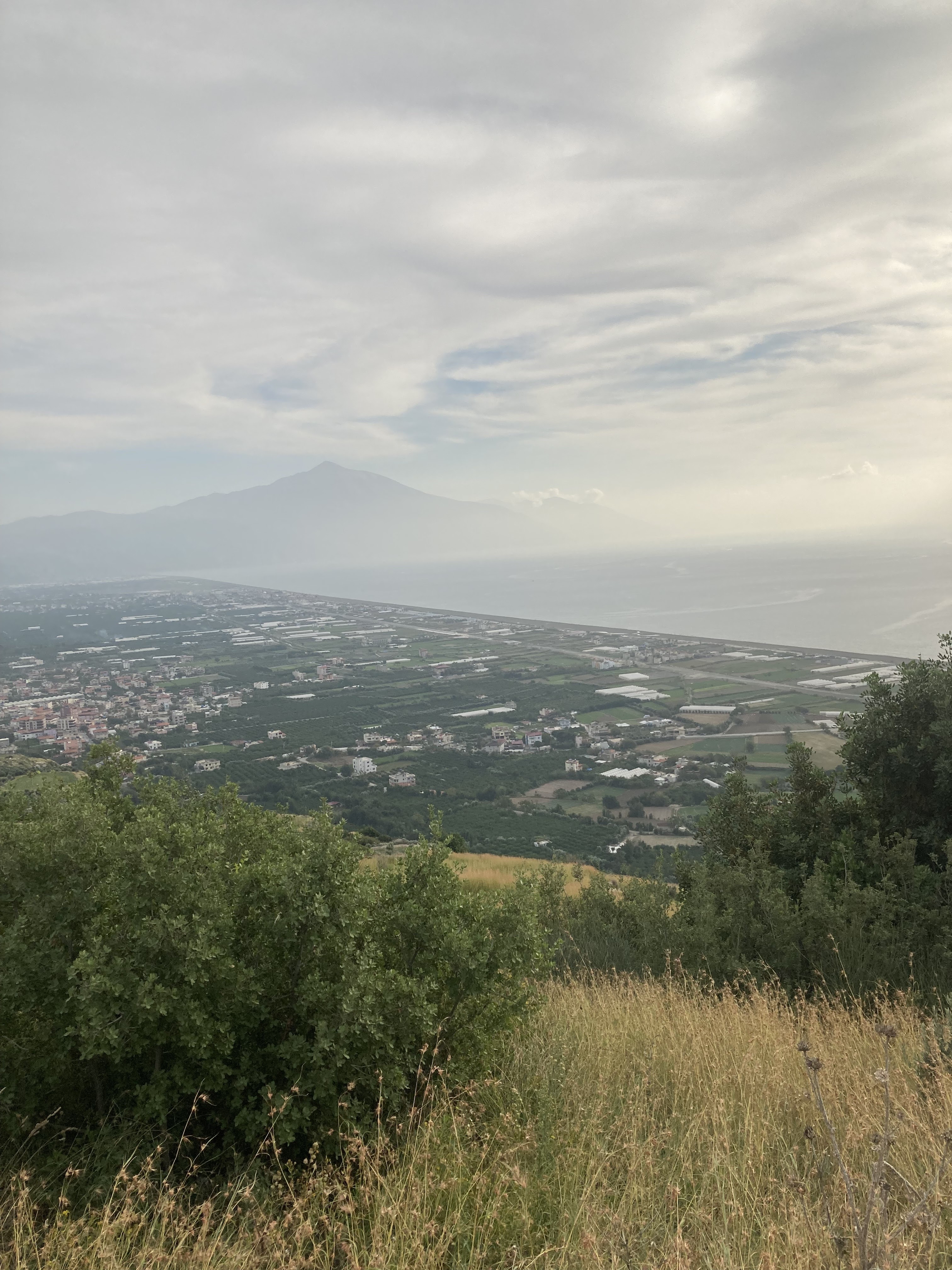
Mount Cassius, seen from Antakya in Turkey. On the other side is Syria.
This afternoon, Ireland added itself to the list of European countries to suspend the processing of asylum applications by refugees from Syria. Austria, Belgium, Croatia, the Czech Republic, Denmark, Finland, France, Germany, Greece, Italy, the Netherlands, Norway, Poland, Sweden, Switzerland and the UK had already done something similar.  It is, of course, very convenient in terms of right-wing domestic narratives about defending European identities and stopping the boats. It also plays very readily into the standard Western mythological narrative of the individual hero (or villain). When will we learn? "Get rid of the bad guy" we always say "and the problem is solved." It's truly extraordinary that, only a couple of days after Assad's fall, European countries should be taking actions that imply Syria's problems are over.

Of course, there are many Syrian people who desperately want this to be true. Many of the Syrian friends we worked with in Turkey to create SUPPLIANTS OF SYRIA have been expressing relief, joy, and a deep desire to return to what remains their beloved home, in spite of the devastation wrought upon it. Some Syrians have begun the journey: and of course the actions of European governments can only encourage this. But there are also a great many people travelling in the opposite direction: people who, in one way or another, may have worked for the Assad government, or who may fear that others will think they did. Just because the dictator has fallen, it doesn't mean there is going to be a free and peaceful, benign and gentle regime established in his place. Look at what happened after Gaddafi's fall. Or Saddam Hussein's. Or Louis XVI's. A revolution, including one that overthrows a tyrant, leaves a void, and a void becomes a contested space that may be filled in many ways.

Those same European governments who have suspended asylum claims are also rapidly considering whether to remove HTS (the insurgent organisation that brought down the regime) from the list of terrorist organisations. It would suit their agenda to do so. However, HTS is an Islamist organisation that emerged from IS and Al-Qaida. Since 2017, they have held sway in Idlib, which was the last stronghold of IS - a place to which none of the refugees I have met expressed any desire to return. It is true that the HTS leader, known in Idlib as Abu Mohammed al-Jolani, has reverted to his birth name Ahmed al-Sharaa, and is taking some pains to paint the country's future as egalitarian and democratic (whatever that may mean - the Suppliants ask). But his history does not suggest the sort of leader Western powers like to see in the Middle East. From 2003-6 he was a jihadist combatant in Iraq, and spent time under American incarceration, including in Abu Ghraib. After 2011, he returned to Syria to fight for IS. On his triumphant arrival in Damascus, he spoke of it as “a victory for the Islamic nation”. “I left this land over 20 years ago, and my heart longed for this moment,” he said. “Sit quietly my brothers and remember God almighty.”

They might also want to remember President Erdogan of Turkey. HTS has a complex relationship with the Northern neighbour who houses so many of their compatriots, but there is no doubt that it was their uneasy alliance which allowed HTS to hold sway in Idlib for the last seven years. Turkey wants a Syrian regime that is hostile to the Kurds, and an excuse to reduce its enormous refugee population. As so often, Erdogan lines up uneasily beside the Europeans. 

Those last seven years in the micro-state around Idlib offer the best indication of how HTS may try to rule Syria (in so far as there is even a state left to rule). The basic services of government were supplied, and taxes were levied to pay for them. They also imposed deeply conservative rules, particularly on women, and dealt brutally with any opposition. Informed sources are suggesting we may see something close to the Taliban. Meanwhile, Turkey has increased its attacks on the Kurds, who are deprived of their uneasy alliance with Assad, and Israel has been advancing from the Occupied Golan, intent on taking Syrian military bases so as to avoid their coming under Islamist control.

Is this really the moment to suspend all asylum claims from Syrian refugees? 

Thursday, October 31, 2024

From Zoukak Theatre in Beirut

 In 2013, Border Crossings worked with Zoukak Theatre in the Lebanese capital Beirut as part of our development process for This Flesh is Mine. This post is their letter to international friends and fellow artists in the face of the Israeli invasion of their lands.

Zoukak Theatre

These are terrible days in our contemporary history. Decades of efforts to create laws, conventions, and agreements that uphold common human values and unite us as citizens of the world are being systematically trampled upon, violently disregarded, and dismantled by a monstrous machine of death, destruction, and dehumanization, reducing entire regions in Palestine and Lebanon to rubble—all under the pretext of Israel’s right to defend itself.

As we write these lines, surrounded by the sounds of drones, military aircraft, missiles, bombings, and the looming threat of embargoes and settler occupation in our country, we wonder how many more wars can we survive? What can be said and done today in the face of such horror? What can we, as artists who already operate on the margins of society, do to make any difference in the course of history? It might sound naïve, but we do know what to do. While a massacre is taking place in the street behind us, art can confront injustice, maintain connectedness, and reinforce a sense of shared existence. We know that individual efforts can influence public debate and rebuild values that bring about a potential for global change. 

Since our inception in 2006—during another brutal Israeli war on Lebanon—Zoukak has remained committed to working under difficult circumstances, both locally and internationally. Now, in 2024, eighteen years later, we find history tragically repeating itself, though on an even larger scale. We are witnessing an unprecedented level of armed aggression by Israel, compounded by the use of advanced military technologies, including artificial intelligence, cyber warfare systems, and internationally prohibited weapons.

A few days ago, we decided to cancel our biennial festival, Zoukak Sidewalks, which was a special edition this year, marking Zoukak’s 18th anniversary. We had considered it a milestone—a step into adulthood in terms of both responsibility and freedom. Responsibility, in the sense of our ongoing commitment to engage with society through art, and freedom as the ability to question, challenge, and continuously recreate the world around us through the active power of imagination.

The ongoing brutal Israeli war on Lebanon has forced us to halt our efforts to sustain this vital cultural encounter. We were looking forward to welcoming you - our international and local colleagues and audience members - and sharing reflections on this significant moment as part of our nearly decade-long tradition in Beirut. While circumstances have forced us to pause, we remain steadfast in our commitment to continue creating. Today, in the face of death and destruction, there is power in our gathering - to create art as an act of resistance and to support relief initiatives and the basic needs of those most affected by the attacks. As we stand on the edge, the act of listening becomes vital. It is through deep listening that we can shape practices toward togetherness and justice.

In this historic moment, we call on the international cultural and artistic community to stand united against colonialist atrocities, funded and co-produced by governmental and taxpayer money in the “West.” We urge you to raise your voice about the current situation, which has reached an irreversible point: daily massacres, widespread displacement, and the extensive destruction of civilian areas, all met with disturbing international complacency. This is not only about our own survival but about the future of human consciousness. We call upon your solidarity during these dark times for Lebanon, Palestine, and the world. 

We grieve our losses daily, even as we know the time for true mourning has not yet come—one that promises to be long and difficult, if we ever get the chance to mourn. Now, the urgent task is to stop this monstrosity!

Watching a young girl in Gaza carry her injured little sister on her shoulders, walking barefoot for two kilometers to give her a chance to live, we can’t help but find within ourselves that same strength to move forward. 

We await the day when we can share artistic work in the theatre again. Until then, we hope those living and witnessing this atrocity—whether up close or from afar—are able to stay safe and maintain their sanity.

Zoukak Theatre

Monday, October 28, 2024

The Question of Language


First Quechua Lexicon, 1560
Source: Wikimedia Commons
A few days ago there was a (positively) provocative exchange on our Instagram page, asking why our posts and other communications about THE MOUTH OF THE GODS were in English. The comment read: "No tiene sentido qué hablen de herencia latina, hablen de "descolonizar" y "festejen" el día de la invasión y pongan todos los nombres en inglés"; which translates "It makes no sense to talk about Latin heritage, talk about "decolonizing" and "commemorating" the day of the invasion and put all the names in English."

I take the point. English - the language of globalisation and conquest - doesn't seem to be the ideal medium in which to express anti-colonial sentiments. On the other hand, neither does Spanish, the language in which the comment was made! It may well be true that Spanish is the language through which London's Latin American communities communicate with one another, and so the marker of their difference in our local context - but it is every bit as much the language of colonial rule as English. If we're really going fully to "de-colonise" communication, then the languages we have to turn to are the Indigenous ones. But, while there certainly are speakers and learners of Quechua and Aymara in this city, the use of these languages in publicity would exclude all but a very small number of people. The purpose of Instagram posts is not to be our artistic statement in themselves, but to attract people to the performance, where the fuller statement is made.  I hope this performance will offer a much fuller and richer reflection on the language issue.

We are very aware of the complex questions surrounding Indigenous languages in relation to colonisation.  As Franz Fanon argued, someone "who has a language consequently possesses the world expressed and implied by that language" - so the maintenance and promotion of Indigenous languages is essential to the preservation and resurgence of Indigenous cultures, with their distinct and hugely helpful ways of thinking in relation to community, spirituality and environment. This is why the UN has decided to designate a Decade of Indigenous Languages, of which our work is a part. In his hugely important book about writing and theatre-making in post-colonial spaces De-colonising the Mind, the Kenyan writer Ngũgĩ wa Thiong'o makes a powerful case for the avoidance of English (and other imperial languages) on the grounds that they exclude those who are already marginalised in post-colonial societies by a lack of educational opportunities. He is, of course, entirely right. 

In performance THE MOUTH OF THE GODS will actually represent a complex engagement with these very questions. There will be some use of English, in the spoken scenes performed by actors, but these will be deliberately distanced from the audience by their framing through the observation of an Indigenous community, offering a Brechtian estrangement from the language we tend to assume is "normal". The power and dominance of English will be deliberately distanced and questioned. There will be some Spanish, probably spoken and certainly in some of the sung texts from the Codex Martínez Compañón; but the dramatic context will not allow Spanish its cultural dominance either. "O dolce Jesú mio" feels much less Catholic when used to mourn an Indigenous leader executed with the endorsement of the Church. 

The final sections of the show are entirely in Indigenous language. The powerful aria Hanaq Pachap Kusikuynin, written in  Quechua, leads us towards the short opera San Francisco Xavier, which is in Chiquitano. The title is its only element in Spanish, and the only overt reference to the Jesuit order on whose missions it was originally created. Otherwise, the anonymous 18th century Indigenous writer used Chiquitano words for "god", "heaven" and so on: words which were in use long before colonisation, and so liberate the music from the Catholicising constraints of imperial evangelism. My hope is that the piece will move closer and closer to an assertion of Indigenous cultures and their value. It's just that you have to cut through the accretions of colonial language and dominance in order to get there. 


Wednesday, October 23, 2024

Premier in Adana - Radical Empathy

From Suppliants of Syria

Lucy and I went back to Turkey last week, for the premier of the film version of Suppliants of Syria.  The film is feeling like an ever more important part of this project, not least because of the huge challenges of raising the funds to perform the play in the region where it's set. I'm determined that we will get it to Adana, where we can share it with the Syrian women who took part, but that goal is still a long way off, and in the meantime we owed it to them to impart some sense of how we've been responding to their offer and their work.

It had been some time since I'd looked at the film, so I was able to be more objective about it than is usual when my work first goes in front of audiences.  I'm pleased to say that I was very moved by it - the women's sharing of personal stories, intercut with the Choruses from the Greek play Suppliants, is really searing in its honesty. Their acting, the cinematography and the music feel so rooted in that experience that it's impossible to resist its emotional force. And it's very exciting to have that put into dialogue with more political and structural considerations - there's a very theatrical, I guess Brechtian, interplay between the emotional truths and the objective frames around them.

Which said, my own emotional response pales into insignificance beside the reaction of the women themselves. In the Q&A that followed the screening, one of them, Iman, said that the film was "an incredible achievement - but I have been crying all the way through." I had thought that this was rhetorical, but Lucy, who was sitting amongst them, told me that all of them had been in tears from very early in the film. I suppose there was a lot being re-visited for them all; and there were also new stories they probably did not know, about the personal journeys of their friends who were sitting beside them. There's a moment in the film where some of them share with me that they had never told the stories before. The frame of the creative project was essential to draw out these incredibly important truths.

Another audience member was a Turkish NGO worker, who said that the film would bring out empathy in its audiences, and this was really important for the ongoing refugee work of her organisation.  I found myself responding that what is needed everywhere - not just in Turkey but also in Europe, America and global - is a new radical empathy as the way past the politics of prejudice.  It's very hard to hate somebody when you have heard them tell stories like these.  

Monday, October 14, 2024

In Praise of KAOS

Janet McTeer as Hera in KAOS

The internet has gone wild with fury at Netflix's decision not to commission a second series of KAOS. Actually, most of the protest has been about KAOS being "axed", which isn't really what has happened, as there only was ever one series actually commissioned. But the world of TV, and especially streamed TV, is such that anything that doesn't make it into Series 2 is deemed to have "failed". Commercially, which is the only context in which the language of "success" and "failure" has any meaning, I can only assume that Netflix were right, and that the series hadn't achieved the viewing figures that would make another iteration seem a sound business proposition. The fans who are up in arms don't measure the work's worth by its audience figures, of course - and neither do I. And I loved this series. But, on reflection, I'm actually rather glad that there won't be a second run.

Why? KAOS, to my mind, was a superb drama, and that is not the same thing as soap opera. It was a beautifully crafted, wonderfully insightful and provocative work of art, and as such was self-contained. That makes it astonishingly difficult to repeat. I can't think of any TV series (or film, or play) that has managed it, and of course many "successful" franchises have tried. Netflix's own version of The Handmaid's Tale was a superb adaptation of the novel (with some judicious changes) in its first series, but was left with nothing to adapt in series 2. As a result, it just resorted to more of the same, which is the opposite of dramatic. Gilead carried on being oppressive, Offred carried on being oppressed. So what?

Aurora Perrineau as Riddy

It was precisely because KAOS was such great drama that it resolved itself in an entirely satisfactory way. Again, I'm departing from online orthodoxy here. The prevailing view is that there were lots of loose ends and unresolved plot lines, doubtless deliberately set up by creator Charlie Covell in order to facilitate the longed for series 2. Maybe there was an element of that, but Covell is much too skilled a dramatist to leave their drama hanging in the air, its meaning incomplete. Any drama will leave its audience with the sense that further events might evolve, but that is part of its meaning, not a bid for further attempts to finish. The Handmaid's Tale is a case in point: at the end of the novel Offred is captured, and the reader is left puzzled and disturbed at what may have happened to her, and how the tapes on which she tells her story have survived. But a sequel that answers these questions diminishes, rather than augments, the original work. In Shakespeare's great tragedies, the audience leave thinking about the deaths of Hamlet, Macbeth or Cleopatra, but they also leave imagining what life might be like under the regimes of Fortinbras, Malcolm or Octavian. 

In KAOS, what we are left to imagine is the chaos itself. The whole series, from the moment in Episode 1 when Jeff Goldblum's paranoid Zeus spots a wrinkle, is about the imminence of chaos, a sense that the old order of the gods is about to collapse. Covell's gods are an elision between classical Olympus and today's mega-rich, constantly indulging their appetites at the expense of mere mortals. The threat to their everlasting decadence is that mortals learn of how their deaths (Eurydice descending into a stark black and white Underworld) are not, as their religion suggests, a step towards reincarnation, but an absolute destruction as they are turned into the "Meander water" that feeds the gods and ensures their immortality.

Isn't this exactly what is happening in the world? Aren't we dominated by a few extremely wealthy people whose "success" is built on the oppression of all others, and the destruction of the planet?  Aren't the people who have long been lulled into submission finally working out the mythology of centuries, and moving to overthrow them? We are living in the last generation before the revolution - before the chaos that characterises social and political meltdown, but which is the only way for new structures to emerge.

Misia Butler as Caeneus and Aurora Perrineau as Riddy

It's crucial to KAOS's power as drama of the current moment that its casting embraces "diversity".  Covell's approach, unlike most directors working in mainstream media, is not tokenistic but very carefully considered and central to their work's meaning. Eurydice (Riddy) is a mixed race woman with feminist credentials. Her companion in revealing the reality of the Underworld is Caeneus, a trans man. In each case, and elsewhere, the casting itself illuminates both the original mythology and the way in which it is being used here. The myth of Caeneus has always seemed to me particularly unpleasant and problematic: assigned female at birth, Caeneus was raped by Poseidon, who then granted his wish to be made male so that he would never be raped again. He was, however, murdered by the centaurs as they taunted him over not "really" being male. In KAOS, Caeneus is assigned female at birth in an Amazon community, but is aware from the start of being trans, and is supported by his mother, for whom he waits in the Underworld. His sexual encounter with Riddy is natural and simple, although socially transgressive, and it is this love affair that allows them to understand the reality of the gods, and to begin the process of undermining their power. At the end of the series, Caeneus remains in the Underworld, able to survive beyond the moment when he's supposed to become Meander water, and Riddy is on the surface, carrying her revolutionary knowledge.  

So yes - there could be a series in which they proclaim the truth, get ignored, then persuade, and either triumph or not - but we don't need that.  KAOS, utterly brilliantly, has arrived at exactly the moment in world history for which it was made. We will look back in wonder at its prescience. 

Wednesday, July 03, 2024

Election Eve

Caught on camera: Noor Alhuda Hajali and Keir Starmer

For anyone who happens to have missed it, tomorrow is Election Day in the UK. It's the culmination of what has been a very predictable and frankly dull campaign, sparked by the Prime Minister's "surprise" announcement six weeks ago: an announcement that seems to have been motivated as much as anything by fatigue. Sunak and the Tories knew that the game was up, and didn't have the energy to carry on. On the radio this morning a Cabinet Minister acknowledged that Labour was about to win a landslide, and in the Telegraph a former Home Secretary fired a starting pistol for the Conservative leadership race that will inevitably follow their defeat. 

"Change" has been Starmer's buzz word throughout the campaign, but it isn't very easy to ascertain precisely what this much-heralded change will actually be. He says he has changed his party, and that much is certainly true. Labour is now a small-c conservative party. Its main priority, he tells us, is the creation of wealth. He has dropped the Green Investment Plan that had seemed to offer some ecological slant to policy. He has back-pedalled on the abolition of University tuition fees. He has also abandoned the entire (Corbynist) manifesto on which he stood to be Labour leader. He has purged the party of dissenting voices, following the example of Boris Johnson's withdrawal of the whip from all Remainer Conservative MPs before the 2019 election. He has supported Israel's genocidal attacks on the Palestinian Territories. He makes "tough" noises about immigration. When asked if he was a socialist, he replied that he was one because he "always puts the country first and party second." I had always thought socialism had something to do with the common ownership of the means of production. So in truth there is remarkably little policy difference between the two main parties in tomorrow's election. Both say they want to "grow the economy" with no acknowledgement of the environmental devastation and global injustice that involves. Both say they will not increase taxes, although at the same time they want to cut NHS waiting lists, recruit more police and more teachers etc.. Both want to "stop the boats". Labour's opposition has not been based on differences in policy but criticism of execution and management. Our "democratic choice" is reduced to whether we prefer corrupt people who line their mates' pockets and turn Downing Street into an illegal drinking den, or a dull and conventional team of management consultants. What they are actually attempting to achieve, however, is identical. And it shows no vision whatsoever.

Of course, in some ways this is reassuring at a moment when politicians who undoubtedly have a vision of sorts, the populist parties of the radical right, are making such headway elsewhere. The European elections were shocking, and the consequences of Emmanuel Macron's petulant response are likely to be even worse. Ireland may also see a snap election, called opportunistically because Sinn Féin has lost popularity over (you've guessed it) immigration. Indian friends have been relieved that Modi and the BJP no longer have an overall majority, but the murderous and deluded messiah of Hindutva remains in power. Never mind what looks almost certain to happen in America in November. 2024 is the year when nearly half the world goes to the polls, but that does not make it a year in which we can celebrate democracy.  It makes it the moment when we have to question if we even have democracy at all.

Anyone visiting us from 5th century Athens would have no doubt on that score. We do not have democracy, we have elections; and elections, the Athenians believed, are the antithesis of democracy. They are oligarchic, or aristocratic. A wealthy "political class" parades itself before the public to be elected, but that public has no real power or participation. In Aeschylus's Suppliants, which offers the frame for our current project SUPPLIANTS OF SYRIA, the Chorus of refugees makes the first recorded reference to democracy. As the citizens decide whether to admit them, they ask "What is this thing they call democracy?" Within the play, and within Athenian society, it is a process of debate between the citizenry that leads to a jointly agreed policy decision. An humane decision, as it happens. This approach to democracy was genuinely participatory, as well as being intimately linked to theatre, the space where the different arguments could be rehearsed prior to decision-making processes.

It isn't possible simply to reproduce Athenian democracy today, but it is certainly possible to learn from it, and to modify our own tired and broken system accordingly. The Athenian citizenry numbered about 30 to 40,000 - a body that excluded women, children, slaves and foreigners, so they weren't actually "the people" in any egalitarian way. We can be more inclusive, and still work with similar, manageable numbers, which means that on a local level it is possible to reach sound and informed decisions on the basis of full participation. That in turn can allow for more nuanced forms of representation, whereby power is delegated to representatives at national and international assemblies. 

In the coming years, we want to explore this model of civic engagement in our theatrical spaces, recognising the urgent need for democratic regeneration. SUPPLIANTS OF SYRIA represents the beginning of this investigation, and will involve a process of exchange between very different people present at the performance, in the context of listening to the voices of others. Given the context of the current elections, it is only right that our first experiment with this approach to theatre engages with the question of migration. Allowing the voices of the refugees themselves into the theatrical space at once overturns the inanities about "smashing the smugglers' business model". If the politicians really wanted to "stop the boats", then they could just allow the refugees to get on planes. We need to change the culture so that it stops being about short-term personal gain and becomes about what is actually just and equitable. This the antithesis of the soundbite, the refutation of easy sloganeering and reductive advertisement. Who knows - it may even help us start to develop a vision for the world we might want to leave to our children.

*

I had better include a disclaimer on this post, though the fact that I have to do this is in itself is evidence of the very problem we are trying to address. When the election was called, for the first time ever, the Charity Commission emailed registered charities (including Border Crossings) to remind them of their "responsibilities when campaigning or engaging in political activity."  They were clear that "Charities have the legal right to campaign so long as doing so furthers the charity’s purposes and is in the best interests of the charity. Charities must also remain independent and must not give their support to a political party." I believe this blog post fits these legal criteria.