Showing posts with label Turkey. Show all posts

Friday, March 13, 2026

In dialogue with researchers

SUPPLIANTS OF SYRIA.  Photo: John Cobb
SUPPLIANTS OF SYRIA finally had its first performance run last week at Hoxton Hall, and I'm very happy to say it was really well received. Flo London called it "Impactful theatre...  Necessary theatre", while Beyond the Curtain said it was "a stimulating, confronting and eye-opening piece of theatre". But the best piece of writing about the play was actually written before the author had even seen it, and that's Natasha Remoundou-Howley's programme note. "The stage" she writes "becomes a contested space of citizenship and rights: where belonging, inclusion, and diversity are questioned, scrutinized, and rehearsed. This is theatre that demands visibility because the agents of this claim are refugee women performing their inalienable right to exist, to be heard, and to be seen."

I first encountered Natasha's research and critical writing when I was planning the play, I suppose around 2022. I Googled "Suppliants Aeschylus Syria", and a piece she had written in 2017 appeared. It was called The Suppliants of Syria: Narratives of Displacement and Resettlement in Refugee Performances of Greek Tragedy. So that was where our title came from. Some time later I sent Natasha a note via her Academia page, thanking her for the article and explaining what we were up to. Over a year passed, and I thought no more about it, until in September 2025 I got a very apologetic reply: Natasha had somehow missed seeing the message, and was excited to hear more. We met in Dublin, and now she's a board member of our Irish company!

Revisiting that original article today, I realise it's not so preoccupied with Aeschylus' Suppliants as I had thought. The play is discussed, but the main focus of the piece is on some other contemporary pieces of theatre which are based on Greek models, and which involve female Syrian refugees. One of these, Queens of Syria, I saw when it came to London in 2016. I also made use of the film version as part of our workshop for THE PROMISED LAND in 2018, with Zoe Lafferty, who had directed the London staging, coming to talk to our group. Natasha's article recounts how this was largely a platform for testimony, and how its international reach foundered when the US refused artistic visas to the women on the grounds that they were refugees living in Jordan.

That was in 2014. Two years after that, the EU-Turkey deal brought brought about a situation where the vast majority of Syrian refugees cannot travel at all. I came to understand the background and details of this cruel policy through a dialogue with another academic friend, İlke Şanlıer who leads the Migration Research Centre at Çukurova University in Adana, Turkey, and who became our co-producer for the play. The fact that the women were confined to Turkey shaped both the subject of our play and its form. As in Queens of Syria there is specific personal testimony - but for our project it was impossible for this to be delivered directly from the stage. Instead we had to film the women's interviews, and this necessity came to symbolise the wider issues of exclusion and othering which surround the discourse on migration. This in turn led to the use of the Greek theatre model - three professional performers set against a large community Chorus - to create our dramaturgical structure. 

It’s important for our work that we should be self-aware in making the piece, and so move the audience towards a similar reflexivity. Simply putting a refugee’s personal story on stage does make a statement, but as an intercultural theatre company we also need to consider the act of watching, the role of the spectator, and so the role of the society in which the event is happening. A carefully considered contextualisation deepens the meaning of the testimony: without this, it is far too easy for a British or European audience to become self-satisfied in the mere act of listening to people from the Arab region. In the case of Syrian people confined to Turkey by the EU-Turkey deal, there is a real responsibility to be considered, and this goes much deeper than the specifics of one particular situation. Why do Europeans exclude people from the region? Why the  prejudice? Why the constant assertion of superiority? Why the fear?

Facing these questions in dialogue with the material offered to us by the Syrian women, we found ourselves making a piece which confronted the rise of fascism across the world, across Europe, and particularly in our own communities. We realised that there is nothing specifically Arabic or Islamic about the institutional cruelties practised and indeed performed by ISIS: this sort of fascistic tendency is present in our own society, and made manifest in the prejudices displayed against refugees, the demonisation of Islam, and the attitude which many men continue to display towards women. 

At the centre of the performance was a debate with the audience, and I think that symbolised the way in which the play placed itself within a discourse. I'm incredibly grateful to the researchers who helped to generate that. 

Wednesday, December 11, 2024

After Assad

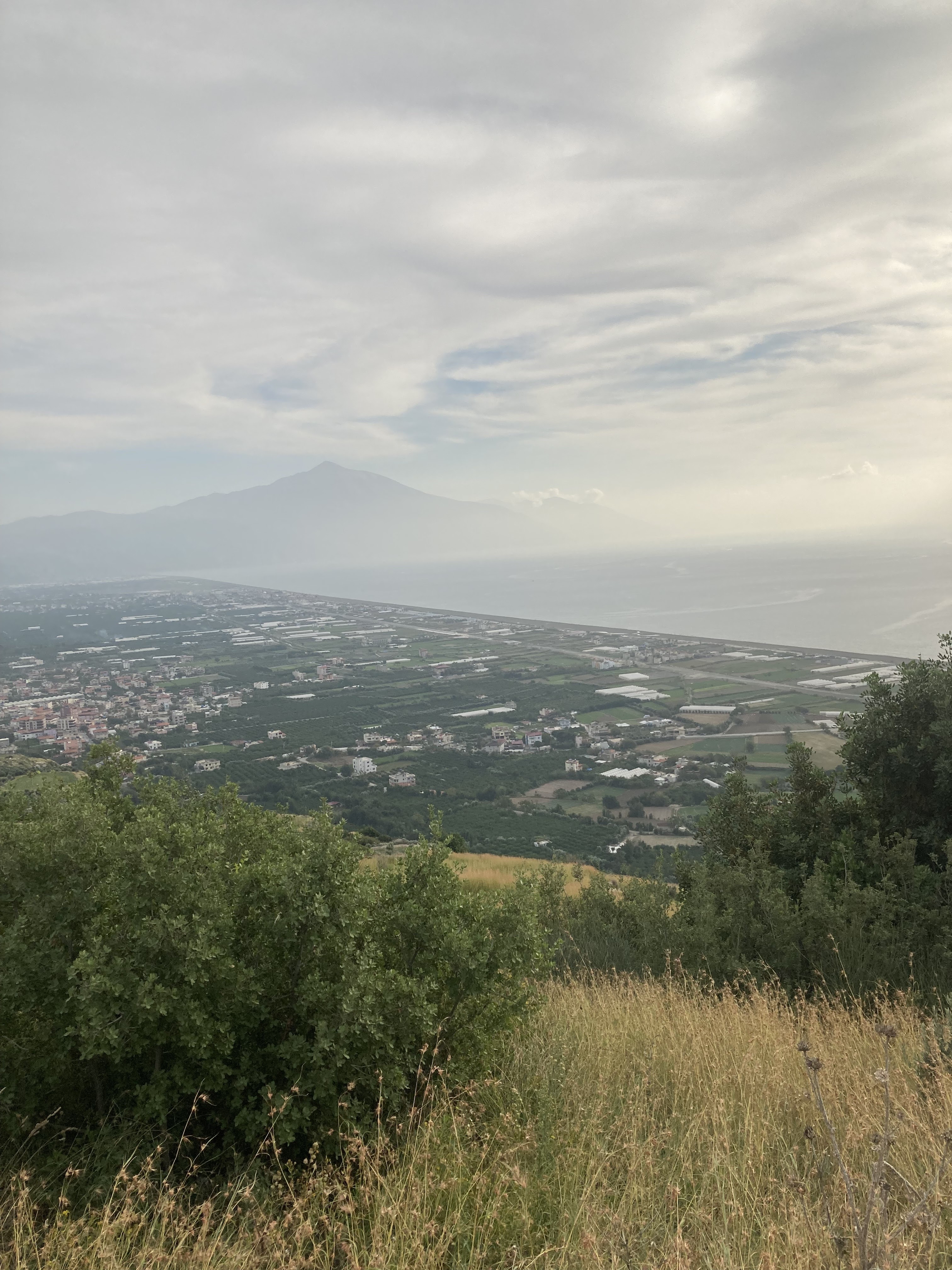
Mount Cassius, seen from Antakya in Turkey. On the other side is Syria.
This afternoon, Ireland added itself to the list of European countries to suspend the processing of asylum applications by refugees from Syria. Austria, Belgium, Croatia, the Czech Republic, Denmark, Finland, France, Germany, Greece, Italy, the Netherlands, Norway, Poland, Sweden, Switzerland and the UK had already done something similar.  It is, of course, very convenient in terms of right-wing domestic narratives about defending European identities and stopping the boats. It also plays very readily into the standard Western mythological narrative of the individual hero (or villain). When will we learn? "Get rid of the bad guy" we always say "and the problem is solved." It's truly extraordinary that, only a couple of days after Assad's fall, European countries should be taking actions that imply Syria's problems are over.

Of course, there are many Syrian people who desperately want this to be true. Many of the Syrian friends we worked with in Turkey to create SUPPLIANTS OF SYRIA have been expressing relief, joy, and a deep desire to return to what remains their beloved home, in spite of the devastation wrought upon it. Some Syrians have begun the journey: and of course the actions of European governments can only encourage this. But there are also a great many people travelling in the opposite direction: people who, in one way or another, may have worked for the Assad government, or who may fear that others will think they did. Just because the dictator has fallen, it doesn't mean there is going to be a free and peaceful, benign and gentle regime established in his place. Look at what happened after Gaddafi's fall. Or Saddam Hussein's. Or Louis XVI's. A revolution, including one that overthrows a tyrant, leaves a void, and a void becomes a contested space that may be filled in many ways.

Those same European governments who have suspended asylum claims are also rapidly considering whether to remove HTS (the insurgent organisation that brought down the regime) from the list of terrorist organisations. It would suit their agenda to do so. However, HTS is an Islamist organisation that emerged from IS and Al-Qaida. Since 2017, they have held sway in Idlib, which was the last stronghold of IS - a place to which none of the refugees I have met expressed any desire to return. It is true that the HTS leader, known in Idlib as Abu Mohammed al-Jolani, has reverted to his birth name Ahmed al-Sharaa, and is taking some pains to paint the country's future as egalitarian and democratic (whatever that may mean - the Suppliants ask). But his history does not suggest the sort of leader Western powers like to see in the Middle East. From 2003-6 he was a jihadist combatant in Iraq, and spent time under American incarceration, including in Abu Ghraib. After 2011, he returned to Syria to fight for IS. On his triumphant arrival in Damascus, he spoke of it as “a victory for the Islamic nation”. “I left this land over 20 years ago, and my heart longed for this moment,” he said. “Sit quietly my brothers and remember God almighty.”

They might also want to remember President Erdogan of Turkey. HTS has a complex relationship with the Northern neighbour who houses so many of their compatriots, but there is no doubt that it was their uneasy alliance which allowed HTS to hold sway in Idlib for the last seven years. Turkey wants a Syrian regime that is hostile to the Kurds, and an excuse to reduce its enormous refugee population. As so often, Erdogan lines up uneasily beside the Europeans. 

Those last seven years in the micro-state around Idlib offer the best indication of how HTS may try to rule Syria (in so far as there is even a state left to rule). The basic services of government were supplied, and taxes were levied to pay for them. They also imposed deeply conservative rules, particularly on women, and dealt brutally with any opposition. Informed sources are suggesting we may see something close to the Taliban. Meanwhile, Turkey has increased its attacks on the Kurds, who are deprived of their uneasy alliance with Assad, and Israel has been advancing from the Occupied Golan, intent on taking Syrian military bases so as to avoid their coming under Islamist control.

Is this really the moment to suspend all asylum claims from Syrian refugees? 

Wednesday, October 23, 2024

Premier in Adana - Radical Empathy

From Suppliants of Syria

Lucy and I went back to Turkey last week, for the premier of the film version of Suppliants of Syria.  The film is feeling like an ever more important part of this project, not least because of the huge challenges of raising the funds to perform the play in the region where it's set. I'm determined that we will get it to Adana, where we can share it with the Syrian women who took part, but that goal is still a long way off, and in the meantime we owed it to them to impart some sense of how we've been responding to their offer and their work.

It had been some time since I'd looked at the film, so I was able to be more objective about it than is usual when my work first goes in front of audiences.  I'm pleased to say that I was very moved by it - the women's sharing of personal stories, intercut with the Choruses from the Greek play Suppliants, is really searing in its honesty. Their acting, the cinematography and the music feel so rooted in that experience that it's impossible to resist its emotional force. And it's very exciting to have that put into dialogue with more political and structural considerations - there's a very theatrical, I guess Brechtian, interplay between the emotional truths and the objective frames around them.

Which said, my own emotional response pales into insignificance beside the reaction of the women themselves. In the Q&A that followed the screening, one of them, Iman, said that the film was "an incredible achievement - but I have been crying all the way through." I had thought that this was rhetorical, but Lucy, who was sitting amongst them, told me that all of them had been in tears from very early in the film. I suppose there was a lot being re-visited for them all; and there were also new stories they probably did not know, about the personal journeys of their friends who were sitting beside them. There's a moment in the film where some of them share with me that they had never told the stories before. The frame of the creative project was essential to draw out these incredibly important truths.

Another audience member was a Turkish NGO worker, who said that the film would bring out empathy in its audiences, and this was really important for the ongoing refugee work of her organisation.  I found myself responding that what is needed everywhere - not just in Turkey but also in Europe, America and global - is a new radical empathy as the way past the politics of prejudice.  It's very hard to hate somebody when you have heard them tell stories like these.  

Friday, April 19, 2024

Sidi Bouzid

Street scene: Regueb, Sidi Bouzid, Tunisia

I've been in Tunisia this week, thanks to an invitation from ATAC (Association Tunisienne de L’Action Culturelle), who initiate cultural actions for human rights in the face of some great challenges! Riadh Abidi and Nouha Hajji, who run the organisation, are incredibly committed to social justice and the role of culture in securing it: so this seemed an ideal place to offer a first preview screening of our SUPPLIANTS OF SYRIA film. So far, it's only fully accessible to Arabic-speaking audiences, as that's how far the subtitling process has got - but an Arabic-speaking audience is exactly what we have here, even though we are a long way from Syria and from Adana, at least physically. The cultural links between Syrian refugees and Tunisians are of course very strong, and are being made stronger by the response to the Gaza crisis across the Islamic world. What's more, the question of Fortress Europe is very real here, as in Turkey. On the day we screened the film, Giorgia Meloni was in Tunis for the fourth time this year, having "further discussions" around migration with President Saied. There's already a basic deal in place between Tunisia and the EU, akin to the (much larger) EU-Turkey deal, whereby Tunisia is paid to intercept migrants crossing the Mediterranean. The Tunisian government says it has prevented 21,000 crossings this year alone. Many of these migrants had already crossed the Sahara to get this far: they come from conflict or post-conflict zones like the DRC, Sierra Leone, Northern Nigeria and Senegal. 

But it was not just the section of the film about European exclusion of desperate people that struck a chord here. Sidi Bouzid, the city where we showed the film, was also the place where the Arab Spring began. It's not a very big city - it has fewer than 50,000 inhabitants - and that makes the reach of what happened here all the more extraordinary. On 17th December 2010, a 26 year old street trader called Mohamed Bouazizi set himself on fire in the public street, burning to death. His self-immolation was an act of desperate protest against endemic corruption: his goods had been confiscated and he had been publicly humiliated by civic officials after he refused to bribe them. Bouazizi's actions led to a wave of further protests in the city and the surrounding areas, which the people of Sidi Bouzid, with great foresight, recorded on their phones and uploaded to social media. In particular, they recorded the authorities' use of violence against them: there were at least 20 further deaths. The protests spread across the country, and by January 14th 2011, President Ben Ali had been forced to flee the country. Not long after, further revolutionary actions began across the Arab World; including, of course, the outbreak of the ongoing conflicts in Syria.

So the question at the centre of Aeschylus's Suppliants, and of our SUPPLIANTS OF SYRIA, seemed incredibly immediate and intense at Wednesday's screening: "What is this thing they call democracy?" As David Wiles points out in the film, democracy is not necessarily compatible with human rights - indeed he suggests there may be a fundamental incompatibility between the two. If, as European and American governments like to suggest, the "representative" systems that they have in place serve to enact the rule of "the people", then what of the rights of other people who are by definition not part of the "rule" in that state? When "the people" rise up to claim their rights, which would seem to be a "democratic" endeavour, why does it so often lead to greater repression or to anarchy? More than a decade on, can any positive meaning be found in the tragic death of Mohamed Bouazizi?


I saw these images on a wall in Regueb, a smaller town in the Govenornate of Sid Bouzid, this morning. I may be wrong, but I think the man portrayed is Mohamed Bouazizi. 

Thursday, October 10, 2019

Don't Let Them Tell You Stories

The Calais Jungle.  Photo: Jamie Wiseman
DON'T LET THEM TELL YOU STORIES is a new play by Brian Woolland, who wrote THE PLAYS OF LOVE AND WAR.  During 2017-19, Brian took part in our project THE PROMISED LAND, looking at the situation of refugees across Europe and Turkey.

The play, written in response, is being given a rehearsed reading at Rich Mix on October 11th at 6.30pm.  The cast is Rachid Sabitri, Olivia Darnley, Ross Hatt, Peyvand Sadeghian and David Furlong, directed by Michael Walling.

Click here for full details - it's free!

Brian Woolland writes:

Whilst participating in THE PROMISED LAND project, I was privileged to have many remarkable conversations with young people recently arrived in Europe from Syria, Iraq, Iran, Nigeria and Mali; conversations which were illuminating, inspirational and deeply challenging to many of my own preconceived notions about 'refugees'.
This play is a response to the project and to those conversations. As the project developed it became increasingly evident that all talk about migration and immigration in simplistic numerical terms is a denial of humanity – of theirs (whoever they might be) and of our own. The play also aims to address the assumption that by creating borders and building walls we can pretend that what’s on the other side is not our concern, not part of our world.
The play is not a documentary drama, and certainly not verbatim theatre, but it does draw heavily on conversations with participants in the project, including those refugees we met in Adana, Bologna, London, Oldenburg and Toulouse. 
I would like to thank all who participated in every way in THE PROMISED LAND project. I am particularly grateful to Micaela Casalboni and Nicola Bonazzi of Teatro dell’ Argine (Bologna) for their richly insightful conversations and inspirational theatre company. And above all to Michael Walling of Border Crossings, for asking me to take part in the project, for our continuing conversations and for organising this rehearsed reading. 

Wednesday, February 07, 2018

The Promised Land - Adana. Guest Blog by Eleanor Brown (CARAS)

Lucy Dunkerley meets Syrian women in Adana 
After a week spent in Adana, Turkey, it’s time to distil some thoughts. It was the beginning of a two year Erasmus + project led by the remarkable theatre company, Border Crossings. CARAS has had a long-term partnership with them, sharing skills, experience and enthusiasm for working with people from all over the world. During January, I went with them as a volunteer, exploring the situation for Syrian refugees who have crossed the Turkish border, and considering ways to place that within a wider context.

Adana is a beautiful place - a golden yellow train station standing in a square surrounded by fluttering flags strung between lampposts and date palms, orange trees heavy with fruit lining every street, poinsettias grown to glorious shrubs showing off their deep red foliage and putting Christmas window-sill versions to shame; streets that fill with the smell of grilled aubergine and kebap as night falls, hookah cafes with apple scented tobacco smoke on the air; and mosques dating back to the 1500s, calls to prayer rolling and echoing between Turkish delight shops, market stalls, and clouds of swooping pigeons. There are shops with stacks of functional, everyday pottery; baskets of herbs; furniture makers; and street cats galore. There’s a great, turquoise river that curves through it all, and a back drop of snow-capped mountains towering in the near distance. It feels like the sort of place that gets on with things without much fuss.

We were a group of academics, business people, theatre practitioners, educators, writers, students and NGO workers, all sharing our understanding and experience of the current refugee crisis. During our time together we began to understand the specific legal context of Turkey, the migration routes of refugees to Turkey and beyond, and to think deeply about how we each respond to the opportunities and challenges this brings.

Finding shared ground with refugees wasn’t hard: swapping plant names with Kurdish park gardeners (poinsettia is ‘Attaturk çiçeği’, orange is ‘portakal’, and crocus is ‘çiğdem’); talking to Bushra, a young Syrian woman striving to learn Turkish to pass the entrance exam to university, who declared a love of Shakespeare; and meeting Fatima, a shy three-year-old who liked counting and loved her dad. These are the ordinary, exceptional people who become refugees, bounced between systems that are confusingly complex and disempowering, navigating an unplanned new path, and hoping for home.

In the NGOs ‘Association for Solidarity with Asylum Seekers and Migrants’ and ‘Support to Life’ we heard stories about the current situation: informal tent settlements dotted throughout the city, the challenges of supporting a transient population making a meagre living through migrant agricultural labour, tension between local and new populations and concern about rising costs of living for all, and the challenges of supporting children traumatised by spending their early years in a war. Amongst workers, there were familiar narratives of resilience and hope finding their way through a context of limited resources and restricted options, and a drive to raise awareness and bring about change with compassion, hard work, and front-line action.

Coming back to London and life at CARAS helps to create a wider context. In Turkey, we were with people at the start of one of the world’s huge forced migration routes. Many Syrians will remain in Turkey under temporary protection, and some might seek citizenship eventually, but for others their migration will continue. Some will be granted third-country resettlement in EU nations, some will ultimately consider it safe enough to return home, and others will make their own way via informal networks through Europe to reach a place that feels safe to them; others still will achieve their ambitions, gaining well paid employment and opening up opportunities again: Abdullah wants to continue his medical studies and be a heart surgeon, Burhan is an engineer, and Roshan is aiming to continue her career as a researcher in biochemistry.

Crossing the vast distance that is Turkey by air, seeing snowing mountains and plains, patchworked fields, a blue expanse of coast dotted with islands, rivers and power-stations, hilltop wind-farms, tiny villages and the great metropolis that is Istanbul brought home just how far people flee in order to feel safe. It’s not just Syrians crossing into neighbouring countries, but Afghans embarking on enormous overland journeys, sub-Saharan Africans crossing the harsh expanses of desert and the treacherous Mediterranean sea, everyone driven by fear and nurturing an aspiration to reach a place that allows them to live freely and safely.

People we meet in London are sometimes at the end of their journey, although some will have applications refused and will continue to be moved. The context in the UK is very different too- we are not experiencing a mass humanitarian crisis on the scale that Turkey, Lebanon, Jordan, Italy and Greece are. But we are working with the same human needs for connection, advice, access to support, and recognition of trauma and the ongoing impacts of forced migration. We face similar myths and stigma about asylum seekers being given better support than others (have a look at these for some myth-busting: asylum accomdation and asylum support payment report), and an ‘othering’ of refugees that prevents people meeting connecting on a human level.

As this project continues, there will be time to consider alternative responses, how we work together across sectors and throughout the EU, and to deepen our understanding of a whole host of human experiences. Stay with us. Follow the story. Next stop: Bologna.

Read more on the dedicated PROMISED LAND blog.

Sunday, October 02, 2011

Zeynep's internship


This is the team in the office, including Aike and Zeynep, our two interns. Zeynep, from Turkey, finished her internship this week, and here's what she had to say about it:

"I arrived in London for my internship in the middle of the Origins Festival. So I took my part in it. I have seen how things work in such a big event. I had a chance to meet a lot of indigenous artists and see their work, and they were amazing. But the most important thing I learned during the festival is that it is actually possible to help indigenous cultures to present themselves to other cultures without being 'authentic' or 'nostalgic'. I have seen how indigenous cultures live and how they are affected by other cultures; which made me realise that cultures which are not 'modernised' or 'globalised' are the ones closest to human spirit. It was so intimate that I felt like I will be able to see the ropes connecting us with the nature if it kept going. Fortunately, Border Crossings is not doing this like a hobby; there will be Origins Festivals every two years.

Although Michael Walling is the heart of the company, he is aware of the vital importance of collaborative work and will make you realise it. So I found my internship period quite productive because I was in an environment where my opinions and thoughts were valued and respected.

During my time in the office, I have learned about publicity, fundraising and mechanics of a non-profit theatre company. I get the chance to have many conversations with a wise and committed artistic director, Michael Walling, about his work and theatre making. I learned many things about playwright dramaturgy, play development and dramaturgical researching from an inspiring associate director Carissa Hope Lynch.

I had many opportunities to see different artistic venues and communities in London. I attended many talks, openings and workshops with Michael Walling’s guidance. I watched more than thirty plays in three months, thanks to recommendations and help for finding affordable tickets.

One of my primary aims was to see devising process of a play. But my internship period ended before Border Crossings started devising. Nevertheless, I have been given the chance to work with other companies like MeWe and I observed several rehearsals.

All in all, I spent three months in London full of art and inspiration thanks to Border Crossings. I am going back to my country with my hands full of knowledge and new ideas."