Showing posts with label refugees. Show all posts

Friday, March 13, 2026

In dialogue with researchers

SUPPLIANTS OF SYRIA.  Photo: John Cobb
SUPPLIANTS OF SYRIA finally had its first performance run last week at Hoxton Hall, and I'm very happy to say it was really well received. Flo London called it "Impactful theatre...  Necessary theatre", while Beyond the Curtain said it was "a stimulating, confronting and eye-opening piece of theatre". But the best piece of writing about the play was actually written before the author had even seen it, and that's Natasha Remoundou-Howley's programme note. "The stage" she writes "becomes a contested space of citizenship and rights: where belonging, inclusion, and diversity are questioned, scrutinized, and rehearsed. This is theatre that demands visibility because the agents of this claim are refugee women performing their inalienable right to exist, to be heard, and to be seen."

I first encountered Natasha's research and critical writing when I was planning the play, I suppose around 2022. I Googled "Suppliants Aeschylus Syria", and a piece she had written in 2017 appeared. It was called The Suppliants of Syria: Narratives of Displacement and Resettlement in Refugee Performances of Greek Tragedy. So that was where our title came from. Some time later I sent Natasha a note via her Academia page, thanking her for the article and explaining what we were up to. Over a year passed, and I thought no more about it, until in September 2025 I got a very apologetic reply: Natasha had somehow missed seeing the message, and was excited to hear more. We met in Dublin, and now she's a board member of our Irish company!

Revisiting that original article today, I realise it's not so preoccupied with Aeschylus' Suppliants as I had thought. The play is discussed, but the main focus of the piece is on some other contemporary pieces of theatre which are based on Greek models, and which involve female Syrian refugees. One of these, Queens of Syria, I saw when it came to London in 2016. I also made use of the film version as part of our workshop for THE PROMISED LAND in 2018, with Zoe Lafferty, who had directed the London staging, coming to talk to our group. Natasha's article recounts how this was largely a platform for testimony, and how its international reach foundered when the US refused artistic visas to the women on the grounds that they were refugees living in Jordan.

That was in 2014. Two years after that, the EU-Turkey deal brought brought about a situation where the vast majority of Syrian refugees cannot travel at all. I came to understand the background and details of this cruel policy through a dialogue with another academic friend, İlke Şanlıer who leads the Migration Research Centre at Çukurova University in Adana, Turkey, and who became our co-producer for the play. The fact that the women were confined to Turkey shaped both the subject of our play and its form. As in Queens of Syria there is specific personal testimony - but for our project it was impossible for this to be delivered directly from the stage. Instead we had to film the women's interviews, and this necessity came to symbolise the wider issues of exclusion and othering which surround the discourse on migration. This in turn led to the use of the Greek theatre model - three professional performers set against a large community Chorus - to create our dramaturgical structure. 

It’s important for our work that we should be self-aware in making the piece, and so move the audience towards a similar reflexivity. Simply putting a refugee’s personal story on stage does make a statement, but as an intercultural theatre company we also need to consider the act of watching, the role of the spectator, and so the role of the society in which the event is happening. A carefully considered contextualisation deepens the meaning of the testimony: without this, it is far too easy for a British or European audience to become self-satisfied in the mere act of listening to people from the Arab region. In the case of Syrian people confined to Turkey by the EU-Turkey deal, there is a real responsibility to be considered, and this goes much deeper than the specifics of one particular situation. Why do Europeans exclude people from the region? Why the  prejudice? Why the constant assertion of superiority? Why the fear?

Facing these questions in dialogue with the material offered to us by the Syrian women, we found ourselves making a piece which confronted the rise of fascism across the world, across Europe, and particularly in our own communities. We realised that there is nothing specifically Arabic or Islamic about the institutional cruelties practised and indeed performed by ISIS: this sort of fascistic tendency is present in our own society, and made manifest in the prejudices displayed against refugees, the demonisation of Islam, and the attitude which many men continue to display towards women. 

At the centre of the performance was a debate with the audience, and I think that symbolised the way in which the play placed itself within a discourse. I'm incredibly grateful to the researchers who helped to generate that. 

Friday, July 04, 2025

PERFORMING POSSIBILITY - Guest blog by Niamh McGrath

Niamh McGrath in the
PERFORMING POSSIBILITY workshop in Cork

Alongside THE LEGEND OF EUROPA, Border Crossings and Teatro dell’Argine are also collaborating on a Youth project under the Erasmus + programme, called PERFORMING POSSIBILITY, together with the YMCA in Cork and Opera di Padre Marella in Bologna.  Although this is a self-contained project in its own right, PERFORMING POSSIBILITY is also proving hugely helpful in researching material for the professional theatre work.  

The young people in Cork, many of whom live in very remote rural areas of the county, have little experience of European travel, and few opportunities to encounter people their own age who live in different countries and diverse communities, particularly migrants and refugees. The young people at Opera di Padre Marella have often faced huge challenges in their journeys to Italy, and continue to encounter prejudice and bureaucratic difficulties as they attempt to forge new lives in Europe. The encounter between these very different groups is hugely valuable in and of itself: for that encounter to be creative, playful, exploratory and dialogic makes it deeply significant for them all.  

At the heart of the EUROPA myth is the story of the Athenian youth - seven young men and seven young women - who were regularly offered as food for the Minotaur: a tribute to appease the Cretan King Minos, who would otherwise invade Athens. This myth of young people being sacrificed to preserve the status quo feels horribly close to our contemporary situation, particularly when working with young people who have already given up and suffered so much in the hope of finding peaceful, comfortable lives in Europe, only to face suspicion, prejudice and stereotyping.  

What follows is an account by Niamh McGrath, one of the participants in the first workshop in Cork, of her experiences around encounter, art and advocacy.  

*
PERFORMING POSSIBILITY was a workshop that explored the themes of immigration, stay versus leave and connectivity through theatre and other forms of media. 

I’m writing this on June 8th, which marks World Ocean Day. On this day one can reflect on all the positives of the ocean: a source of food, a recreational area and a means of transportation and connectivity. But living on the island of Ireland, one has to acknowledge that while oceans, seas and other bodies of water can facilitate transport, they also lead to isolation. 

Ireland is on the edge of the European Union. This means that the young people in Ireland are not as connected with the rest of our EU peers to the extent we should be. Therefore the cultural exchange that PERFORMING POSSIBILITY offered is one that is so valued. For myself and 20 other young people in Cork, we had to opportunity to talk to other young people living in the EU. These young people are living in Bologna in Italy, another edge of the EU. These young people were immigrants, who had come from places such as Tunisia, Ukraine and Afghanistan. We were able to talk over Zoom. We talked about our dreams for the future, our music tastes and parts of our cultures (e.g. food). I hope that this cultural exchange will only be the beginning. 

One of the main themes we explored over the week was the idea of staying or going. On the Wednesday, our group wrote reasons to stay and reasons to go on two different pieces of paper. Then on Thursday, in pairs, we picked out words and phrases that appealed to us and wrote something about it. After we would write something, our partners would then respond with something else. My partner Pádraig and I circled around a reason to stay: to walk down the same streets as one’s ancestors. Pádraig came up with the phrase “to walk in the worn down comfortable footprints”. This line has stuck with me. The idea that if I were to leave Ireland, I would be leaving the comfort, the familiar and my own history. 

After writing pieces and answering each other, Pádraig and I had created a piece of theatrical writing that debated the idea of immigration. Then we practised performing the piece. This for me was the tricky bit, as I would not be an actor. But from this experience I have gained a greater understanding of the weight words can carry and how important and thought provoking a few well placed pauses can be. 

The thing that I believe will always stick with me from this experience is the realisation of the links between advocacy and art. There are many was to advocate for change - lobbying policy makers, running campaigns, protesting - but also through the arts. Theatre and drama can tell a story, prove a point and provoke a thought. The power in the delivery of what you say is priceless. 

In my opinion the best part of the workshop was the new perspective I left with. The workshop not only opened my eyes to the power of theatre but also showed me a snapshot into the lives of other young people who are living on another edge of Europe. This experience is something I would one hundred percent recommend. 


Wednesday, December 11, 2024

After Assad

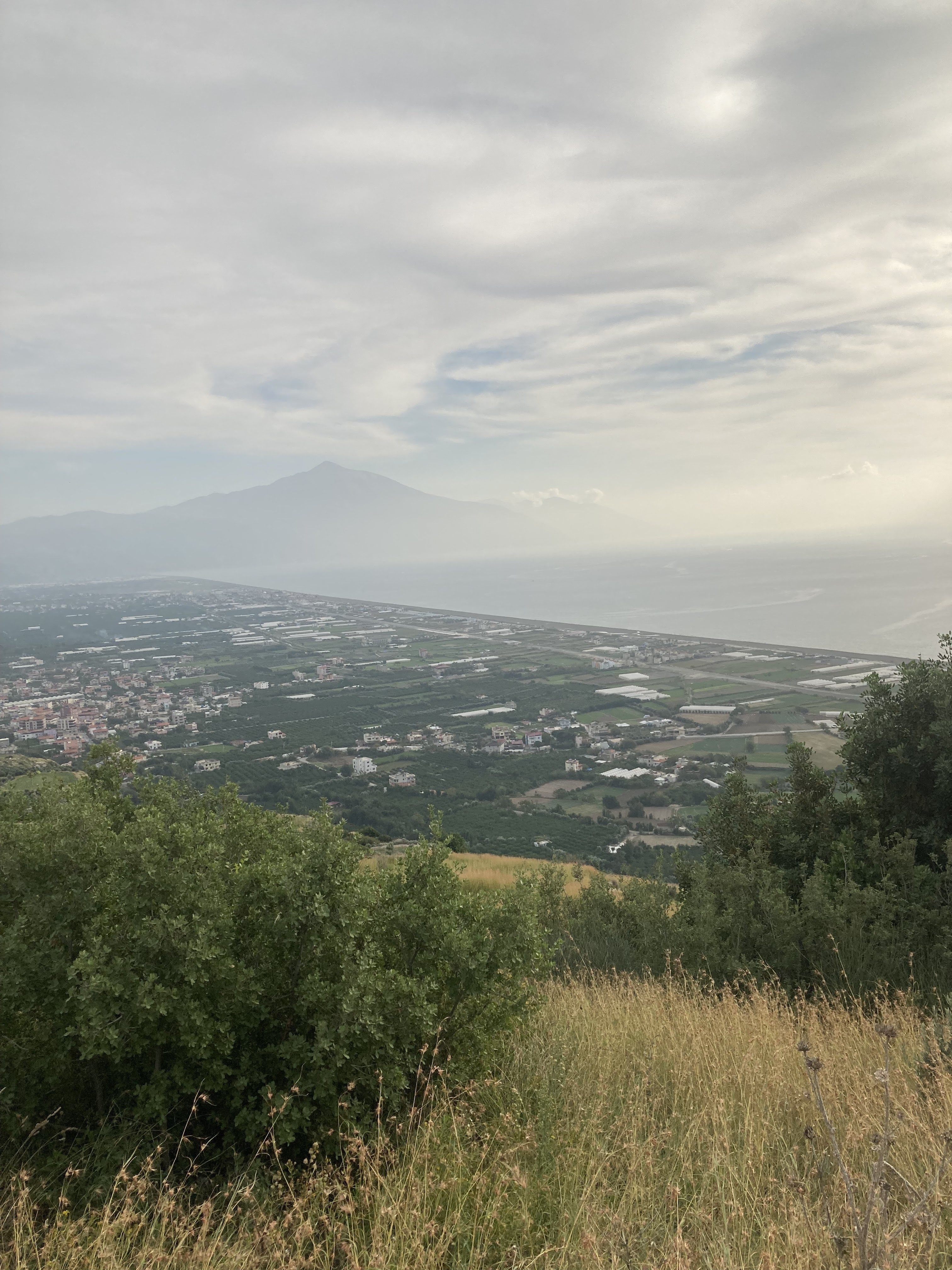
Mount Cassius, seen from Antakya in Turkey. On the other side is Syria.
This afternoon, Ireland added itself to the list of European countries to suspend the processing of asylum applications by refugees from Syria. Austria, Belgium, Croatia, the Czech Republic, Denmark, Finland, France, Germany, Greece, Italy, the Netherlands, Norway, Poland, Sweden, Switzerland and the UK had already done something similar.  It is, of course, very convenient in terms of right-wing domestic narratives about defending European identities and stopping the boats. It also plays very readily into the standard Western mythological narrative of the individual hero (or villain). When will we learn? "Get rid of the bad guy" we always say "and the problem is solved." It's truly extraordinary that, only a couple of days after Assad's fall, European countries should be taking actions that imply Syria's problems are over.

Of course, there are many Syrian people who desperately want this to be true. Many of the Syrian friends we worked with in Turkey to create SUPPLIANTS OF SYRIA have been expressing relief, joy, and a deep desire to return to what remains their beloved home, in spite of the devastation wrought upon it. Some Syrians have begun the journey: and of course the actions of European governments can only encourage this. But there are also a great many people travelling in the opposite direction: people who, in one way or another, may have worked for the Assad government, or who may fear that others will think they did. Just because the dictator has fallen, it doesn't mean there is going to be a free and peaceful, benign and gentle regime established in his place. Look at what happened after Gaddafi's fall. Or Saddam Hussein's. Or Louis XVI's. A revolution, including one that overthrows a tyrant, leaves a void, and a void becomes a contested space that may be filled in many ways.

Those same European governments who have suspended asylum claims are also rapidly considering whether to remove HTS (the insurgent organisation that brought down the regime) from the list of terrorist organisations. It would suit their agenda to do so. However, HTS is an Islamist organisation that emerged from IS and Al-Qaida. Since 2017, they have held sway in Idlib, which was the last stronghold of IS - a place to which none of the refugees I have met expressed any desire to return. It is true that the HTS leader, known in Idlib as Abu Mohammed al-Jolani, has reverted to his birth name Ahmed al-Sharaa, and is taking some pains to paint the country's future as egalitarian and democratic (whatever that may mean - the Suppliants ask). But his history does not suggest the sort of leader Western powers like to see in the Middle East. From 2003-6 he was a jihadist combatant in Iraq, and spent time under American incarceration, including in Abu Ghraib. After 2011, he returned to Syria to fight for IS. On his triumphant arrival in Damascus, he spoke of it as “a victory for the Islamic nation”. “I left this land over 20 years ago, and my heart longed for this moment,” he said. “Sit quietly my brothers and remember God almighty.”

They might also want to remember President Erdogan of Turkey. HTS has a complex relationship with the Northern neighbour who houses so many of their compatriots, but there is no doubt that it was their uneasy alliance which allowed HTS to hold sway in Idlib for the last seven years. Turkey wants a Syrian regime that is hostile to the Kurds, and an excuse to reduce its enormous refugee population. As so often, Erdogan lines up uneasily beside the Europeans. 

Those last seven years in the micro-state around Idlib offer the best indication of how HTS may try to rule Syria (in so far as there is even a state left to rule). The basic services of government were supplied, and taxes were levied to pay for them. They also imposed deeply conservative rules, particularly on women, and dealt brutally with any opposition. Informed sources are suggesting we may see something close to the Taliban. Meanwhile, Turkey has increased its attacks on the Kurds, who are deprived of their uneasy alliance with Assad, and Israel has been advancing from the Occupied Golan, intent on taking Syrian military bases so as to avoid their coming under Islamist control.

Is this really the moment to suspend all asylum claims from Syrian refugees? 

Wednesday, October 23, 2024

Premier in Adana - Radical Empathy

From Suppliants of Syria

Lucy and I went back to Turkey last week, for the premier of the film version of Suppliants of Syria.  The film is feeling like an ever more important part of this project, not least because of the huge challenges of raising the funds to perform the play in the region where it's set. I'm determined that we will get it to Adana, where we can share it with the Syrian women who took part, but that goal is still a long way off, and in the meantime we owed it to them to impart some sense of how we've been responding to their offer and their work.

It had been some time since I'd looked at the film, so I was able to be more objective about it than is usual when my work first goes in front of audiences.  I'm pleased to say that I was very moved by it - the women's sharing of personal stories, intercut with the Choruses from the Greek play Suppliants, is really searing in its honesty. Their acting, the cinematography and the music feel so rooted in that experience that it's impossible to resist its emotional force. And it's very exciting to have that put into dialogue with more political and structural considerations - there's a very theatrical, I guess Brechtian, interplay between the emotional truths and the objective frames around them.

Which said, my own emotional response pales into insignificance beside the reaction of the women themselves. In the Q&A that followed the screening, one of them, Iman, said that the film was "an incredible achievement - but I have been crying all the way through." I had thought that this was rhetorical, but Lucy, who was sitting amongst them, told me that all of them had been in tears from very early in the film. I suppose there was a lot being re-visited for them all; and there were also new stories they probably did not know, about the personal journeys of their friends who were sitting beside them. There's a moment in the film where some of them share with me that they had never told the stories before. The frame of the creative project was essential to draw out these incredibly important truths.

Another audience member was a Turkish NGO worker, who said that the film would bring out empathy in its audiences, and this was really important for the ongoing refugee work of her organisation.  I found myself responding that what is needed everywhere - not just in Turkey but also in Europe, America and global - is a new radical empathy as the way past the politics of prejudice.  It's very hard to hate somebody when you have heard them tell stories like these.  

Friday, April 19, 2024

Sidi Bouzid

Street scene: Regueb, Sidi Bouzid, Tunisia

I've been in Tunisia this week, thanks to an invitation from ATAC (Association Tunisienne de L’Action Culturelle), who initiate cultural actions for human rights in the face of some great challenges! Riadh Abidi and Nouha Hajji, who run the organisation, are incredibly committed to social justice and the role of culture in securing it: so this seemed an ideal place to offer a first preview screening of our SUPPLIANTS OF SYRIA film. So far, it's only fully accessible to Arabic-speaking audiences, as that's how far the subtitling process has got - but an Arabic-speaking audience is exactly what we have here, even though we are a long way from Syria and from Adana, at least physically. The cultural links between Syrian refugees and Tunisians are of course very strong, and are being made stronger by the response to the Gaza crisis across the Islamic world. What's more, the question of Fortress Europe is very real here, as in Turkey. On the day we screened the film, Giorgia Meloni was in Tunis for the fourth time this year, having "further discussions" around migration with President Saied. There's already a basic deal in place between Tunisia and the EU, akin to the (much larger) EU-Turkey deal, whereby Tunisia is paid to intercept migrants crossing the Mediterranean. The Tunisian government says it has prevented 21,000 crossings this year alone. Many of these migrants had already crossed the Sahara to get this far: they come from conflict or post-conflict zones like the DRC, Sierra Leone, Northern Nigeria and Senegal. 

But it was not just the section of the film about European exclusion of desperate people that struck a chord here. Sidi Bouzid, the city where we showed the film, was also the place where the Arab Spring began. It's not a very big city - it has fewer than 50,000 inhabitants - and that makes the reach of what happened here all the more extraordinary. On 17th December 2010, a 26 year old street trader called Mohamed Bouazizi set himself on fire in the public street, burning to death. His self-immolation was an act of desperate protest against endemic corruption: his goods had been confiscated and he had been publicly humiliated by civic officials after he refused to bribe them. Bouazizi's actions led to a wave of further protests in the city and the surrounding areas, which the people of Sidi Bouzid, with great foresight, recorded on their phones and uploaded to social media. In particular, they recorded the authorities' use of violence against them: there were at least 20 further deaths. The protests spread across the country, and by January 14th 2011, President Ben Ali had been forced to flee the country. Not long after, further revolutionary actions began across the Arab World; including, of course, the outbreak of the ongoing conflicts in Syria.

So the question at the centre of Aeschylus's Suppliants, and of our SUPPLIANTS OF SYRIA, seemed incredibly immediate and intense at Wednesday's screening: "What is this thing they call democracy?" As David Wiles points out in the film, democracy is not necessarily compatible with human rights - indeed he suggests there may be a fundamental incompatibility between the two. If, as European and American governments like to suggest, the "representative" systems that they have in place serve to enact the rule of "the people", then what of the rights of other people who are by definition not part of the "rule" in that state? When "the people" rise up to claim their rights, which would seem to be a "democratic" endeavour, why does it so often lead to greater repression or to anarchy? More than a decade on, can any positive meaning be found in the tragic death of Mohamed Bouazizi?


I saw these images on a wall in Regueb, a smaller town in the Govenornate of Sid Bouzid, this morning. I may be wrong, but I think the man portrayed is Mohamed Bouazizi. 

Wednesday, March 27, 2024

Developing SUPPLIANTS OF SYRIA - Guest post by Liam Rees

In the workshop room for SUPPLIANTS OF SYRIA

For four weeks, director Michael Walling and three actors (Richard Adetunji, Vlad Gurdis and John Rogers) have been exploring response to The Suppliants by Aeschylus, in which the suppliant women flee forced marriage and seek asylum in Greece, but are met by a seemingly endless debate about the correct course of action. I'd been interested in Border Crossings' approach to devising for some time, and was delighted to join them for a week, acting as a dramaturgical outside eye. Here are some observations from the process.

“Democracy is a conversation.” We can agree on that, can’t we?

The oldest written record of the word “democracy” is in The Suppliants by Aeschylus, and this rehearsal room is obsessed with the idea of democracy. As one actor explains, it comes from the Greek ‘demos’ meaning people, and ‘kratos’ meaning power. So the power of the people. But how is that power expressed? In theatre, it’s through our voice, and there’s a constant back and forth of disagreements, compared experiences, and conflicting perspectives in the room. There’s a cacophony of voices in the rehearsal room: the actors, the director, Aeschylus, and the real life suppliants, a group of Syrian women seeking asylum in Turkey. Like Aeschylus, their words and voices have been recorded and interpreted but they can’t be in the room with us. There will always be some gap in our understanding…

“The worst thing that’s ever happened to you is the worst thing that’s ever happened to you.”

Each day in rehearsals is different but always centres around trying to understand the plight of the suppliant women. One day is spent exploring the classical text via mask work. It unlocks a more mythic aspect to the text, less reliant on a personal or psychological connection. In a way the mask protects the actor from any traumatic material. The next day we watch interviews with the Syrian women and everything is all too real. We dig into our own experiences and our own points of connection with the suppliants of Syria. There’s no mask to hide behind. These aren’t characters we’re playing. We’re five men trying to make sense of men at war and male violence against women. At one point we ask if we should have more women in the room; but is that then forcing them to take on more emotional labour? Surely men need to take responsibility for sorting the issues they cause? It’s “not all men” but it is almost always a man. There’s no simple answer and at the end of every day we take care to check in with each other and not take the heavy, personal, messy questions home with us. But the questions never go away throughout the process. Michael shares anecdotes about visiting Turkey and the ethical issues inherent in documenting and interviewing asylum seekers. Is this exploitation or genuine dialogue? Does paying them for their time turn suffering into a commodity to be consumed? Is there any “good” way to tell their story?

“It’s great that we’re having this conversation.”

Every day brings new questions and every new question leads to rewrites and reinterpretations of the source material. There’s Aeschylus’ original text, the interviews, and a meta-commentary performed by the actors as fictionalised versions of themselves.  At times it can feel overwhelming. Are there too many questions that we can’t answer? In the heat of one discussion we’re forced to ask what the point of this project is? Are we simply going in circles? If it’s impossible to understand someone else’s experience then what is the point in trying? Is this conversation actually intended to result in action? Or is it a distraction? A means for us to absolve ourselves of feelings of guilt?

There’s a repeated phrase in one section: It’s great that we’re having this conversation. 

Because silence doesn’t feel like an option.

Everything about this show invites disagreement.

For now, there’s still time for the cast and crew to decide what this show should be.

But that conversation can't go on forever, can it?

Liam Rees is a director who specialises in developing new work and new writing. He has a particular interest in international collaboration and enjoys making theatre that uses digital tech to put the internet onstage and facilitate more international conversations. 

Wednesday, November 02, 2022

Invasions

Paul Coe and Cecil Patten planting the Aboriginal flag on Dover Beach in 1976

On Monday, 31st October 2022, Home Secretary Suella Braverman described the arrival of refugees and migrants in small boats from across the Channel as an "invasion". It was an extraordinary use (or abuse) of language, but one characteristic of post-Brexit Britain, where, as Fintan O'Toole argues in his superb book Heroic Failure, there is a deliberate appropriation of victimhood by the former imperial power. Quite how people who have fled persecution in Iran or Afghanistan, or ongoing civil war in Syria, risking their lives in a small boats because there are no safe legal routes to Britain, can be regarded as "invaders" is beyond belief. How a country that seeks to deport them to Rwanda, a country with a very dubious human rights record, can be regarded as the innocent victim is equally bizarre. 

An invasion, just to be clear, is an act of aggression. It demonstrates an intention to possess the land invaded and to dominate its population.

Of course, the linguistic twist is deliberate. By casting Britain as the victim and the refugees as powerful aggressors, fear is unleashed and prejudice is compounded. The day before Braverman's pronouncement, a right-wing terrorist had attacked a migrant centre in Dover. If the migrants are constructed as aggressors, then his murderous bombing becomes an act of righteous self-defence. It's very dangerous.

There have been, and are, real invasions around the world. The invasion of Ukraine was a real invasion by a powerful state intent on acquiring more territory. The colonial invasions which Britain made against the lands now known as (for example) Australia and Canada were also real invasions. In these cases, however, the prevailing discourse in Britain tends to use terms like "discovery", so as to shift the moral balance. It was an important milestone when the City of Sydney chose to describe Cook's landing as an invasion in its official documentation. Since then, "Australia Day" is frequently referred to as "Invasion Day" by Indigenous activists and their allies, with a hugely different emotional resonance.

A few months ago, we unveiled a plaque on Dover Beach, of all places, to commemorate the actions of Aboriginal activists Paul Coe and Cecil Patten in 1976. Pointing up the illegal and aggressive nature of colonial actions, they staged an "invasion" of Britain, planting their flag on the beach and writing to the Prime Minister to explain that they now ruled his country. It was very funny - and it showed the absurdity of the original colonial claim.  

Here's a link to our video about the "Aboriginal Invasion".  I recommend it to the Home Secretary. 


Saturday, January 25, 2020

Migrants and ‘Traffickers’ - past and present

Guest blog by Prof. Crispin Bates (University of Edinburgh)
David Furlong in rehearsals for THE GREAT EXPERIMENT
Crispin Bates was one of our Consultant Historians for the devising process of our new production: THE GREAT EXPERIMENT.  Here he reflects on the history of migrations informing the play, and its relevance today.

The problems associated with today's mass migrations are nothing new. They have always arisen from the incompetent or misguided policies of governments that have often been responsible for creating the conditions from which migrants are trying to escape. In the current European refugee crisis an attempt is commonly made to distinguish between ‘deserving’ refugees, to whom asylum should be granted, and ‘economic migrants’ who should be excluded. However the distinction is not so clear- cut. So-called ‘economic migrants’ are often the victims of mis-rule by totalitarian regimes. Their poverty is therefore brought about or compounded by the actions of politicians. Persecution can involve political and economic discrimination as well as the loss of civil liberties. The chaos of war produces famine and economic distress that is as much a threat to life as the military’s guns and bombs.

Perhaps the most extreme form of political repression arises when a country is occupied by a foreign power. This describes the condition of many countries in Africa and Asia during the era of European colonialism. Political rights and civil liberties were minimal, and territories were administered primarily in the interests of the occupying power, and not those of the indigenous population. The question arises therefore whether labour migrants of the colonial era were maximising their economic opportunities, or were simply refugees. The answer, as today, is often both. Migrants made choices, but only amongst a very limited range of options. One might question the freedom of choice when it comes to most economies, but in these circumstances the range of options was often peculiarly constrained.

Global migration has a longer history than most people imagine. Apart from the millions of Europeans who migrated to America and other countries in the hope of a better life, some 20 million Chinese migrated overseas between 1840 and 1940. Mostly they went to Malaysia, where they worked in the tin mining industry, to the Dutch East Indies (Indonesia), Siam, French Indo-China, and South Africa, where they were employed in gold mining.  Indians migrated overseas in equally large numbers from the 1830s onwards.  And wherever Asian workers went they were soon followed by merchants, who traded, set up shops and restaurants and small scale industries. Many of these migrants came from regions with traditionally high levels of out-migration, such as Bihar in northern India, as well as from Tamil Nadu in the south, but eventually every part of the Indian subcontinent became involved. They mostly left to work in sugar plantations in British colonies in the Caribbean and southern Indian Ocean, as well as in South Africa, Fiji, and in the French colonies of Reunion, Guadeloupe and Martinique. Their role was to replace African slave labour following the abolition of slavery in the British empire in 1833/4 and the French empire a decade later. Indian labourers signed up in even larger numbers to work in the paddy fields, coffee, tea and rubber plantations of Sri Lanka, Myanmar and Malaysia. They also served as construction workers, much as they do in the Middle East in the present day. They were often employed using notoriously one-sided labour contracts which obliged them to work continuously for three, four or five years for a single employer, who was thereby reimbursed for the cost of their passage. They had no passports to be confiscated, only an emigration certificate and a contract of employment, but if they did not complete their contract, they would lose the right to a free passage home.

Criticisms from the Anti-Slavery Society in London, who dubbed the first wave of indentured migration ‘a new system of slavery’, led to the suspension of indentured migration in 1838, but it was then resumed in 1843 under close supervision. Opponents of Indian overseas migration within India were reassured by the planters that they would only recruit the poorest of the poor and the most unskilled of Indian workers. However, statistical evidence suggests that by the late 1850s migrants were being recruited from amongst the landless and impoverished within all sections of society. The great Indian Uprising of 1857 gave a boost to the trade, as the economy of rural north India was devastated by war with successive famines following in 1861 and 1865. Tens of thousands of high caste Indians from disbanded regiments of the Bengal army, in particular, found themselves out of work at this time and many migrated overseas. It is true that the wages of indentured labourers were often better than those available locally. However, the alternative employment opportunities were severely limited.
Tobi King Bakare in rehearsals for THE GREAT EXPERIMENT
The indenture contract was similar to that in use in most modern armies. It was less onerous in one respect, as if they saved enough the workers could buy themselves out of the contract at any time. However, the work was hard and although hospitals were provided and Protectors and Inspectors were appointed (to whom they could and did complain), the rights of workers were limited, and always constrained by the pervasive racism of their employers and colonial governments. If workers fled from the plantation they could be arrested and imprisoned for vagrancy (a law borrowed from Britain), and workers who were absent from work, without permission, were in some colonies penalised with a two-day deduction of wages for every day they were away (the notorious ‘double cut’). Although banned by law by the end of the century, overseers in some estates often did not hesitate to use violence and abuse to keep their workers in line.

Like most long-distance migrants, the Indian recruits (referred to as ‘coolies’ – a title that later assumed a derogatory meaning) had only a limited knowledge of where they were going. There were sugar plantations in India, and some were already familiar with the type of work involved. But most had no relevant previous experience. What attracted them was the possibility of saving money and returning home with it. In some cases by migration they also hoped to escape caste, gender, or religious persecution. Better still, many were allowed to acquire land – something they could never have achieved in India - and stayed on in the sugar colonies. In the British colony of Trinidad, the earliest migrants were offered a free grant of land if they agreed to stay rather than claim the free passage home to which they were entitled. In time, many gave up working on the plantations and became farmers or shopkeepers.

Between 1.5 and 2 million Indians were contracted as indentured workers. Eventually large settled communities of Indian workers were established in the sugar colonies, which by the early twentieth century was to make this form of recruitment redundant. Other forms of recruitment also took place contemporaneously for the inter-Asian labour trade. These included the so-called ‘free migration’ of workers and the use of Indian kanganies and maistries who advanced wages and lent money to workers to pay their passage. Workers were assembled in gangs to work especially in the coffee and tea plantations of Assam and Sri Lanka, and later in the all important rubber plantations of Malaysia. Unlike the migration of indentured labourers to work in the sugar trade, this form of migration was not closely supervised by colonial governments. We will therefore never know the true numbers, but many millions were involved. Migration to work in sugar plantations probably accounted in fact for barely 10% of the total.

In all these migrations there was an opportunity for betterment, but at huge risk and often at great cost. Prior to the introduction of steamships, disease might break out on ships during the long sea passage, leading to extraordinary levels of mortality. Some were also lost in drownings at sea and shipwrecks. The treatment meted out to workers by former slave owners in the early years was often harsh. Gradually though, over time, conditions were improved with the introduction of improved rations and increasingly rigorous inspections. The complaints and protests of the workers, who struggled against colonial discrimination, played an important role in ameliorating the trade: so much so that the Internal Labour Organisation in the 1920s looked to indentured labour regulations for examples on how to define the rights of workers.  Much as in the present day, the least fortunate migrants were those who found themselves working in entirely unregulated industries, such as agriculture or domestic work.
Nisha Dassyne in rehearsals for THE GREAT EXPERIMENT
It is often assumed that planters and factory owners were themselves responsible for recruiting the workers. However, intermediaries of various sorts played a crucial role in all Indian overseas labour migration. The most important of these intermediaries was the kangani or sirdar: who was commonly a returnee migrant worker or overseer, who could provide knowledge and information about the passage, guarantee their safe arrival, and their onward employment. Much like modern people smugglers (often referred to as ‘traffickers’), they were pilloried at the time. They provided a service to the planters by securing for them employees, usually from the Indian rural locality where they originated, that the planters could not otherwise secure. They had to be paid for this, and often demanded extortionate fees. At the same time, they organised and supported the workers: navigating their way to the depot, providing them food and clothing during the passage, lending money (at high rates of interest), and securing the best possible wages for them if they chose to re-indenture on the sugar estate (in which they also claimed a share). They were indispensable to all concerned, but their loyalties were always in question.

Attempts were made by numerous colonial governments to do away with the kanganis, sirdars and other intermediaries to develop what they imagined as an entirely ‘free’ market in labour migrants. This proved to be impossible, even after the abandonment of the indentured labour contract in the 1920s under pressure from Indian nationalists. Much like people smugglers in the present-day they provided a service which no-one else could. To survive and improve their life chances, migrants had to undertake long journeys and depended upon the networks and knowledge provided by intermediaries. Even though colonial labour migration was not illegal, contracts could not be secured without the involvement of intermediaries.

In the present-day, the growth of free trade has been accompanied by an ever greater tightening of border controls. This began in the 1880s with immigration restrictions introduced by Canada and Australia to halt the inward rush of impoverished Chinese migrant labourers. Travel restrictions became more widespread in the 1930s with the impact of the depression, with the eruption of strikes and race riots being often blamed on migrant communities. Border controls then became endemic after World War II, as newly independent social democratic states struggled to define and control their citizens, to raise taxes, and to determine the legal rights of their populations. It is these restrictions, that have made intermediaries of various sorts even more important than they were in the past for those seeking and needing to cross the globe in search of sanctuary and employment.

In the parts of the Middle East and north Africa torn apart by warfare and civil strife there are no consulates where refugees can apply for asylum. At the same time, European air, sea and road transport regulations forbid any migrant to board a plane without a visa of some sort. Smuggling is thus driven by EU policy. Many politicians have pointed out how the foreign policies of the European powers, particularly the arming of rebels in the aftermath of the ‘Arab Spring’ and the bombing of Libya, Iraq and Syria, have contributed to the exodus. Nineteenth century colonialism limited the opportunities of Indian subjects so that they had little choice but to become indentured migrants, for which they were recruited by Indian sirdars. So too, have European governments compounded a state of war and then created a legal regime where would- be migrants have no choice but to put themselves in hands of smugglers, who are the only ones capable of organising their escape.

In colonial times, the Royal Commission on Indentured Migration to Mauritius in 1875, received conflicting evidence of the exploitative behaviour of sirdars: sometimes they seemed to serve the interests only of themselves, but at other times they clearly defended their gangs of workers. Neither the workers or planters could survive without them. The Royal Commission concluded there they were an ‘evil’ (hypocritically blamed on ‘the persistence of native practices’) than must be endured.8 Just as there were ‘good’ and ‘bad’ sirdars in colonial times, the same can be said of intermediaries in the present: at the one end there are legitimate and responsible foreign labour recruiters and at the other end are the ‘traffickers’ who use intimidation to coerce migrants into exploitative employment in industries lacking regulation, such as agriculture, domestic and sex work. People smugglers lie somewhere in between. It is the illegality of their actions that often causes people smugglers to be prosecuted as ‘traffickers’, but for the difficult circumstances of migrants and the need for their services, European governments have a case to answer too. Because of their illegality, smugglers are forced to abandon lorries or boats before reaching their destinations, off-loading sea passengers onto dinghies that either sink or are confiscated upon arrival. Intermediaries in colonial times travelled with migrants for the whole journey, acted as overseers on the plantations, and often spent their entire lives with the persons they recruited and accompanied overseas. In fact the life of migrants was probably less hazardous in colonial times than it is now. The culpability of European governments for the poor conditions migrants have to suffer is in many ways similar, but the results are even more devastating today.
*

Crispin Bates is Professor of Modern and Contemporary South Asian History at the University of Edinburgh and Co-Investigator with Prof. Andrea Major (Leeds University) in the AHRC-funded ‘Becoming Coolies’ research project on the origins of Indian overseas labour migration in the colonial era. See www.coolitude.shca.ed.ac.uk.

To find out more about THE GREAT EXPERIMENT and to book tickets, visit https://www.bordercrossings.org.uk/programme/great-experiment

Tuesday, December 31, 2019

2019 - at Border Crossings and Beyond

Ino Moxo - ORIGINS Festival
2020 will see Border Crossings reach its 25th anniversary.  During 2019, we've been busier than ever, working to bridge the gaps between cultures and to generate mutual respect and understanding in the globalised world.  The task has never felt more necessary...

In many ways, this has been an extraordinary year for us, packed with incident and excitement.  At the centre of our programme was ORIGINS 2019: our 10th anniversary Festival of First Nations. Launched at the British Museum back in March with a compelling performance by Indigenous Australian musician Eric Avery, the Festival proper covered two packed weeks in June, taking in some of London's most iconic venues and populating them with world-class Indigenous performances.  It was an incredible privilege to present the first ever London showings of Peru's Grupo Integro, with their brilliant, mind-expanding production of INO MOXO at the Southbank - a piece that made time stand still and took the consciousness of the spectator into the visionary space of Ayahuasca ritual.  Equally unforgettable, and historic, was Madeline Sayet's WHERE WE BELONG, particularly when it played the Sam Wanamaker Playhouse at Shakespeare's Globe - placing the Indigenous voice right at the heart of British culture, and offering a completely new view of what that culture may come to mean in the 21st century.  AVA Dance company's NO WOMAN'S LAND at The Place brought Inuit culture to the Festival in the charismatic person of Naulaq LeDrew, as well as gaining a UK National Dance Awards Nomination for Avatâra Ayuso.
Where We Belong - ORIGINS Festival
I was also thrilled with the Festival's programme of Participation and Learning - in some ways the fullest yet, with brian solomon//ELECTRIC MOOSE creating a new dance piece with community dancers and a youth orchestra from the North Kensington community.  WESTWAY SOLSTICE, performed on three summer evenings in sight of Grenfell Tower, offered vitality, hope and energy for our communities and our youth.
Westway Solstice - ORIGINS Festival
Our ORIGINS participation work from the 2017 Festival had an ongoing life this year too, when the photographic exhibition POCAHONTAS AND AFTER visited St Andrews.  Word of that project has spread...   it's put us in touch with the Powhatan nation themselves.  Two of their Chiefs honoured us with their presence at the ORIGINS opening, and I've since visited them in Virginia, accompanied by Madeline Sayet, to explore the possibility of making a new play together...   Watch this space!

The year has also seen us working on a number of collaborative projects across Europe, three of them funded by the EU's Erasmus + programme. In the spring, we co-produced UNDER THE WHALEBACK with the North Frisian Theatre - a production hailed as their best work to date!  THE PROMISED LAND, which focused on the role of the arts and culture in making Europe a welcoming space for refugees, saw us undertake two fascinating weeks of exploration and training in Oldenburg and Toulouse, based on museum work and business coaching.  The project came together in the e-book which we published during the summer: it's proved a huge hit across a whole range of sectors, offering a combination of policy frameworks and recommendations, theoretical discussions and practical approaches. The project also led to Brian Woolland's new play DON'T LET THEM TELL YOU STORIES, which we presented as a rehearsed reading in October at Rich Mix.  MORE THAN WORDS, which looks at ways to work with communities who have little knowledge of the local language, reached a key point with a week in Luxembourg, during which we brought together a range of disciplines and approaches to answer a range of framing questions.  The Intellectual Outputs, including a film starring the Italian clown Raffaele Messina and directed by myself, will come out in the spring of 2020!

The spectre of Brexit has inevitably haunted these projects throughout 2019.  Almost every time we worked in Europe, we seemed to be on the edge of a precipice.  There have been many occasions when it has been very likely that our projects would simply stop - cut off, incomplete and futile.  It was a relief that we managed to finish all we had planned in THE PROMISED LAND, and it now seems that the Transition Period will allow MORE THAN WORDS to be completed during 2020.  But that is, at best, a minor gain in the face of a very frightening future.  In 2016, the day after the referendum, we had to welcome a group of European visitors to London.  On Friday 13th December 2019, I was in Southern Italy for a meeting around the MORE THAN WORDS project, and had to explain to our European partners that the election result was the point of no return. As Border Crossings enters its Silver Jubliee Year, it is faced with the prospect of being an international organisation in a nationalist country, an intercultural organisation in a monocultural space, an advocate of reconciliation under a government dedicated to false and divisive imperialist mythologies.  The last few years have been challenging - but the ones ahead will be much, much harder.

We have our strategies, of course.  We have many dear friends and allies.  We are deeply aware that the "hostile environment" makes our work all the more necessary.  You can look forward to some innovative and creative announcements in the coming months. And, most importantly, you can look forward to THE GREAT EXPERIMENT - our new devised play which explores the imperial history on which our country's new mythology of exceptionalism appears to be based. It seems we may have hit the perfect moment for this essential piece of theatre.

I wish you all a year of peace, hope and resilience.  

Thursday, October 10, 2019

Don't Let Them Tell You Stories

The Calais Jungle.  Photo: Jamie Wiseman
DON'T LET THEM TELL YOU STORIES is a new play by Brian Woolland, who wrote THE PLAYS OF LOVE AND WAR.  During 2017-19, Brian took part in our project THE PROMISED LAND, looking at the situation of refugees across Europe and Turkey.

The play, written in response, is being given a rehearsed reading at Rich Mix on October 11th at 6.30pm.  The cast is Rachid Sabitri, Olivia Darnley, Ross Hatt, Peyvand Sadeghian and David Furlong, directed by Michael Walling.

Click here for full details - it's free!

Brian Woolland writes:

Whilst participating in THE PROMISED LAND project, I was privileged to have many remarkable conversations with young people recently arrived in Europe from Syria, Iraq, Iran, Nigeria and Mali; conversations which were illuminating, inspirational and deeply challenging to many of my own preconceived notions about 'refugees'.
This play is a response to the project and to those conversations. As the project developed it became increasingly evident that all talk about migration and immigration in simplistic numerical terms is a denial of humanity – of theirs (whoever they might be) and of our own. The play also aims to address the assumption that by creating borders and building walls we can pretend that what’s on the other side is not our concern, not part of our world.
The play is not a documentary drama, and certainly not verbatim theatre, but it does draw heavily on conversations with participants in the project, including those refugees we met in Adana, Bologna, London, Oldenburg and Toulouse. 
I would like to thank all who participated in every way in THE PROMISED LAND project. I am particularly grateful to Micaela Casalboni and Nicola Bonazzi of Teatro dell’ Argine (Bologna) for their richly insightful conversations and inspirational theatre company. And above all to Michael Walling of Border Crossings, for asking me to take part in the project, for our continuing conversations and for organising this rehearsed reading. 

Sunday, April 07, 2019

The Promised Land - A Week in Oldenburg

At the Migration Centre, Oldenburg
Artistic Director Michael Walling reports on THE PROMISED LAND week in Oldenburg:

We spent a lot of time talking about the Shoah.  If you are in Germany, and you’re dealing with questions of cultural diversity, cultural conflict and the presence of the “Other”, then that is to be expected. If you’re also talking about the role of museums, then it becomes inevitable.  German museums, and the German cultural sector more widely, have a crucial role as the guardians of this “cultural memory”.  Holding history and educating society about it, they are charged with ensuring that nothing like the Shoah ever happens again.

This is very important in understanding why Germany has been so exemplary in its response to the (so-called) “refugee crisis” of 2015, and the presence of so many new citizens in its cities since that time.  A highlight of our week in Oldenburg was a visit to the city’s Migrationcenter – a space where refugees were able to learn skills and language in a positive, supportive and well-equipped environment, mentored by experts, with the real expectation of a place in the job market.  We met people on the way to becoming painters, carpenters, metalworkers, dressmakers, hairdressers, warehouse managers, gardeners and cooks.  The Centre Manager explained to me that the German government asked her to justify their funding on the basis of how many people were placed in jobs after training.  It makes perfect sense: invest in new citizens when they arrive so that they come to be contributors to the social and economic space.  It saves a lot of benefit costs and a lot of psychological pain.

The contrast with other countries we have seen during THE PROMISED LAND is very marked.  In the UK, asylum seekers are still not allowed to work, or even to be formally educated or trained.  In Italy, where the situation had seemed a little more positive only a year ago, migrants are now being demonised.  The Reception Centre Opera Padre Marella, which we visited in Bologna, has been told to close by the end of the month.  The young men who were living there will become homeless: Micaela from Teatro dell’Argine tells me that many are simply disappearing into a growing sub-culture, and will no doubt be condemned as morally degenerate when they turn to crime because they have no other way to feed themselves.  In Turkey, where the situation is particularly difficult because of the country’s position as a holding place on the periphery of Europe, we saw Syrians being caricatured as terrorists by Turkish students, even when they were in the same room.  France, where we will be working next, seems as hostile as ever to the presence of minority cultures.

Germany is different BECAUSE of cultural memory.  There is a deep desire to be international and open, a clear moral sense of the danger that comes with “Othering” people from different countries and cultural backgrounds.  If anything proves the constantly reiterated point made by the project team - that the problems faced in Europe around migration are essentially cultural problems in the host population - then it is this.  In a society that recalls with pain and shame what happened when other people were labelled as alien, when it cast itself as culturally and racially superior, then that space of remembrance becomes ready for acceptance and peaceful co-existence.

Of course, Germany is no Utopia.  There are clear economic pressures, and the threat of the AfD is very real.  I found it disturbing that the refugees should themselves be the subject of programmes against anti-Semitism, because they come from Arab countries where there is an understandable objection to Israeli policy towards the Palestinian people.  To subject these traumatised people to images of mass graves in concentration camps is not best practice in cultural education.  But it was heartening to see at IBIS, a refugee organisation we visited, that refugees were being offered specific training in how to counter the threat of the radical right.

Exploring the relationship between Germany’s horror at its own history and the open culture that characterises its present, I perceive an extraordinary contrast with the woeful inadequacy of historical understanding in other European countries.   Germany looks back on the Third Reich with shame: but in France, Italy, Turkey and the UK, an assertive imperial past is still regarded as a matter of pride.  Much of the Brexit discourse has been around Britain being “a great country”, which still seems to regard its past global hegemony as a civilising mission.  Our museum sector and our cultural sector need to learn from Germany: we have to reassess our imperial past for what it was – a plundering of global resources, both material and human, which has resulted in the grotesque inequalities that blight the world today.  We have to confront the systematic massacres of indigenous peoples in Australia, North America and sub-Saharan Africa, the uprooting of people from their lands and the psychological wrecking of their languages and cultures.  We have to get past the comfortable lie that the Shoah was a uniquely evil event in human history.  It was conducted on an industrial scale that was indeed unique – but the underlying urge to destroy those regarded as inferior is common to the imperial projects initiated by European societies across many centuries: projects of which many nations are still taught to be proud.  We have to develop a cultural sector and a museum sector that is inclusive and honest about history: that is what will equip us to deal with the huge dangers of the present.

So it was good that we talked a lot about the Shoah during our week in Germany.  But, at the same time, I felt that the museums we saw were not applying the same sense of cultural responsibility to the present.  We saw an outreach project at Oldenburg Castle, where a group of migrant women had responded artistically to the building, with some really challenging insights – but their work was not incorporated into the narrative of the museum itself.  The Castle retained its identity as the legacy of a “great man” from the 17th century – there was no sense that it might have been built or run by people who were less wealthy, who might have been female, and who might even have come from somewhere else.  Migration and the need for inclusion imply a new understanding of local history that relates the specifics of the locality to the international networks and influences that mould such spaces.  We need to link the local and the global – a process towards which European programmes are well placed to contribute.

It’s odd to find myself responding in this way to North German culture.  After all, this is the land of Lutheranism.  It was here that the Bach Passions were created, offering a lasting example of “great art” that is also participatory, “high culture” that is available to the entire community.  But contemporary Germany still seems to harbour a belief in cultural class divisions: a perturbing exclusivity seemed present in the museum spaces that we saw.

This brings me back to our evening at IBIS, and our morning at the Migrationcenter.  In both cases, the refugees themselves showed us the way towards a culture of welcome.  At IBIS, after they had told us about the centre and its work, we all sat down to eat together, and the young refugee men (they were all men) played music.  They danced – and we danced.  We danced together.  The music was Middle Eastern, and the dance traditional.  If anyone had felt possessive, then this was their culture, not ours.  But they invited us in, and we participated.  And this led us very easily towards the important conversations, to the human stories, to the empathy that makes for acceptance.  One young man told me about his journey across a European border in the back of a van with 38 others crammed into a tiny space, unable to breathe. He talked about kicking the door down, about old people and children collapsing at the roadside, about the driver running away.  Another man talked about an ISIS massacre, and the murder of his grandmother.  They told us this because they wanted us to know, and because they were at ease to speak.  A sharing of culture had facilitated this profound exchange of truth – this most basic necessity for social cohesion and functional democracy.

At the Migrationcenter, we were also invited to participate.  The refugees asked us to plant flowers in their garden to mark our visit, and to write messages on the eye-shaped symbols they had carved, which were then mounted on sticks as an art installation outside the centre.  I found it very moving that this should happen – that it should be them who welcomed us, and not the other way round.  That it was they who drew off collaborative artistic practice to make sense of our presence in what had become their space.

Here is what I wrote on the eye:
The Eye is the Beginning.
Before we can encounter another person
chat with them
eat with them
work with them
vote for them
love them
first we must see them. 
In this symbol, the most basic and necessary act of welcome:
You Are Here.  We See You.

Tuesday, January 15, 2019

2018-19


I didn't write the post that normally ends the year on this blog: although, now I think about it, 2018 was an extraordinary year for Border Crossings.  We found ourselves leading two large-scale European projects, The Promised Land and More Than Words, as well as partnering in a third.  Our photographic exhibition, Pocahontas and After, was visited by more than 20,000 people during its time at Syon House in West London, and won a British Library Labs Award.  It's now on its way to St Andrews...  We offered a whole series of ORIGINS Offshoots events with some amazing partners, including the National Maritime Museum, whose new galleries opened in the autumn, featuring the sound installation that we had jointly commissioned from Tanya Tagaq.  As the year ended, we got the news that the Arts Council will fund us for the 2019 ORIGINS Festival - that's something to look forward to in June!

So - why has it taken me until January 15th even to think about taking stock of the year that has just ended?  Well, today is the date of the "Meaningful Vote" in Parliament, and there is a palpable tension in the air.  Everything we do or try to do in Britain at the moment happens in the shadow of Brexit.  Only weeks before the date when we are due to leave the EU, there is complete uncertainty as to the terms of that departure - indeed, in my more optimistic moments, it seems far from certain that it will happen at all.  Here's hoping.  From the perspective of the company, Brexit is a terrifying paradox: it has the potential to destroy us, and (if it happens) will certainly make it much more difficult to sustain our work.  On the other hand, it makes all that we are doing even more essential.

Over Christmas, I read Fintan O'Toole's brilliant analysis of Brexit: Heroic Failure: Brexit and the Politics of Pain.   What an extraordinary post-colonial irony that it should be an Irishman who provides the clearest insight into what we might call "the English question"!  It's the post-coloniality that is most striking in O'Toole's argument: England, he suggests, has tried to compensate for its colonial history by re-casting itself as the colonised, and for the meagre rewards of World War Two by regarding itself as defeated and invaded.  Brexit is the result of an independence movement against a colonial power that does not exist, and a defence against an invasion that has never happened and never will.

The last days of 2018 underlined his case, when a series of little boats, bearing tiny numbers of desperate refugees, attempted to cross the Channel.  Far from admiring this echo of Dunkirk (O'Toole is very good on the "Dunkirk spirit"), Sajid Javid decided that this was a "major incident", and deployed the Royal Navy.  The over-reaction is comic in its extremity - but it is also characteristic of the present moment.  "We are being invaded, we are under threat, we are the victims.  There is bound to be pain, but it's like the war: the pain is part of our heroism."  Except that the pain is entirely of our own making.

What O'Toole makes abundantly clear is that, while Remain politicians have been obsessed with dire warnings about "the economy, stupid", Leave has understood Brexit for what it truly is - a crisis in culture.  This is what I mean when I say that our work is being made more and more essential by what is happening.  What sort of a culture could accept the representation of a handful of hapless refugees as an invading force?  Only one that has completely lost its sense of reality, one that has been fed an entire bogus mythology.  Whatever happens politically in the coming weeks, the work of recreating our identity for a contemporary, intercultural, globalised space will take a long time, and is very urgent.  It is in the cultural sphere that this turmoil must be resolved.

And that is what Border Crossings does.  The Promised Land is all about the refugee question, and how culture can aid the process of integration, of building new communities in which both established and new citizens have a place.  ORIGINS, Pocahontas And After and The Great Experiment all engage with the mythologies around our colonial past, and seek to redress them through the voices of the colonised.  That's why we have to keep going, however difficult it is likely to be.

Happy New Year, everyone.


Tuesday, December 04, 2018

Clown

Raffaele Messina
The Clown is radical.  In a space of violence and despair, the Clown makes the outrageous gesture of spontaneous joy.  In the space of pain, suspicion and mistrust, the Clown offers vulnerability and empathy, the healing contact of the compassionate, unbroken gaze.  
 
In 2002, a group of Clowns, led by Patch Adams, went into Kabul to confront the violence unleashed across Afghanistan by George W. Bush and his allies.  The film of their journey is astonishing: it is also deeply upsetting.  In one sequence, a young child is treated for the most horrifying skin injuries.  Among the doctors, offering presence, openness and care, there is a figure in a red nose, holding a balloon.  
 
Earlier this year, as part of THE PROMISED LAND project, we spent a morning with the remarkable organisation Clowns Without Borders, who have been working regularly amongst the refugees across Europe and the Middle East.  To Sam Holdsworth, who runs the UK branch, the presence of the Clown at the moment of arrival is of huge importance in establishing the potential for welcome and moving forward.  As somebody emerges from the sea, there should not only be food, warmth and medical care: there should also be a very simple, very basic, acknowledgment of common humanity.  Even a joke.  How silly, how apparently insignificant.  How serious, how profound. 

In late November, Lucy, Sinead Emery and I went to Potenza in Southern Italy to work with the wonderful Clown Raffaele Messina as part of the MORE THAN WORDS Erasmus + project.  This project looks at how the arts and cultural sectors can engage communities who have little or no knowledge of the local language.  I had expected the week might concentrate on the Clown as a workshop technique, looking at the training methodology as a means to communication without language.  Instead, Raffaele chose something far more basic – how the Clown can be the face of welcome.  How the Clown can offer a sense of something more important than the labours of language learning or the morass of immigration bureaucracy.  How the Clown can be the bridge between people.
Lucy clowns for the locals
As a result, the week felt almost Grotowski-like in its concentration on the self.  We worked on openness and eye contact, on truly seeing inside the other.  We worked on our animal nature, our instinctiveness, the weight or lightness of our bodies in space.  We worked on emotion, and on how to concentrate that emotion into the tiny mask of the red nose.  I had worked a lot with mask before, and knew its potential to drive one personality from the body and allow another, more elemental being to take possession.  I had observed how the great clowns, like Chaplin, were essentially mask actors.  What I had not been prepared for was the totally transformative power of the red nose – the way in which a tiny piece of leather or plastic can open up a buried self: childlike, hilarious, innocent and raw.  Unleashed in the streets of Materra, the Clowns reached out to locals and to tourists, provoking laughter, tenderness and song.  People responded because they felt no threat.  Only joy.  The radical act of joy. 

Tuesday, October 09, 2018

Bearing Witness

A photo from the Lublin ghetto
In the city of Lublin, in Eastern Poland, in 1992, an avant-garde performance group called NN Theatre was given the use of the city's old Grodzka Gate.  One day an old lady came to see them.  She said she remembered living in the gate as a small child, kept hidden from the outside world.  She had no real knowledge of who she was, and no recollection of her parents.  She did recall that she had been smuggled away, and so she thought that she was probably a Jewish child, who had somehow been protected from the Nazis.

The young Poles who ran the theatre company were astonished and moved.  They had not known about the history of the building they occupied.  It turned out that it had also been known as "the Jewish Gate", and that it led from the old centre of Lublin to what had been the Jewish quarter of the city - an area that the Nazis had completely destroyed.  As a result of this encounter, the theatre company completely changed its course, and set about documenting the Jewish history of their space, so that today it is closer to a museum than a theatre. The Gate still has a performance space, and it is sometimes used - but NN Theatre is now primarily a witness to the horrific history in its locality.  The young man who showed Lucy and myself around the exhibition, and who works with this material every day, was visibly moved by much of what he told us.  To give just one example, there is a series of photographs of a young boy from Lublin during the 1930s - birthdays, holidays and parties - so powerful because they are so ordinary.  The last photograph shows him carefully groomed for his first day at school: it was September 1939.  After that, there is nothing.

The Holocaust hangs like a malignant smog over Poland.  Of the six million Jewish people killed in Europe, three million were Polish. The death camps were almost all in Poland: Auschwitz, Treblinka, Belzec, Sobibor, Chelmno. Lublin's closest camp was Majdanek.  At the start of the war, the city had 120,000 citizens, of whom 43,000 were Jewish.  Almost all of them were killed.

A few days earlier, I had visited the extraordinary Jewish Museum in Warsaw, called POLIN.  In a very different way from the Grodzka Gate, this is also a theatrical experience.  There are actually very few objects in this museum.  Rather, there are spaces to experience, stories to probe, projected imagery and concealed nuggets of text.  There is a reconstructed wooden synagogue of the 18th century, a little cinema screening Yiddish films of the 1920s, a reconstructed Warsaw street.  And, of course, towards the end there is the horrific material on the Holocaust.  In a narrow but high metal tank with rusted walls, there are graphic photos and accounts, on a very intimate scale, of the act of killing.

I found these exhibits almost unbearable - even more than at the Jewish Museum in Berlin.   Much of this emotional power derives from the long and detailed narrative that precedes the Holocaust section.  As POLIN's website explains: "We present 1000 years of Polish-Jewish coexistence, speaking of cooperation, rivalry and conflicts, autonomy, integration and assimilation. While seeking to confront thorny issues, we also bring attention to bright chapters in our common history."  The Jewish presence in Poland has been huge, ever since the early Middle Ages. POLIN makes much of the tolerance initiated by Bolesław III in the early 12th century, and his recognition of the economic advantages that would be brought by Jewish migrations into Poland.  The history is not always one of harmony, but it is one of cultural co-operation - what the EU would call "integration", as opposed to "assimilation".  The Jews remained Jewish and the Christians Christian - but they lived complementary lives.  In the early years of the Second Polish Republic, the centenary of which is being marked this year, the Jewish population was hopeful for a productive intercultural future.  "Fate has joined us with the Polish people for good", wrote Sholem Asch in his 1928 book Haynt (Today), "and our wishes and hopes belong to both nations, to one road, to a common bright future."

Both museums, in very different ways, offer narratives of hope, of peaceful coexistence, of cross-cultural understanding.  Above all, they bear witness to the horror that results from the dehumanising rhetoric of racism.  Why then, I found myself asking, has Poland moved so far to the political right in recent years?  Why has it become so notably intolerant of ethnic and cultural difference?  Why has the arrival of Syrian refugees in Europe triggered such consternation there, seeing the rise of a home-grown fascism?

There are no easy answers to this, of course - but I do wonder whether the pressing need to bear witness to the Shoah might not have had an unintended consequence in shifting the narrative.  Emphasising Polish history as an exemplar of tolerance through its Jewish past might serve to suggest a particularly deep relationship between a Polish society largely defined by its Catholicism, and a Jewish society also defined by a religion which shares many of the same scriptural roots.  The profound horror of the Polish experience under Nazi occupation might lead to a very understandable reluctance to criticise the state of Israel, with its foundation myth so rooted in the Shoah.  If modern Poland (and other countries in modern Europe) remains traumatised by the events of the early 1940s, then that may be one reason for the deep suspicion displayed towards Islamic cultures and people.  The Israeli state has a tendency to cast itself as a victim of Islamic aggression, and terror attacks by Islamist groups have helped feed the idea of a Judeo-Christian Euro-American world under assault from this inimical "Other".  A society that defines itself by its Catholic religion and its history of coexistence with Jewish people is very likely to be suspicious of Muslim migrations.

The witness that is borne to the Shoah is essential, of course - and so is the narrative of Polish and Jewish coexistence.  But we need to look for other narratives too.  Perhaps we need to bear witness to the remarkable policies of religious and cultural multiplicity practised under the Ottoman Empire.  Perhaps we need to revisit the dynamic and vibrant culture of Moorish Spain, where Christian, Jewish and Muslim scholars and artists engaged in profound and productive cultural exchange.

Museums, theatres...  we have work to do.