Showing posts with label promised land. Show all posts

Wednesday, July 20, 2022

The lasting benefits of collaboration

Guest blog by Brian Woolland

discussing his new novel The Invisible Exchange
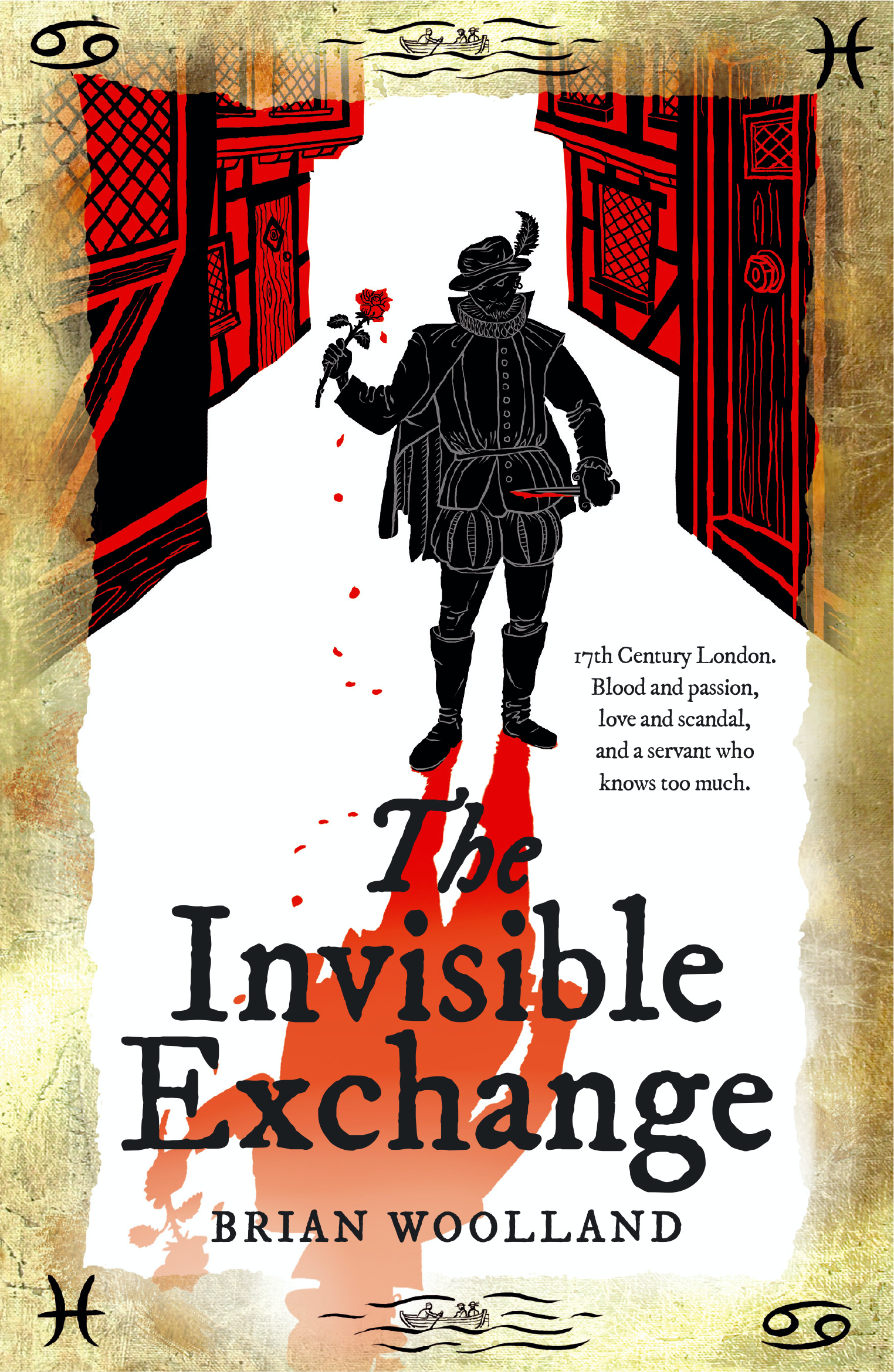

Working with Border Crossings

I first met Michael Walling in 1996 at a conference at Reading University, Ben Jonson and Theatre, where Michael had been invited to lead a workshop on Jonson’s Poetaster. Since then we have worked together in several different capacities. We’ve established a warm friendship and a working relationship that has been very productive. I readily acknowledge that my collaborations with Border Crossings have all been greatly influential on my writing, but this blog is specifically about the evolution of my new novel, The Invisible Exchange (published at the end of July 2022), and how working with Border Crossings has been so significant in its development.

I’ve written three plays for Border Crossings – Double Tongue (2001/2002), This Flesh is Mine (2014) , and When Nobody Returns (2016). I also took an active part in The Promised Land project. The development of each of the plays involved extensive research, workshops and discussions – with Michael, the casts and those with interests in the subject matter. The processes of preparing and writing a play might seem very different from writing a historical novel set in the early C17th, but there are surprising similarities.

The historical background to the novel

Frances Howard

I first became aware of the story of Frances Howard at about the time that Michael and I first met, when I was a lecturer in theatre at Reading University, and much of my work was focused on early C17th theatre. Contemporary events are often referred to in plays of the period. Aspects of Frances Howard’s extraordinary story are alluded to (albeit thinly disguised) in several plays of the period – perhaps most notably those by Ben Jonson, Thomas Middleton and John Webster. Frances Howard was the daughter of Lord Thomas Howard (Earl of Suffolk). In 1604, at the age of fourteen, she was married to Robert Devereux, 3rd Earl of Essex, who was about six months younger than her. The arranged marriage was intended as a political reconciliation between two immensely powerful families. But the marriage was a disaster. Despite his inability (or unwillingness) to consummate the marriage, Essex became intensely jealous of his wife’s popularity at court, and he insisted she leave London and live at Chartley Manor, his moated mansion house in Staffordshire, where Mary Queen of Scots had been held under house arrest immediately prior to her execution. Frances was there for much of the summer and early autumn of 1611. 

On 25th September 1613, her marriage was annulled, and thus she became the first Englishwoman to successfully seek her own divorce – but in a deeply misogynist society she paid a terrible price for her fierce intelligence and independent spirit. Two years after marrying her second husband (Viscount Rochester, formerly Robert Carr) she was accused of murdering Sir Thomas Overbury, who had been imprisoned in the Tower of London on a charge of treason. No evidence was produced at her trial which would stand up in a modern law court, and she was not permitted to defend herself despite having to suffer a stream of damning accusations which amounted to little more than malicious libels. The central argument against her was that she was a ‘creature of the deed’ – meaning that if she dared to initiate her own divorce proceedings, then she must be capable of murder.

The story fascinated me for numerous reasons. Frances’s trial revealed so much – not only about misogyny, but also about corruption at the heart of the Stuart court. I was intrigued by the parallels with our so-called ‘modern’ times. Frances was treated as a femme fatale who was branded by her prosecutor as so evil that she wasn’t allowed to speak in her own defence at her trial. The murder of Sir Thomas Overbury resulted in the execution of four ‘bit-part players’ and the imprisonment Frances and Rochester (by then they had become Earl and Countess of Somerset). Frances pleaded guilty to the charge of murder, though it seems likely that this was a kind of plea-bargaining because by then she and Rochester had a daughter, and the family was allowed to live together in relative comfort in the Tower. That in itself is very strange, for if they had been genuinely guilty of murder they would almost certainly have been executed. After seven years in the Tower, however, they were pardoned by King James, and released.

All of this intrigued me, although I had no idea how I would write a novel about it – until I came across rumours in contemporary pamphlets which referred to persistent rumours that Frances was seen in and around London during the period when Essex kept her under virtual house arrest at his mouldering manor house in Staffordshire. There is no evidence in the historical records that she was spirited out of Chartley, but for me it provoked ‘the big suppose’ that gave me starting point for the novel that became The Invisible Exchange. 

Points of view

When Michael and I first met, we naturally talked about shared interests. One of those interests was the theatre of Ben Jonson. Jonson was a complex man who wore his contradictions proudly. In some ways he was a conservative. In his poetry he often champions the stability of an old order, but in his plays he positions those from the underclasses and in the social margins at the very centre, he gives them real agency and invests them with wit and energy that far surpasses their social ‘superiors’. As Peter Barnes (who also participated in that conference) put it: 'Jonson never writes about Kings and Queens, that whole moth-eaten hierarchy of privilege and incompetence, but about people like us, working people who work to live...' (1). It was exactly those qualities that appealed so much to me and which also attracted me to the work of Border Crossings, for one of the defining characteristics of the company’s work is the desire to give voice to those who have been socially, politically, historically and geographically marginalised.

Although Frances Howard was an aristocrat (her family was said to be one of the wealthiest in the Kingdom) she has been marginalised by the Jacobean ‘justice’ system and by historians until very recently. I was interested in the way the story revealed the ways that institutionalised misogyny vilified and silenced her. (2) I started on a version in which the story was told predominantly from her point of view, but I found that didn’t enable me to reveal the mechanisms of that misogyny. I continued working on the novel in various different versions over many years, setting it aside for long periods while I worked on other projects, then returning to it. It was there in the background while I worked with Border Crossings on the two Homer plays and on The Promised Land project.

The workshops with Zoukak Theatre in Beirut (3) had a profound impact on me, and on the development of This Flesh is Mine. I took a series of early drafts of scenes which I imagined would form the spine of the finished play. As in The Iliad itself, these episodes were predominantly from the point of view of Achilles. In response to those workshops the play changed in many ways. As I wrote in an earlier blog:

Perhaps the most important single change in my thinking was to realise the importance of Briseis in the narrative. She is only mentioned twice in The Iliad – in the opening pages and the final pages. The … ‘spine’ of scenes referred to above… now becomes what is effectively Act One – which is set in an ancient world.  The characters – Achilles, Agamemnon, Briseis, Hecuba, amongst others – continue through to the second act; which is set in a modern world. In Act One, the modern bleeds into the classical; and in Act Two, the classical bleeds through into the modern. And what starts with Achilles as the central character … gradually shifts focus to Briseis and Hecuba. (4)

This Flesh is Mine

The conversations with Michael and with the workshop participants at Zoukak (and at a later stage with the Palestinian actors of Ashtar Theatre) resulted in major changes to the play that became This Flesh is Mine. On a more sub-conscious level, these conversations affected my thinking about the historical novel (which was gently simmering on a back burner at that time). When I returned to working on it, I knew that I needed to use a different narrative voice, to find a central character who would have the potential to engage a reader through an unusual perspective – in short, an equivalent to Briseis. He or she would be an outsider, who had access to the corridors of power, who knew the world of the Jacobean court but was not part of it. I wrote several chapters from the point of view of a gentleman usher. I wrote chapters through the eyes of Frances’s personal maid. But found that their social roles made them too passive. They could observe, but not affect what they saw. I needed a character who could exert more agency. 

And so, after several false starts, I experimented with telling the story through the eyes of a character who had been a relatively minor player in earlier drafts – Matthew Edgworth, a rogue and a fixer who’s employed by Rochester to enable his affair with Frances. Matthew is a fictional character, although the world he inhabits is thoroughly researched. In the novel he talks briefly about how much he learnt from going to the theatres from an early age. I didn’t consciously create him in the tradition of those Jacobean malcontents who breathe such wit and dark energy into some of the plays of the period – for example, Edmund in King Lear, Bosola in The Duchess of Malfi, Flamineo in The White Devil (both by John Webster), De Flores in Middleton and Rowley’s The Changeling – but that is what Matthew became, a cross between a malcontent servant determined to break the glass ceiling and a Jonsonian trickster. As Matthew puts it (for the novel is written in his voice), “I’ve never had my master’s looks but I’m no fuckwit. If a smockfaced page can rise to favour, I too can make my way in the world, even if my scarred face will never decorate the pillows of the powerful.” Matthew’s story began to develop a life of its own. The overweening ambition and ruthless cunning that he’s inherited from his dramatic ancestors drives the novel’s plot, but it also serves an additional function, giving him access to the palaces and grand houses of the aristocracy, as well as the murky underworld of Jacobean London – the taverns, the gambling dens, the brothels and the prisons. 

When Nobody Returns – seeing from inside and outside

Although I cannot identify a specific moment during the development process for When Nobody Returns which is an equivalent to those workshops with Zoukak, it’s clear to me with hindsight that the discussions with Michael and the cast, and with the workshop participants (5) led me to write a play in which each of the three central characters, Telémakhos, Penelope and Odysseus, is in some ways an ‘outsider’. Telémakhos and Penelope have been forced to become outsiders in their own homeland because of the occupation. At the start of the play (and of The Odyssey) Telémakhos is twenty years old, the same age his father was when he left home to fight in the Trojan War. He hears rumours about his father, and is determined to discover the truth about them, so he leaves for mainland Greece to seek out those who knew his father. His identity is bound up with knowing his father, living up to (or living down) the stories he hears about him. When he reaches the court of Menelaus he becomes a stranger in a strange land, and on returning to Ithaka and finally meeting his father, his sense of self, of what is right, of what is necessary to rid the island of the occupation, is profoundly challenged. 

When Nobody Returns

The main character in When Nobody Returns may be Odysseus, but the point of view in the play shifts. We see the occupation of Ithaka through the eyes of Penelope; and, as in Homer, it is Telémakhos’s curiosity that takes him to the court of Menelaus, where he hears stories about his father. Penelope has become an outsider in her own home, and her attempts to subvert the occupation are important – for what they reveal about her strength, and also for what they reveal about the inhumanity of the occupation. Telémakhos is an outsider in search of the ‘inside’ information that will lead him to his father. And his father, Odysseus, is a stranger to himself, struggling to come to terms with his own identity as he battles those demons that still haunt him after his experiences of war. And throughout the play there is a continuing interrogation of what we mean by home – what draws us back, what keeps us away, and what happens when the solid certainties of home become unstable, whether through occupation or trauma.

Thematically, a number of similar concerns run through The Invisible Exchange. Matthew Edgworth is both an insider and an outsider. Like Odysseus, he’s a shape shifter, a master of disguise who can adapt to different social situations; and like Odysseus, he’s renowned for his cunning, but he is a dangerous man; a danger to others, and ultimately a danger to himself. But there are also echoes of Telémakhos in his characterisation. For all his roguish cunning, there’s a softer side to Matthew than the character he seeks to present us with. As Kate (Frances Howard’s maid) says to him: ‘You are not so heartless as you pretend.’ And the relentless curiosity he shares with Telémakhos makes him open to the different cultures he encounters. He’s successful as a trickster because he can use the desires of those he’s gulling against them. But to do that successfully, he has to be an attentive listener and to think as others think As he says about working for Rochester, ‘… the trick of it was to plant the seed, give it time to grow, then be astonished at his razor wit as the seed sprouted and the plan became his own.’ In the course of the novel, he meets four strong, powerful women, each from very different backgrounds: Frances Howard, the aristocrat; Alice, a woman he finds working as a prostitute; Kate, Frances’s personal maid; and Hannah, a cunning woman. He assumes he can manipulate and exploit them. But each of them challenges his certainties. Despite thinking he can work for Frances as well as Rochester, that he can play them off against each other to his own ends, he realises that Frances is ‘as ruthless as any of the men in her family, and far shrewder than her lover or her husband.’ I’ll leave the reader to discover how Matthew is confounded by his dealings with Kate and Hannah. It is, however, important to mention Alice, for her character evolved in response to our experiences of The Promised Land project. Matthew first meets her when he visits a brothel, ‘the House at the Sign of the Vixen in Petticoat Lane. I’d come to see Diego, the broker for the house. He owed me favours.’ Matthew sees a common prostitute. Alice, however, is not what she seems. As she herself says, ‘No matter where you found me, I’m no whore. And I cannot be bought.’ She refuses the easy labels that society assigns to her, and gradually we (and Matthew) discover her history. The large-scale settlement of Huguenot refugees in Spitalfields did not take place until the 1680s. But the persecution of Protestants in France and Holland had started long before that. This novel speculates that some families, such as Alice’s, had already tried to settle in the area in the early seventeenth century. By the time we were working on The Promised Land project, I had begun to make real progress with The Invisible Exchange. But Alice was still a walk-on role. I had always thought of her as intelligent and spirited, but hearing so many stories of real refugees, told with such passion and dignity, I felt compelled to allow Alice a far more significant role in the novel than I had originally conceived. It was the role her story demanded. I conceived of The Invisible Exchange as the first novel in a trilogy. I am currently working on the second, Creatures of the Deed. The character of Alice has now become so important and her story so urgent that the third novel in the trilogy (provisionally entitled The Turbulent Surge) has Alice as the central character and narrator. She will get to tell her story. 

Work that changes us

One of the things I have most enjoyed about working with Michael and with Border Crossings has been the sense that the work we’re doing may be for others, but it changes us. The process itself is always a discovery. Crossing borders – our own as well as those imposed by others (political / social / cultural) – is at the heart of the work. I have been challenged and my work has been enriched by the collaborations. In The Invisible Exchange, Matthew’s attitudes and assumptions are of his time and his place, but he sees possibilities, and he acts on them:

‘I liked the way Hannah thought. Stay alert to possibilities. When Lady Luck smiles, be sure to smile back and accept what she’s offering with good grace, for she’ll turn on you and damn you quick as blink. You see a possibility. You make it happen.’

The Invisible Exchange is now available in paperback from all bookshops, and in all e-book formats from 28th July.

1 Extract from the text of  Peter Barnes’s illustrated lecture on Jonsonian comedy at the Reading Conference on 10th January 1996.


2 David Lindley’s excellent book, The Trials of Frances Howard (Routledge 1993), offers a closely argued and rigorously research analysis of this institutionalised misogyny. 


3 The workshops in Beirut were funded by The British Council. The original intention had been for Border Crossings to co-produce with Zoukak. For logistical reasons that proved impossible. 


4 Michael has also written a blog about the process of working with Zoukak.


5 The key workshops that informed the development of the play took place in Salisbury with young people from military families, and with Palestinians at a summer school held in Jordan under the auspices of the Al Qattan organisation.


Tuesday, December 31, 2019

2019 - at Border Crossings and Beyond

Ino Moxo - ORIGINS Festival
2020 will see Border Crossings reach its 25th anniversary.  During 2019, we've been busier than ever, working to bridge the gaps between cultures and to generate mutual respect and understanding in the globalised world.  The task has never felt more necessary...

In many ways, this has been an extraordinary year for us, packed with incident and excitement.  At the centre of our programme was ORIGINS 2019: our 10th anniversary Festival of First Nations. Launched at the British Museum back in March with a compelling performance by Indigenous Australian musician Eric Avery, the Festival proper covered two packed weeks in June, taking in some of London's most iconic venues and populating them with world-class Indigenous performances.  It was an incredible privilege to present the first ever London showings of Peru's Grupo Integro, with their brilliant, mind-expanding production of INO MOXO at the Southbank - a piece that made time stand still and took the consciousness of the spectator into the visionary space of Ayahuasca ritual.  Equally unforgettable, and historic, was Madeline Sayet's WHERE WE BELONG, particularly when it played the Sam Wanamaker Playhouse at Shakespeare's Globe - placing the Indigenous voice right at the heart of British culture, and offering a completely new view of what that culture may come to mean in the 21st century.  AVA Dance company's NO WOMAN'S LAND at The Place brought Inuit culture to the Festival in the charismatic person of Naulaq LeDrew, as well as gaining a UK National Dance Awards Nomination for Avatâra Ayuso.
Where We Belong - ORIGINS Festival
I was also thrilled with the Festival's programme of Participation and Learning - in some ways the fullest yet, with brian solomon//ELECTRIC MOOSE creating a new dance piece with community dancers and a youth orchestra from the North Kensington community.  WESTWAY SOLSTICE, performed on three summer evenings in sight of Grenfell Tower, offered vitality, hope and energy for our communities and our youth.
Westway Solstice - ORIGINS Festival
Our ORIGINS participation work from the 2017 Festival had an ongoing life this year too, when the photographic exhibition POCAHONTAS AND AFTER visited St Andrews.  Word of that project has spread...   it's put us in touch with the Powhatan nation themselves.  Two of their Chiefs honoured us with their presence at the ORIGINS opening, and I've since visited them in Virginia, accompanied by Madeline Sayet, to explore the possibility of making a new play together...   Watch this space!

The year has also seen us working on a number of collaborative projects across Europe, three of them funded by the EU's Erasmus + programme. In the spring, we co-produced UNDER THE WHALEBACK with the North Frisian Theatre - a production hailed as their best work to date!  THE PROMISED LAND, which focused on the role of the arts and culture in making Europe a welcoming space for refugees, saw us undertake two fascinating weeks of exploration and training in Oldenburg and Toulouse, based on museum work and business coaching.  The project came together in the e-book which we published during the summer: it's proved a huge hit across a whole range of sectors, offering a combination of policy frameworks and recommendations, theoretical discussions and practical approaches. The project also led to Brian Woolland's new play DON'T LET THEM TELL YOU STORIES, which we presented as a rehearsed reading in October at Rich Mix.  MORE THAN WORDS, which looks at ways to work with communities who have little knowledge of the local language, reached a key point with a week in Luxembourg, during which we brought together a range of disciplines and approaches to answer a range of framing questions.  The Intellectual Outputs, including a film starring the Italian clown Raffaele Messina and directed by myself, will come out in the spring of 2020!

The spectre of Brexit has inevitably haunted these projects throughout 2019.  Almost every time we worked in Europe, we seemed to be on the edge of a precipice.  There have been many occasions when it has been very likely that our projects would simply stop - cut off, incomplete and futile.  It was a relief that we managed to finish all we had planned in THE PROMISED LAND, and it now seems that the Transition Period will allow MORE THAN WORDS to be completed during 2020.  But that is, at best, a minor gain in the face of a very frightening future.  In 2016, the day after the referendum, we had to welcome a group of European visitors to London.  On Friday 13th December 2019, I was in Southern Italy for a meeting around the MORE THAN WORDS project, and had to explain to our European partners that the election result was the point of no return. As Border Crossings enters its Silver Jubliee Year, it is faced with the prospect of being an international organisation in a nationalist country, an intercultural organisation in a monocultural space, an advocate of reconciliation under a government dedicated to false and divisive imperialist mythologies.  The last few years have been challenging - but the ones ahead will be much, much harder.

We have our strategies, of course.  We have many dear friends and allies.  We are deeply aware that the "hostile environment" makes our work all the more necessary.  You can look forward to some innovative and creative announcements in the coming months. And, most importantly, you can look forward to THE GREAT EXPERIMENT - our new devised play which explores the imperial history on which our country's new mythology of exceptionalism appears to be based. It seems we may have hit the perfect moment for this essential piece of theatre.

I wish you all a year of peace, hope and resilience.  

Thursday, October 10, 2019

Don't Let Them Tell You Stories

The Calais Jungle.  Photo: Jamie Wiseman
DON'T LET THEM TELL YOU STORIES is a new play by Brian Woolland, who wrote THE PLAYS OF LOVE AND WAR.  During 2017-19, Brian took part in our project THE PROMISED LAND, looking at the situation of refugees across Europe and Turkey.

The play, written in response, is being given a rehearsed reading at Rich Mix on October 11th at 6.30pm.  The cast is Rachid Sabitri, Olivia Darnley, Ross Hatt, Peyvand Sadeghian and David Furlong, directed by Michael Walling.

Click here for full details - it's free!

Brian Woolland writes:

Whilst participating in THE PROMISED LAND project, I was privileged to have many remarkable conversations with young people recently arrived in Europe from Syria, Iraq, Iran, Nigeria and Mali; conversations which were illuminating, inspirational and deeply challenging to many of my own preconceived notions about 'refugees'.
This play is a response to the project and to those conversations. As the project developed it became increasingly evident that all talk about migration and immigration in simplistic numerical terms is a denial of humanity – of theirs (whoever they might be) and of our own. The play also aims to address the assumption that by creating borders and building walls we can pretend that what’s on the other side is not our concern, not part of our world.
The play is not a documentary drama, and certainly not verbatim theatre, but it does draw heavily on conversations with participants in the project, including those refugees we met in Adana, Bologna, London, Oldenburg and Toulouse. 
I would like to thank all who participated in every way in THE PROMISED LAND project. I am particularly grateful to Micaela Casalboni and Nicola Bonazzi of Teatro dell’ Argine (Bologna) for their richly insightful conversations and inspirational theatre company. And above all to Michael Walling of Border Crossings, for asking me to take part in the project, for our continuing conversations and for organising this rehearsed reading. 

Sunday, April 07, 2019

The Promised Land - A Week in Oldenburg

At the Migration Centre, Oldenburg
Artistic Director Michael Walling reports on THE PROMISED LAND week in Oldenburg:

We spent a lot of time talking about the Shoah.  If you are in Germany, and you’re dealing with questions of cultural diversity, cultural conflict and the presence of the “Other”, then that is to be expected. If you’re also talking about the role of museums, then it becomes inevitable.  German museums, and the German cultural sector more widely, have a crucial role as the guardians of this “cultural memory”.  Holding history and educating society about it, they are charged with ensuring that nothing like the Shoah ever happens again.

This is very important in understanding why Germany has been so exemplary in its response to the (so-called) “refugee crisis” of 2015, and the presence of so many new citizens in its cities since that time.  A highlight of our week in Oldenburg was a visit to the city’s Migrationcenter – a space where refugees were able to learn skills and language in a positive, supportive and well-equipped environment, mentored by experts, with the real expectation of a place in the job market.  We met people on the way to becoming painters, carpenters, metalworkers, dressmakers, hairdressers, warehouse managers, gardeners and cooks.  The Centre Manager explained to me that the German government asked her to justify their funding on the basis of how many people were placed in jobs after training.  It makes perfect sense: invest in new citizens when they arrive so that they come to be contributors to the social and economic space.  It saves a lot of benefit costs and a lot of psychological pain.

The contrast with other countries we have seen during THE PROMISED LAND is very marked.  In the UK, asylum seekers are still not allowed to work, or even to be formally educated or trained.  In Italy, where the situation had seemed a little more positive only a year ago, migrants are now being demonised.  The Reception Centre Opera Padre Marella, which we visited in Bologna, has been told to close by the end of the month.  The young men who were living there will become homeless: Micaela from Teatro dell’Argine tells me that many are simply disappearing into a growing sub-culture, and will no doubt be condemned as morally degenerate when they turn to crime because they have no other way to feed themselves.  In Turkey, where the situation is particularly difficult because of the country’s position as a holding place on the periphery of Europe, we saw Syrians being caricatured as terrorists by Turkish students, even when they were in the same room.  France, where we will be working next, seems as hostile as ever to the presence of minority cultures.

Germany is different BECAUSE of cultural memory.  There is a deep desire to be international and open, a clear moral sense of the danger that comes with “Othering” people from different countries and cultural backgrounds.  If anything proves the constantly reiterated point made by the project team - that the problems faced in Europe around migration are essentially cultural problems in the host population - then it is this.  In a society that recalls with pain and shame what happened when other people were labelled as alien, when it cast itself as culturally and racially superior, then that space of remembrance becomes ready for acceptance and peaceful co-existence.

Of course, Germany is no Utopia.  There are clear economic pressures, and the threat of the AfD is very real.  I found it disturbing that the refugees should themselves be the subject of programmes against anti-Semitism, because they come from Arab countries where there is an understandable objection to Israeli policy towards the Palestinian people.  To subject these traumatised people to images of mass graves in concentration camps is not best practice in cultural education.  But it was heartening to see at IBIS, a refugee organisation we visited, that refugees were being offered specific training in how to counter the threat of the radical right.

Exploring the relationship between Germany’s horror at its own history and the open culture that characterises its present, I perceive an extraordinary contrast with the woeful inadequacy of historical understanding in other European countries.   Germany looks back on the Third Reich with shame: but in France, Italy, Turkey and the UK, an assertive imperial past is still regarded as a matter of pride.  Much of the Brexit discourse has been around Britain being “a great country”, which still seems to regard its past global hegemony as a civilising mission.  Our museum sector and our cultural sector need to learn from Germany: we have to reassess our imperial past for what it was – a plundering of global resources, both material and human, which has resulted in the grotesque inequalities that blight the world today.  We have to confront the systematic massacres of indigenous peoples in Australia, North America and sub-Saharan Africa, the uprooting of people from their lands and the psychological wrecking of their languages and cultures.  We have to get past the comfortable lie that the Shoah was a uniquely evil event in human history.  It was conducted on an industrial scale that was indeed unique – but the underlying urge to destroy those regarded as inferior is common to the imperial projects initiated by European societies across many centuries: projects of which many nations are still taught to be proud.  We have to develop a cultural sector and a museum sector that is inclusive and honest about history: that is what will equip us to deal with the huge dangers of the present.

So it was good that we talked a lot about the Shoah during our week in Germany.  But, at the same time, I felt that the museums we saw were not applying the same sense of cultural responsibility to the present.  We saw an outreach project at Oldenburg Castle, where a group of migrant women had responded artistically to the building, with some really challenging insights – but their work was not incorporated into the narrative of the museum itself.  The Castle retained its identity as the legacy of a “great man” from the 17th century – there was no sense that it might have been built or run by people who were less wealthy, who might have been female, and who might even have come from somewhere else.  Migration and the need for inclusion imply a new understanding of local history that relates the specifics of the locality to the international networks and influences that mould such spaces.  We need to link the local and the global – a process towards which European programmes are well placed to contribute.

It’s odd to find myself responding in this way to North German culture.  After all, this is the land of Lutheranism.  It was here that the Bach Passions were created, offering a lasting example of “great art” that is also participatory, “high culture” that is available to the entire community.  But contemporary Germany still seems to harbour a belief in cultural class divisions: a perturbing exclusivity seemed present in the museum spaces that we saw.

This brings me back to our evening at IBIS, and our morning at the Migrationcenter.  In both cases, the refugees themselves showed us the way towards a culture of welcome.  At IBIS, after they had told us about the centre and its work, we all sat down to eat together, and the young refugee men (they were all men) played music.  They danced – and we danced.  We danced together.  The music was Middle Eastern, and the dance traditional.  If anyone had felt possessive, then this was their culture, not ours.  But they invited us in, and we participated.  And this led us very easily towards the important conversations, to the human stories, to the empathy that makes for acceptance.  One young man told me about his journey across a European border in the back of a van with 38 others crammed into a tiny space, unable to breathe. He talked about kicking the door down, about old people and children collapsing at the roadside, about the driver running away.  Another man talked about an ISIS massacre, and the murder of his grandmother.  They told us this because they wanted us to know, and because they were at ease to speak.  A sharing of culture had facilitated this profound exchange of truth – this most basic necessity for social cohesion and functional democracy.

At the Migrationcenter, we were also invited to participate.  The refugees asked us to plant flowers in their garden to mark our visit, and to write messages on the eye-shaped symbols they had carved, which were then mounted on sticks as an art installation outside the centre.  I found it very moving that this should happen – that it should be them who welcomed us, and not the other way round.  That it was they who drew off collaborative artistic practice to make sense of our presence in what had become their space.

Here is what I wrote on the eye:
The Eye is the Beginning.
Before we can encounter another person
chat with them
eat with them
work with them
vote for them
love them
first we must see them. 
In this symbol, the most basic and necessary act of welcome:
You Are Here.  We See You.

Tuesday, December 04, 2018

Clown

Raffaele Messina
The Clown is radical.  In a space of violence and despair, the Clown makes the outrageous gesture of spontaneous joy.  In the space of pain, suspicion and mistrust, the Clown offers vulnerability and empathy, the healing contact of the compassionate, unbroken gaze.  
 
In 2002, a group of Clowns, led by Patch Adams, went into Kabul to confront the violence unleashed across Afghanistan by George W. Bush and his allies.  The film of their journey is astonishing: it is also deeply upsetting.  In one sequence, a young child is treated for the most horrifying skin injuries.  Among the doctors, offering presence, openness and care, there is a figure in a red nose, holding a balloon.  
 
Earlier this year, as part of THE PROMISED LAND project, we spent a morning with the remarkable organisation Clowns Without Borders, who have been working regularly amongst the refugees across Europe and the Middle East.  To Sam Holdsworth, who runs the UK branch, the presence of the Clown at the moment of arrival is of huge importance in establishing the potential for welcome and moving forward.  As somebody emerges from the sea, there should not only be food, warmth and medical care: there should also be a very simple, very basic, acknowledgment of common humanity.  Even a joke.  How silly, how apparently insignificant.  How serious, how profound. 

In late November, Lucy, Sinead Emery and I went to Potenza in Southern Italy to work with the wonderful Clown Raffaele Messina as part of the MORE THAN WORDS Erasmus + project.  This project looks at how the arts and cultural sectors can engage communities who have little or no knowledge of the local language.  I had expected the week might concentrate on the Clown as a workshop technique, looking at the training methodology as a means to communication without language.  Instead, Raffaele chose something far more basic – how the Clown can be the face of welcome.  How the Clown can offer a sense of something more important than the labours of language learning or the morass of immigration bureaucracy.  How the Clown can be the bridge between people.
Lucy clowns for the locals
As a result, the week felt almost Grotowski-like in its concentration on the self.  We worked on openness and eye contact, on truly seeing inside the other.  We worked on our animal nature, our instinctiveness, the weight or lightness of our bodies in space.  We worked on emotion, and on how to concentrate that emotion into the tiny mask of the red nose.  I had worked a lot with mask before, and knew its potential to drive one personality from the body and allow another, more elemental being to take possession.  I had observed how the great clowns, like Chaplin, were essentially mask actors.  What I had not been prepared for was the totally transformative power of the red nose – the way in which a tiny piece of leather or plastic can open up a buried self: childlike, hilarious, innocent and raw.  Unleashed in the streets of Materra, the Clowns reached out to locals and to tourists, provoking laughter, tenderness and song.  People responded because they felt no threat.  Only joy.  The radical act of joy. 

Tuesday, October 09, 2018

Bearing Witness

A photo from the Lublin ghetto
In the city of Lublin, in Eastern Poland, in 1992, an avant-garde performance group called NN Theatre was given the use of the city's old Grodzka Gate.  One day an old lady came to see them.  She said she remembered living in the gate as a small child, kept hidden from the outside world.  She had no real knowledge of who she was, and no recollection of her parents.  She did recall that she had been smuggled away, and so she thought that she was probably a Jewish child, who had somehow been protected from the Nazis.

The young Poles who ran the theatre company were astonished and moved.  They had not known about the history of the building they occupied.  It turned out that it had also been known as "the Jewish Gate", and that it led from the old centre of Lublin to what had been the Jewish quarter of the city - an area that the Nazis had completely destroyed.  As a result of this encounter, the theatre company completely changed its course, and set about documenting the Jewish history of their space, so that today it is closer to a museum than a theatre. The Gate still has a performance space, and it is sometimes used - but NN Theatre is now primarily a witness to the horrific history in its locality.  The young man who showed Lucy and myself around the exhibition, and who works with this material every day, was visibly moved by much of what he told us.  To give just one example, there is a series of photographs of a young boy from Lublin during the 1930s - birthdays, holidays and parties - so powerful because they are so ordinary.  The last photograph shows him carefully groomed for his first day at school: it was September 1939.  After that, there is nothing.

The Holocaust hangs like a malignant smog over Poland.  Of the six million Jewish people killed in Europe, three million were Polish. The death camps were almost all in Poland: Auschwitz, Treblinka, Belzec, Sobibor, Chelmno. Lublin's closest camp was Majdanek.  At the start of the war, the city had 120,000 citizens, of whom 43,000 were Jewish.  Almost all of them were killed.

A few days earlier, I had visited the extraordinary Jewish Museum in Warsaw, called POLIN.  In a very different way from the Grodzka Gate, this is also a theatrical experience.  There are actually very few objects in this museum.  Rather, there are spaces to experience, stories to probe, projected imagery and concealed nuggets of text.  There is a reconstructed wooden synagogue of the 18th century, a little cinema screening Yiddish films of the 1920s, a reconstructed Warsaw street.  And, of course, towards the end there is the horrific material on the Holocaust.  In a narrow but high metal tank with rusted walls, there are graphic photos and accounts, on a very intimate scale, of the act of killing.

I found these exhibits almost unbearable - even more than at the Jewish Museum in Berlin.   Much of this emotional power derives from the long and detailed narrative that precedes the Holocaust section.  As POLIN's website explains: "We present 1000 years of Polish-Jewish coexistence, speaking of cooperation, rivalry and conflicts, autonomy, integration and assimilation. While seeking to confront thorny issues, we also bring attention to bright chapters in our common history."  The Jewish presence in Poland has been huge, ever since the early Middle Ages. POLIN makes much of the tolerance initiated by Bolesław III in the early 12th century, and his recognition of the economic advantages that would be brought by Jewish migrations into Poland.  The history is not always one of harmony, but it is one of cultural co-operation - what the EU would call "integration", as opposed to "assimilation".  The Jews remained Jewish and the Christians Christian - but they lived complementary lives.  In the early years of the Second Polish Republic, the centenary of which is being marked this year, the Jewish population was hopeful for a productive intercultural future.  "Fate has joined us with the Polish people for good", wrote Sholem Asch in his 1928 book Haynt (Today), "and our wishes and hopes belong to both nations, to one road, to a common bright future."

Both museums, in very different ways, offer narratives of hope, of peaceful coexistence, of cross-cultural understanding.  Above all, they bear witness to the horror that results from the dehumanising rhetoric of racism.  Why then, I found myself asking, has Poland moved so far to the political right in recent years?  Why has it become so notably intolerant of ethnic and cultural difference?  Why has the arrival of Syrian refugees in Europe triggered such consternation there, seeing the rise of a home-grown fascism?

There are no easy answers to this, of course - but I do wonder whether the pressing need to bear witness to the Shoah might not have had an unintended consequence in shifting the narrative.  Emphasising Polish history as an exemplar of tolerance through its Jewish past might serve to suggest a particularly deep relationship between a Polish society largely defined by its Catholicism, and a Jewish society also defined by a religion which shares many of the same scriptural roots.  The profound horror of the Polish experience under Nazi occupation might lead to a very understandable reluctance to criticise the state of Israel, with its foundation myth so rooted in the Shoah.  If modern Poland (and other countries in modern Europe) remains traumatised by the events of the early 1940s, then that may be one reason for the deep suspicion displayed towards Islamic cultures and people.  The Israeli state has a tendency to cast itself as a victim of Islamic aggression, and terror attacks by Islamist groups have helped feed the idea of a Judeo-Christian Euro-American world under assault from this inimical "Other".  A society that defines itself by its Catholic religion and its history of coexistence with Jewish people is very likely to be suspicious of Muslim migrations.

The witness that is borne to the Shoah is essential, of course - and so is the narrative of Polish and Jewish coexistence.  But we need to look for other narratives too.  Perhaps we need to bear witness to the remarkable policies of religious and cultural multiplicity practised under the Ottoman Empire.  Perhaps we need to revisit the dynamic and vibrant culture of Moorish Spain, where Christian, Jewish and Muslim scholars and artists engaged in profound and productive cultural exchange.

Museums, theatres...  we have work to do.

Saturday, June 02, 2018

With Teatro dell'Argine in Bologna


It was Friday afternoon in Bologna’s Contemporary Art Museum, MAMbo.  We were clustered around a pair of huge photographs – an artwork by the Albanian migrant artist Adrian Paci, who now lives in Italy.   Francesca, the facilitator, was asking us to describe what we saw.  Some people commented on the huge effort the artist (whose photographic artwork is a self-portrait) was making to carry the inverted roof on his back.  Some mentioned the pain that must result from the rope that tied it around him.  Others mentioned the strange coldness of the studio space which held him, and others again his near-nudity.  “He’s wearing a diaper,” commented Ann Birot-Salsbury, with a characteristic combination of American directness and European irony.  Slowly we began to reach towards more nuanced and informed, but also more subjective responses.  Wasn’t Bologna full of images in which near naked, bearded men in “diapers” were shown as suffering?  Was the shape of the inverted roof like the wings of an angel?  Or of Icarus?  If this was Icarus, in what sense might he be flying too near to the sun?  Were the photographs perhaps an allegory of the refugee situation in Italy – a man carries his home on his back, tied to him like cultural baggage – and flies too close to a perceived source of light and energy.  None of these responses was “right” or “wrong” – and they said as much about the people making them as they did about the artwork.

This approach, Francesca explained, was the way she engaged groups of learners - whether those were schoolchildren, students, migrants or refugees – with the museum’s collections.  She then led us into the next stage of her workshop process, asking each of us to create through drawing and writing a “suitcase” that we would carry with us on a metaphorical journey – a case that contained an object, a memory, a place, a person and a meal.  Given that we had been thinking about and talking to refugees all week, the exercise proved astonishingly challenging and moving.  It was not simply an exercise in constructing a personal or cultural self, a sense of identity: it was also an exercise about loss.  In choosing what (or who) to take on a voyage, you are forced to contemplate how much you will leave behind.

This brilliant and simple workshop, based on visual art, exemplified what for me is emerging as the strongest element in THE PROMISED LAND project – the need to develop a pedagogy that recognises and embraces subjectivity and viewpoint as necessary and productive attributes of cultural difference; and so celebrates learning as a creative process, which unlocks and reveals new ideas beyond the existing knowledge of either the learner or the facilitator.  This approach was not only seen in Francesca’s workshop, but also through the working practice of our host organisation in Bologna, Teatro dell’Argine, whose development of drama through games and improvisation ran as a constant thread through the training week.  I particularly responded to a game in which the participants were given a hoop, which was used as a mobile window: the person holding the hoop at any moment “seeing” something through it, and responding to it with words, movements and sounds that are followed by the rest of the group in chorus.  On the Thursday evening, we were able to see the developing outcomes of such practice, when we attended a rehearsal of a new production based on the myth of the Tower of Babel, performed by Argine’s ESODI group of young people, which includes a high proportion of refugees and migrants.  The extraordinary levels of openness and trust which the company had unlocked in these insecure and potentially traumatised young people was a joy to behold: the sense of welcome and safety in the room extended to us, as a group of outsiders, accepted into their warm-up games with eye contact, physical contact and deep emotional warmth.  This combination of playfulness and trust was the key to the creative energy we witnessed and experienced that evening.

These thoughts were given focus through the brilliant framing talk we were given by Simona Bodo.  Developing the ideas behind the MAMbo workshop (which she attended with us as a participant), Simona suggested an antithesis between a culture of CONSERVATION and one of CONVERSATION – with the implication that European cultural and educational institutions need to respond to the changing demographics of the populations they serve by making a shift away from a paradigm that privileges the preservation and passing on of existing knowledge and towards one that uses culture as a resource for creative interaction.  HERITAGE, she suggested, needs to be questioned as a concept: it suggests that history and culture are somehow owned by virtue of birth, whereas the current moment of post-coloniality, cosmopolitanism and mass migrations suggests a need to engage in the global interconnectivity of cultural production, of the art and artefacts held in museums, of the texts and myths that become contested spaces in the dynamic theatre of the 21st century.  If we discard HERITAGE and embrace HISTORY as narrative, process and conversation, then we are opening ourselves to learning, to dynamism and to democracy in its fullest sense.

Simona Bodo’s talk also drew off the work of Naomi Klein in relation to the rhetoric of crisis.  To portray something as a crisis, argues Klein, permits the holders of the narrative (particularly governments) to ignore underlying and ongoing causalities, to suspend legal and moral obligations, and to generate a climate of fear and hatred.  This echoed the words of Chiara De Carlo, who works with the refugees living at Opera Padre Marella (OPM).   In Italy, she told us, the rhetoric of a “refugee crisis” has been employed to shift policy and undermine legal process, effectively denying refugees their human rights as defined in the Universal Declaration 1948, and (specifically to refugees) the Geneva Convention 1951.  That sounds very abstract and legalistic – but when talking to Paul (name changed to protect identity), a young man from Nigeria living at OPM, it became a flesh and blood reality.  Paul had been a professional football player in his home country, but had fled after a violent event, possibly involving the deaths of his parents, had traumatised him (1).  He crossed the Sahara, and came to Italy on an over-crowded boat.  In a way he was one of the lucky ones – he was housed in a caring and nurturing home at OPM, and had the chance to act with ESODI and to play football.  But he had also experienced racism and violence around the game, and, after two years, he is no further down the path of acquiring refugee status or knowing whether he will be able to remain in Europe. 

Paul is being held in a limbo outside social narrative or cultural engagement.  
He is being objectified – not empowered. 
Conserved – not conversed with.  
He is not a statistic in a crisis, but a young man who has experienced deep suffering and loss.
He is also resilient, determined and moral.  
Our European societies can only benefit from honouring the contribution he can make.  
*
I wrote this piece as a report for our steering group on THE PROMISED LAND - and there will be more about the week on the project blog soon, from the viewpoint of one of our German partners.  But I felt I needed to publish this today, in the light of the news from Italy.  The President may have prevented the populist parties from appointing a Finance Minister who wants to leave the Euro - he has not intervened to stop the appointment of an Interior Minister who wants to deport asylum seekers and migrants.  Matteo Salvini's declared intention to deport 500,000 "illegal" migrants presents an immediate threat to people like Paul, whose cases have not been decided, and whose well-being, safety, possibly even lives, are in great danger if they are returned to what Salvini terms "home".  The policy is in clear breach of the Geneva Convention, and it is essential that the international community, particularly the EU, insist on the rule of law.  

(1) I should point out that this information was offered spontaneously by Paul in conversation with two of us, and was not elicited in any way.

Wednesday, February 07, 2018

The Promised Land - Adana. Guest Blog by Eleanor Brown (CARAS)

Lucy Dunkerley meets Syrian women in Adana 
After a week spent in Adana, Turkey, it’s time to distil some thoughts. It was the beginning of a two year Erasmus + project led by the remarkable theatre company, Border Crossings. CARAS has had a long-term partnership with them, sharing skills, experience and enthusiasm for working with people from all over the world. During January, I went with them as a volunteer, exploring the situation for Syrian refugees who have crossed the Turkish border, and considering ways to place that within a wider context.

Adana is a beautiful place - a golden yellow train station standing in a square surrounded by fluttering flags strung between lampposts and date palms, orange trees heavy with fruit lining every street, poinsettias grown to glorious shrubs showing off their deep red foliage and putting Christmas window-sill versions to shame; streets that fill with the smell of grilled aubergine and kebap as night falls, hookah cafes with apple scented tobacco smoke on the air; and mosques dating back to the 1500s, calls to prayer rolling and echoing between Turkish delight shops, market stalls, and clouds of swooping pigeons. There are shops with stacks of functional, everyday pottery; baskets of herbs; furniture makers; and street cats galore. There’s a great, turquoise river that curves through it all, and a back drop of snow-capped mountains towering in the near distance. It feels like the sort of place that gets on with things without much fuss.

We were a group of academics, business people, theatre practitioners, educators, writers, students and NGO workers, all sharing our understanding and experience of the current refugee crisis. During our time together we began to understand the specific legal context of Turkey, the migration routes of refugees to Turkey and beyond, and to think deeply about how we each respond to the opportunities and challenges this brings.

Finding shared ground with refugees wasn’t hard: swapping plant names with Kurdish park gardeners (poinsettia is ‘Attaturk çiçeği’, orange is ‘portakal’, and crocus is ‘çiğdem’); talking to Bushra, a young Syrian woman striving to learn Turkish to pass the entrance exam to university, who declared a love of Shakespeare; and meeting Fatima, a shy three-year-old who liked counting and loved her dad. These are the ordinary, exceptional people who become refugees, bounced between systems that are confusingly complex and disempowering, navigating an unplanned new path, and hoping for home.

In the NGOs ‘Association for Solidarity with Asylum Seekers and Migrants’ and ‘Support to Life’ we heard stories about the current situation: informal tent settlements dotted throughout the city, the challenges of supporting a transient population making a meagre living through migrant agricultural labour, tension between local and new populations and concern about rising costs of living for all, and the challenges of supporting children traumatised by spending their early years in a war. Amongst workers, there were familiar narratives of resilience and hope finding their way through a context of limited resources and restricted options, and a drive to raise awareness and bring about change with compassion, hard work, and front-line action.

Coming back to London and life at CARAS helps to create a wider context. In Turkey, we were with people at the start of one of the world’s huge forced migration routes. Many Syrians will remain in Turkey under temporary protection, and some might seek citizenship eventually, but for others their migration will continue. Some will be granted third-country resettlement in EU nations, some will ultimately consider it safe enough to return home, and others will make their own way via informal networks through Europe to reach a place that feels safe to them; others still will achieve their ambitions, gaining well paid employment and opening up opportunities again: Abdullah wants to continue his medical studies and be a heart surgeon, Burhan is an engineer, and Roshan is aiming to continue her career as a researcher in biochemistry.

Crossing the vast distance that is Turkey by air, seeing snowing mountains and plains, patchworked fields, a blue expanse of coast dotted with islands, rivers and power-stations, hilltop wind-farms, tiny villages and the great metropolis that is Istanbul brought home just how far people flee in order to feel safe. It’s not just Syrians crossing into neighbouring countries, but Afghans embarking on enormous overland journeys, sub-Saharan Africans crossing the harsh expanses of desert and the treacherous Mediterranean sea, everyone driven by fear and nurturing an aspiration to reach a place that allows them to live freely and safely.

People we meet in London are sometimes at the end of their journey, although some will have applications refused and will continue to be moved. The context in the UK is very different too- we are not experiencing a mass humanitarian crisis on the scale that Turkey, Lebanon, Jordan, Italy and Greece are. But we are working with the same human needs for connection, advice, access to support, and recognition of trauma and the ongoing impacts of forced migration. We face similar myths and stigma about asylum seekers being given better support than others (have a look at these for some myth-busting: asylum accomdation and asylum support payment report), and an ‘othering’ of refugees that prevents people meeting connecting on a human level.

As this project continues, there will be time to consider alternative responses, how we work together across sectors and throughout the EU, and to deepen our understanding of a whole host of human experiences. Stay with us. Follow the story. Next stop: Bologna.

Read more on the dedicated PROMISED LAND blog.