Showing posts with label mahabharata. Show all posts

Tuesday, July 05, 2022

Peter Brook


Peter Brook: 1925-2022 

"In a dishonourable age it is challenging and stimulating to be reminded of finer attitudes. Each person can measure himself and see what he would most essentially respect when he is faced by a level of behaviour that is more dedicated, goes further than his own....  When somebody reaches a certain very high level he becomes so close to truth that he is incapable of speaking anything other than the truth."  (Peter Brook)

When Peter Brook said this, he was talking about the ideas behind Mahabharata, which he famously staged in the 1980s, but his words apply just as powerfully to his own long life, which has now ended at the magnificent age of 97. I feel rather ashamed that, as long ago as 1995, I was quoted in The Deccan Herald as admiring his professional longevity, still directing in his early 70s. Nearly 30 years later, he still hadn't stopped. Of course he hadn't. Brook could no more stop directing theatre than a Zen master can retire from meditation: it wasn't a job, but a way of being. Only a few months ago, he was directing our friend and collaborator Ery Nzaramba as Prospero in his Tempest Project, with not a hint of any sentimental and wistful self-portraiture about "the farewell to the theatre".  All the same, I like the fact that The Tempest should have been his final piece: a great text about theatre, colonialism, freedom, cultural difference, magic and the spirit.  These were the subjects that dominated his work.  
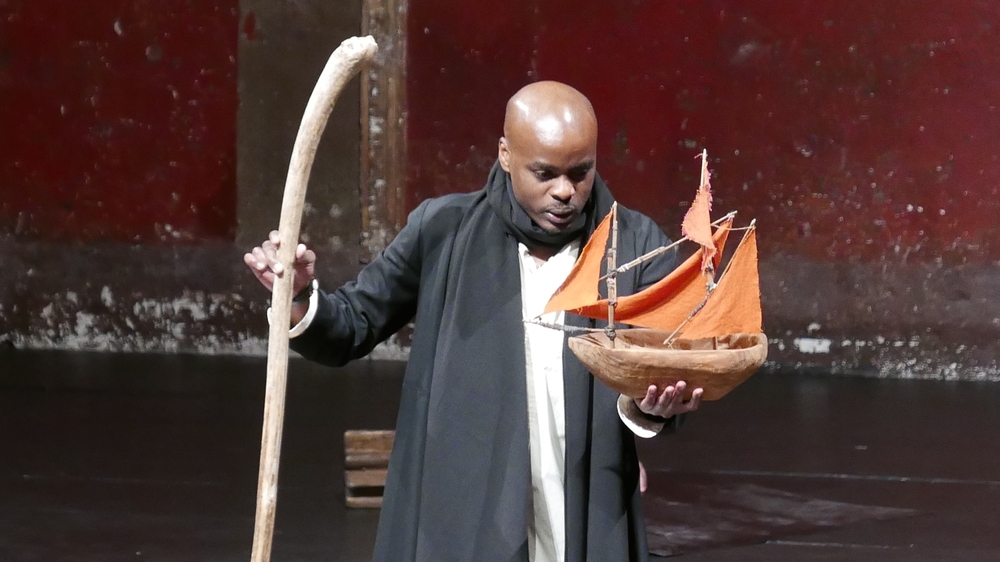
Ery Nzaramba as Prospero

I first became aware of Brook as a teenager, when I picked up a copy of Charles Marowitz and Simon Trussler's Theatre at Work for 30p in a library sale.  I was fascinated to read about his open, free approach to rehearsal and his quest to unlock the secrets in the actors' souls, particularly in his Artaud-inspired Theatre of Cruelty season.  I tried out some of the more outlandish exercises on some hapless sixth-formers who had agreed to act in a piece I wanted to do during the summer holidays; but I never really understood them until Alaknanda Samarth and I recorded Artaud's Theatre and the Plague during the 2020 lockdown.  At the heart of Artaud, and of Brook, there is a spiritual longing - and the cruelty is to do with the barriers our society has put between us and our spiritual truth. Our work, our battle, is to penetrate these barriers - or to cross these borders, I suppose...  

I think this is the reason Brook, from the 70s onwards, took on an intercultural approach to theatre-making, turning his back on the British mainstream to work from the Bouffes du Nord in Paris with a shifting ensemble of international artists.  
"Today" he wrote in There Are No Secrets, "the world offers us new possibilities...  Nothing is more vital to the theatre culture of the world than the working together of artists from different races and backgrounds." (p.94)

Of course I agree. And I remain deeply grateful to Brook for having pioneered intercultural performance as an ideal, and as a necessary response to the post-colonial globalised moment. At the same time, I feel wary of some of what he was trying to achieve (and indeed, did achieve) through cross-cultural collaboration. Mahabharata was a revelation to me in the 80s, when I hadn't even heard of the great poem, but it was also, as Rustom Bharucha famously showed, a diminution of the Indian myth filtered through the lens of Western tragedy, both Shakespearean and Biblical. Brook's engagement with non-Western cultures could often seem exotic and romanticised, as if their raison d'être was to serve as a correctional mirror for the decadent West.  For example, in 1989 he told Véronique Hotte: 

"In Third World countries, which are at heart 'traditional', tradition offers a defence against confusion and chaos, against modern life and its formlessness.  This kind of tradition generates very pure currents which give meaning to life."  (David Williams:Peter Brook - A Theatrical Casebook. p.404)

For all his desire to engage with artists from a range of cultural backgrounds, it was not the culture itself that interested Brook, but the desire to move beyond culture to some supposed "human essence", something that he regarded as "universal".  The truth is that this is impossible: any theatrical endeavour requires the use of language, gesture, colour, music, all of which carry specific cultural meanings. The "universal" often looked uncomfortably like Western culture being read onto non-Western bodies. For me, Brook's work was most potent when it acknowledged the semiotics of the body and of distinct cultures, when the performers drew off their differences rather than their similarities. I recall his wonderful production of the South African anti-apartheid play Sizwe Bansi is Dead at the Pit - or the extraordinary scream of Rwandan actor Carole Karemer in Battlefield, which so clearly drew off the recent past of her people. I think of Mallika Sarabhai as Draupadi in Mahabharata - the only Indian in the cast, and so the central symbol of integrity. I think of Mozart's score, so emphatically European, holding together his gentle and thoughtful Magic Flute. 

The Mahabharata, directed by Peter Brook

It's good to disagree with your teachers, of course: that is how the world and the art form move on. And Peter Brook was a great teacher. Think of all the ideas that underlie modern theatre practice, and how many of them are his: the Empty Space, the Holy Theatre, the Rough Theatre...  His books, which articulate his unending search for the form of theatre and its meaning, will continue to inspire theatre-makers for generations.  

The last of these, Playing By Ear, was published as recently as 2019, and is a meditation on sound and music.  It also, therefore, deals with silence - and the centrality of real silence to any profound theatrical or  spiritual practice.  At the end of this last book, Peter Brook wrote:
"Once, in the Sahara, I climbed up a dune and, looking down, saw that the hollow in front of me was very deep.  I slithered down the sandy wall, and when I reached the bottom I was completely isolated from the desert, and all its tiny sounds had vanished.  There, for the first time, I actually experienced the living presence of total silence....  A touching old English saying arises in my mind: 'Words fail me'.  So this is the moment to end. The most precious thing is: 'Keep Silence.'" (p.138-9)

Wednesday, February 10, 2016

Brook's Battlefield

Battlefield: Ezy Nzaramba
The late Pierre Boulez, David Attenborough and Peter Brook all seem to be proving it: 90 is the age to be.  Many cultures have known for a long time that we need to value our Elders - at last the West seems to be catching up.  And Brook's production Battlefield, created at the age of 90, is actually his finest work for some time.

It's a return to the territory of his famous Mahabharata production - although where that was epic and vast, this is intimate, brief and personal.  This seems to me to offset some of the criticisms Rustom Bharucha made of Mahabharata: unlike the earlier production, Battlefield does not turn the Hindu myth into a Hollywood blockbuster or a Shakespearean tragedy.  Rather, it makes it the occasion for contemplation, introspection, and a complex emotional journey.  The play begins after the climax of Mahabharata, the great war, and deals with the question Eliot asked of the contemporary age: "After such knowledge, what forgiveness?"

It is an urgent, necessary question for an artist to be asking at the end of his life, in what may well be his last piece of work.  In many ways, the play embodies that sense of an unending quest, with older characters attempting to make sense of the world they are about to leave.  Bhishma, who can only die with his own agreement, clings to life in the face of a mortal wound, speaking of how a dying man can long for honey.  When at last he leaves his body, in a moment of extraordinary theatrical simplicity and  power, it is his mother, the River goddess Ganga, who expresses a terrifying, astonishing grief.

I'm making it all sound quite heavy - but actually the play is full of humour too, with Bhishma and other characters telling parables, which are winningly enacted using only cloths and sticks for set and props.  The story of the worm crossing the road who loves his life is at once endearing and provocative.

Being Brook, all of this leads towards a spiritual meaning; and, being Hindu, that meaning is essentially one of resignation.  Yudishtira, left to rule in the aftermath of the war, comes to accept the suffering that has gone before, recognising it as yet another "illusion" (the Sanskrit term is Maya).  Both Michael Billington and Aleks Sierz have challenged this in their reviews of the production, asking whether we can really accept (say) the suffering of the Syrian refugees as something of no real consequence.  This dismissal of human pain could seem particularly callous in relation to the play, given the presence of Rwandan performer Carole Karemera at its heart.  Hinduism can be criticised for its acquiescence in human suffering, partly the result of its cultural origins in India, and its role in the maintenance of power structures.  However, in absolute terms, the theology is right - human lives are tiny, inconsequential things in terms of the scale of space and time, of course they are.  But, as Sartre argued, that doesn't mean we should not care about them - it simply means we have to acknowledge that it is our own decision to choose morality, and that the compassion we feel for the Syrian child or the Rwandan widow is our own compassion, willed and active.  Strangely, this makes our humanity more significant, rather than less.  It is Carole Karemera who gives expression to this deep grief in our condition, through the prolonged wail of the bereaved mother-goddess.