Showing posts with label rwanda. Show all posts

Monday, April 24, 2023

Hate News

Hate Radio

I became very interested in Milo Rau's theatre-making during the lockdowns, when I was able to see several of his pieces online. Lenin, The Last Days of the Ceausescus, La Reprise, Orestes in Mosul, The New Gospel...  all very remarkable.  And I read the text of Compassion - The History of the Machine Gun too.  Wish I'd seen it. But online theatre only goes so far, and the experience of seeing Hate Radio live at BAC last week took my admiration for this extraordinary director to another level. It was terrifying.  

The piece has been described very well in lots of reviews, so I won't go into detail here. For those who want to read more about the show, I particularly recommend this blog by Lily Climenhaga, who like me arrived at the performance from a position of some knowledge, and was perhaps even more stunned by the work as a result.  As Lily explains, the performance is received in a number of distinct ways. You listen to the broadcast from RTLM as the original audience in Rwanda would have done, via your personal radio set with headphones: an experience that is oddly personal and intimate. At the same time, you watch the people who are broadcasting - distanced from you in a perspex box. By contrast with the audio experience, the visual one is cold and detached. You observe the movement of the silent soldier who continually tidies the space and offers snacks and drinks to the presenters. You see the maps and posters with which they surround themselves. You watch them dance along to the pop songs they play, you see the shoulder holster revealed when Kantano Habimana takes off his smart jacket, you suddenly notice the pistol sitting casually on the sound engineer's desk. When Valérie Bemeriki comes close to losing all self-control in one of her diatribes against the "cockroach" Tutsis, you can see her and her fellow presenters "dealing with it" in their various ways during the cheery song that follows - but you can't hear what they're saying. Through this combination of involvement and detachment, the performance at once draws you in to the apparent light entertainment of the radio station, and fills you with horrified fascination at the outpouring of invective that it unleashed. 
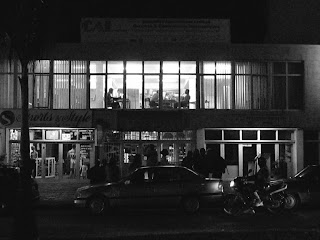
The recreation is detailed. The set was made in response to precise accounts given by Valérie Bemeriki herself when interviewed in prison by Milo Rau and designer Anton Lukas. In 2011, the piece was actually performed in the former RTLM studio in Kigali, with the audience listening on their radios in the street outside, watching the actors through the full-length windows. Lukas took a photograph. 

Hate Radio in Kigali

This hyper-realism is framed by accounts of the genocide itself, based closely on fact but spoken by actors presenting fictional characters on video. The play's last line is spoken by one of these survivors: "When there’s been one genocide then there will be many more." Out of context, this sounds clichéd and trite, but at the end of this performance it is incredibly chilling, because Hate Radio has led you to understand just how easily people can become embroiled in and intoxicated by the rhetoric of extreme violence. 

The performance was perhaps even more telling, even more necessary, in the week when 16 year old Ralph Yarl had been shot in the head by Andrew Lester when he accidentally went to the wrong house in Kansas City's Northland, while trying to pick up his younger brothers. Andrew Lester is an older white man: Ralph Yarl is Black. Lester's grandson Klint Ludwig has given a frank and telling account of how his grandfather has become entangled in the invective and deceit of populist media, particularly Trump's adored Fox News. "He’s become staunchly right-wing, further down the right-wing rabbit hole as far as doing the election-denying conspiracy stuff and COVID conspiracies and disinformation, fully buying into the Fox News, OAN kind of line.” Ludwig says his grandfather had been immersed in “a 24-hour news cycle of fear and paranoia.... It’s stock Fox News, conservative American stuff. It’s ‘anybody who gets an abortion is a murderer.’ And ‘fatherless Black families are the reason why crime exists in this country.’ ”

There's very little distance between Rwanda's Hate Radio and America's Fox News.

Hate Radio

Wednesday, November 02, 2022

Invasions

Paul Coe and Cecil Patten planting the Aboriginal flag on Dover Beach in 1976

On Monday, 31st October 2022, Home Secretary Suella Braverman described the arrival of refugees and migrants in small boats from across the Channel as an "invasion". It was an extraordinary use (or abuse) of language, but one characteristic of post-Brexit Britain, where, as Fintan O'Toole argues in his superb book Heroic Failure, there is a deliberate appropriation of victimhood by the former imperial power. Quite how people who have fled persecution in Iran or Afghanistan, or ongoing civil war in Syria, risking their lives in a small boats because there are no safe legal routes to Britain, can be regarded as "invaders" is beyond belief. How a country that seeks to deport them to Rwanda, a country with a very dubious human rights record, can be regarded as the innocent victim is equally bizarre. 

An invasion, just to be clear, is an act of aggression. It demonstrates an intention to possess the land invaded and to dominate its population.

Of course, the linguistic twist is deliberate. By casting Britain as the victim and the refugees as powerful aggressors, fear is unleashed and prejudice is compounded. The day before Braverman's pronouncement, a right-wing terrorist had attacked a migrant centre in Dover. If the migrants are constructed as aggressors, then his murderous bombing becomes an act of righteous self-defence. It's very dangerous.

There have been, and are, real invasions around the world. The invasion of Ukraine was a real invasion by a powerful state intent on acquiring more territory. The colonial invasions which Britain made against the lands now known as (for example) Australia and Canada were also real invasions. In these cases, however, the prevailing discourse in Britain tends to use terms like "discovery", so as to shift the moral balance. It was an important milestone when the City of Sydney chose to describe Cook's landing as an invasion in its official documentation. Since then, "Australia Day" is frequently referred to as "Invasion Day" by Indigenous activists and their allies, with a hugely different emotional resonance.

A few months ago, we unveiled a plaque on Dover Beach, of all places, to commemorate the actions of Aboriginal activists Paul Coe and Cecil Patten in 1976. Pointing up the illegal and aggressive nature of colonial actions, they staged an "invasion" of Britain, planting their flag on the beach and writing to the Prime Minister to explain that they now ruled his country. It was very funny - and it showed the absurdity of the original colonial claim.  

Here's a link to our video about the "Aboriginal Invasion".  I recommend it to the Home Secretary. 


Wednesday, February 10, 2016

Brook's Battlefield

Battlefield: Ezy Nzaramba
The late Pierre Boulez, David Attenborough and Peter Brook all seem to be proving it: 90 is the age to be.  Many cultures have known for a long time that we need to value our Elders - at last the West seems to be catching up.  And Brook's production Battlefield, created at the age of 90, is actually his finest work for some time.

It's a return to the territory of his famous Mahabharata production - although where that was epic and vast, this is intimate, brief and personal.  This seems to me to offset some of the criticisms Rustom Bharucha made of Mahabharata: unlike the earlier production, Battlefield does not turn the Hindu myth into a Hollywood blockbuster or a Shakespearean tragedy.  Rather, it makes it the occasion for contemplation, introspection, and a complex emotional journey.  The play begins after the climax of Mahabharata, the great war, and deals with the question Eliot asked of the contemporary age: "After such knowledge, what forgiveness?"

It is an urgent, necessary question for an artist to be asking at the end of his life, in what may well be his last piece of work.  In many ways, the play embodies that sense of an unending quest, with older characters attempting to make sense of the world they are about to leave.  Bhishma, who can only die with his own agreement, clings to life in the face of a mortal wound, speaking of how a dying man can long for honey.  When at last he leaves his body, in a moment of extraordinary theatrical simplicity and  power, it is his mother, the River goddess Ganga, who expresses a terrifying, astonishing grief.

I'm making it all sound quite heavy - but actually the play is full of humour too, with Bhishma and other characters telling parables, which are winningly enacted using only cloths and sticks for set and props.  The story of the worm crossing the road who loves his life is at once endearing and provocative.

Being Brook, all of this leads towards a spiritual meaning; and, being Hindu, that meaning is essentially one of resignation.  Yudishtira, left to rule in the aftermath of the war, comes to accept the suffering that has gone before, recognising it as yet another "illusion" (the Sanskrit term is Maya).  Both Michael Billington and Aleks Sierz have challenged this in their reviews of the production, asking whether we can really accept (say) the suffering of the Syrian refugees as something of no real consequence.  This dismissal of human pain could seem particularly callous in relation to the play, given the presence of Rwandan performer Carole Karemera at its heart.  Hinduism can be criticised for its acquiescence in human suffering, partly the result of its cultural origins in India, and its role in the maintenance of power structures.  However, in absolute terms, the theology is right - human lives are tiny, inconsequential things in terms of the scale of space and time, of course they are.  But, as Sartre argued, that doesn't mean we should not care about them - it simply means we have to acknowledge that it is our own decision to choose morality, and that the compassion we feel for the Syrian child or the Rwandan widow is our own compassion, willed and active.  Strangely, this makes our humanity more significant, rather than less.  It is Carole Karemera who gives expression to this deep grief in our condition, through the prolonged wail of the bereaved mother-goddess.

Monday, September 26, 2011

Truth and Reconciliation


debbie tucker green's new play at the Royal Court is a brilliant piece of work. I've always liked her writing - stoning mary was another beautiful play - but this time she combines her characteristic poetic language and provocative stance with an amazing manipulation of space which makes the play speak with great immediacy. When you first enter the room, the audience chairs are distributed around the playing area (theatre-in-the-round, basically). You have to choose where to sit with care. A lot of the chairs have reserved notices on them - often saying things like "Victim's Family" or "Witnesses" - which lead you to believe they will be used in the performance, although in fact many are not. Every chair has the name of a victim from a recent conflict carved onto the seat. The chair I sat on had the name and dates of a little girl from Bosnia, killed in her first decade. It was, to say the least, discomforting. On Friday night, there were also surtitles for the hard of hearing, so another factor around justice and its relationship to where you sit came into play.

What was so exciting about all of this was how it blended into the performance itself. The first line referred to the hardness of the chairs for the families coming to a hearing of the Truth and Reconciliation Commission. The mother of a victim felt unable to sit in the room while she waited for the perpetrators. How people sat in relation to one another, how this reflects power structures and power struggles, became integral to the performance. There's been much talk of the theatricality of such events - and now the links were made explicit, implicating us as an audience in the reality of the political and moral crises under exploration.

Only two characters ever got to sit in the centre of the stage - and they were both ghosts. A Rwandan man and the South African child whose mother refused to take a chair. They were evoked to speak to those who had killed them, those whom they haunted, those who knew exactly how they died. But, even at the centre of the stage, they could not speak directly to those they had left behind and who were desperate for knowledge of them.