Showing posts with label peter brook. Show all posts

Tuesday, July 05, 2022

Peter Brook


Peter Brook: 1925-2022 

"In a dishonourable age it is challenging and stimulating to be reminded of finer attitudes. Each person can measure himself and see what he would most essentially respect when he is faced by a level of behaviour that is more dedicated, goes further than his own....  When somebody reaches a certain very high level he becomes so close to truth that he is incapable of speaking anything other than the truth."  (Peter Brook)

When Peter Brook said this, he was talking about the ideas behind Mahabharata, which he famously staged in the 1980s, but his words apply just as powerfully to his own long life, which has now ended at the magnificent age of 97. I feel rather ashamed that, as long ago as 1995, I was quoted in The Deccan Herald as admiring his professional longevity, still directing in his early 70s. Nearly 30 years later, he still hadn't stopped. Of course he hadn't. Brook could no more stop directing theatre than a Zen master can retire from meditation: it wasn't a job, but a way of being. Only a few months ago, he was directing our friend and collaborator Ery Nzaramba as Prospero in his Tempest Project, with not a hint of any sentimental and wistful self-portraiture about "the farewell to the theatre".  All the same, I like the fact that The Tempest should have been his final piece: a great text about theatre, colonialism, freedom, cultural difference, magic and the spirit.  These were the subjects that dominated his work.  
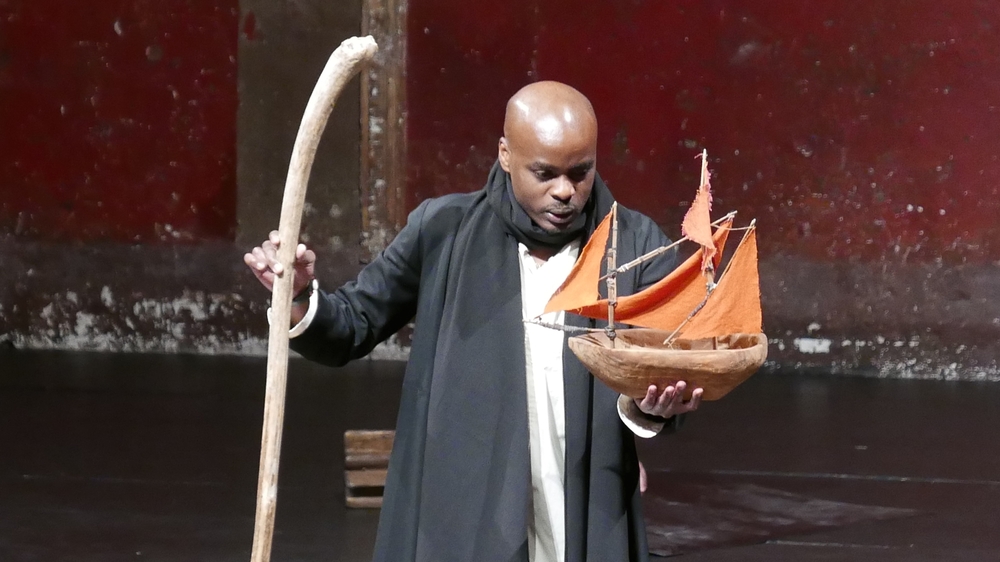
Ery Nzaramba as Prospero

I first became aware of Brook as a teenager, when I picked up a copy of Charles Marowitz and Simon Trussler's Theatre at Work for 30p in a library sale.  I was fascinated to read about his open, free approach to rehearsal and his quest to unlock the secrets in the actors' souls, particularly in his Artaud-inspired Theatre of Cruelty season.  I tried out some of the more outlandish exercises on some hapless sixth-formers who had agreed to act in a piece I wanted to do during the summer holidays; but I never really understood them until Alaknanda Samarth and I recorded Artaud's Theatre and the Plague during the 2020 lockdown.  At the heart of Artaud, and of Brook, there is a spiritual longing - and the cruelty is to do with the barriers our society has put between us and our spiritual truth. Our work, our battle, is to penetrate these barriers - or to cross these borders, I suppose...  

I think this is the reason Brook, from the 70s onwards, took on an intercultural approach to theatre-making, turning his back on the British mainstream to work from the Bouffes du Nord in Paris with a shifting ensemble of international artists.  
"Today" he wrote in There Are No Secrets, "the world offers us new possibilities...  Nothing is more vital to the theatre culture of the world than the working together of artists from different races and backgrounds." (p.94)

Of course I agree. And I remain deeply grateful to Brook for having pioneered intercultural performance as an ideal, and as a necessary response to the post-colonial globalised moment. At the same time, I feel wary of some of what he was trying to achieve (and indeed, did achieve) through cross-cultural collaboration. Mahabharata was a revelation to me in the 80s, when I hadn't even heard of the great poem, but it was also, as Rustom Bharucha famously showed, a diminution of the Indian myth filtered through the lens of Western tragedy, both Shakespearean and Biblical. Brook's engagement with non-Western cultures could often seem exotic and romanticised, as if their raison d'être was to serve as a correctional mirror for the decadent West.  For example, in 1989 he told Véronique Hotte: 

"In Third World countries, which are at heart 'traditional', tradition offers a defence against confusion and chaos, against modern life and its formlessness.  This kind of tradition generates very pure currents which give meaning to life."  (David Williams:Peter Brook - A Theatrical Casebook. p.404)

For all his desire to engage with artists from a range of cultural backgrounds, it was not the culture itself that interested Brook, but the desire to move beyond culture to some supposed "human essence", something that he regarded as "universal".  The truth is that this is impossible: any theatrical endeavour requires the use of language, gesture, colour, music, all of which carry specific cultural meanings. The "universal" often looked uncomfortably like Western culture being read onto non-Western bodies. For me, Brook's work was most potent when it acknowledged the semiotics of the body and of distinct cultures, when the performers drew off their differences rather than their similarities. I recall his wonderful production of the South African anti-apartheid play Sizwe Bansi is Dead at the Pit - or the extraordinary scream of Rwandan actor Carole Karemer in Battlefield, which so clearly drew off the recent past of her people. I think of Mallika Sarabhai as Draupadi in Mahabharata - the only Indian in the cast, and so the central symbol of integrity. I think of Mozart's score, so emphatically European, holding together his gentle and thoughtful Magic Flute

The Mahabharata, directed by Peter Brook

It's good to disagree with your teachers, of course: that is how the world and the art form move on. And Peter Brook was a great teacher. Think of all the ideas that underlie modern theatre practice, and how many of them are his: the Empty Space, the Holy Theatre, the Rough Theatre...  His books, which articulate his unending search for the form of theatre and its meaning, will continue to inspire theatre-makers for generations.  

The last of these, Playing By Ear, was published as recently as 2019, and is a meditation on sound and music.  It also, therefore, deals with silence - and the centrality of real silence to any profound theatrical or  spiritual practice.  At the end of this last book, Peter Brook wrote:
"Once, in the Sahara, I climbed up a dune and, looking down, saw that the hollow in front of me was very deep.  I slithered down the sandy wall, and when I reached the bottom I was completely isolated from the desert, and all its tiny sounds had vanished.  There, for the first time, I actually experienced the living presence of total silence....  A touching old English saying arises in my mind: 'Words fail me'.  So this is the moment to end. The most precious thing is: 'Keep Silence.'" (p.138-9)

Wednesday, February 10, 2016

Brook's Battlefield

Battlefield: Ezy Nzaramba
The late Pierre Boulez, David Attenborough and Peter Brook all seem to be proving it: 90 is the age to be.  Many cultures have known for a long time that we need to value our Elders - at last the West seems to be catching up.  And Brook's production Battlefield, created at the age of 90, is actually his finest work for some time.

It's a return to the territory of his famous Mahabharata production - although where that was epic and vast, this is intimate, brief and personal.  This seems to me to offset some of the criticisms Rustom Bharucha made of Mahabharata: unlike the earlier production, Battlefield does not turn the Hindu myth into a Hollywood blockbuster or a Shakespearean tragedy.  Rather, it makes it the occasion for contemplation, introspection, and a complex emotional journey.  The play begins after the climax of Mahabharata, the great war, and deals with the question Eliot asked of the contemporary age: "After such knowledge, what forgiveness?"

It is an urgent, necessary question for an artist to be asking at the end of his life, in what may well be his last piece of work.  In many ways, the play embodies that sense of an unending quest, with older characters attempting to make sense of the world they are about to leave.  Bhishma, who can only die with his own agreement, clings to life in the face of a mortal wound, speaking of how a dying man can long for honey.  When at last he leaves his body, in a moment of extraordinary theatrical simplicity and  power, it is his mother, the River goddess Ganga, who expresses a terrifying, astonishing grief.

I'm making it all sound quite heavy - but actually the play is full of humour too, with Bhishma and other characters telling parables, which are winningly enacted using only cloths and sticks for set and props.  The story of the worm crossing the road who loves his life is at once endearing and provocative.

Being Brook, all of this leads towards a spiritual meaning; and, being Hindu, that meaning is essentially one of resignation.  Yudishtira, left to rule in the aftermath of the war, comes to accept the suffering that has gone before, recognising it as yet another "illusion" (the Sanskrit term is Maya).  Both Michael Billington and Aleks Sierz have challenged this in their reviews of the production, asking whether we can really accept (say) the suffering of the Syrian refugees as something of no real consequence.  This dismissal of human pain could seem particularly callous in relation to the play, given the presence of Rwandan performer Carole Karemera at its heart.  Hinduism can be criticised for its acquiescence in human suffering, partly the result of its cultural origins in India, and its role in the maintenance of power structures.  However, in absolute terms, the theology is right - human lives are tiny, inconsequential things in terms of the scale of space and time, of course they are.  But, as Sartre argued, that doesn't mean we should not care about them - it simply means we have to acknowledge that it is our own decision to choose morality, and that the compassion we feel for the Syrian child or the Rwandan widow is our own compassion, willed and active.  Strangely, this makes our humanity more significant, rather than less.  It is Carole Karemera who gives expression to this deep grief in our condition, through the prolonged wail of the bereaved mother-goddess.

Saturday, August 25, 2012

The Great White Director

Yesterday afternoon, I went along to Chickenshed to see an open dress rehearsal of Romeo and Juliet.  This is a co-production by Bilimankhwe Arts, who share our office, and Nanzikambe Arts in Malawi.  There's a terrific cast of Malawian actors, speaking mainly Chichewa but also some English, and the piece is directed by Amy Bonsall.  It's performing tonight in Stratford, and then goes back to Malawi, where it will tour open-air venues, largely with the aim of making sense of the play to Malawian youth, who have the honour of studying it for their exams.  My sense is that it will blow their brains.

The play is radically cut (running about 90 minutes) and is delivered in a very direct, storytelling style.  The costumes are traditional African, and so is the music.  There are virtually no props and no set at all - the show will work fantastically in open-air village spaces, school halls, and in Nanzikambe's own open-air theatre.  It's rough, immediate, unpretentious and exciting.  


There were about ten of us invited guests at the rehearsal, one of whom was Emer O'Toole, who works with Helen at Royal Holloway, and who Amy had invited on the back of a piece she wrote for the Guardian on the Globe to Globe Festival.  After the rehearsal (which she clearly enjoyed), Emer asked Amy, and Bilimankhwe's Artsitic Director Kate Stafford, about the "political paradigm" of the company being composed of black actors, but the director being white.  It led to a pretty lively debate, into which I got drawn - and so did the actors.


Emer's case (and I'll try to represent this accurately - but feel free to comment if you're reading this, Emer) was that the position of power in the majority of 'intercultural' productions tends to be held by 'the white person with the money'.  This, she felt, perpetuated a colonial relationship between Europe and its former colonies.  It's an issue I have faced before - though always from white middle-class intellectuals, and usually in relation to my directing 'black work' in the UK.  From the point of view of Border Crossings, my answer is always that we don't do 'black work', but that we create theatre which deals with the fact that different cultures now inhabit the same spaces, globally and at more local levels, and that somehow we need to negotiate ways of living together.  We won't achieve that by separatism.  Even when I have directed an all-black cast, in The Dilemma of a Ghost, it was in a production exploring the relationship between African culture and the westernised cultures of the diaspora - and the cast included English actors as well as Ghanaian ones, precisely so the culture clash could be real.  I deliberately decided not to produce Ama Ata Aidoo's other play, Anowa, which is actually the finer piece of writing in purely literary terms, precisely because in that play Africa speaks to Africa, and I felt that I had no voice in that particular dialogue, and neither did the UK audience.  


We talked about the RSC's Julius Caesar (pictured), which has an all-black cast, but is directed by white director Greg Doran.  Emer asked why, given that the company had assembled this cast, they could not also find a black director.  My response was that the decision to set the production in Africa surely was the direction - and that to hire a black director after that decision had been made would have been tokenistic in the extreme.  The issue here is surely not that the cast is black and the director is white, but that the production has been made by a group of English people (yes, the black actors are English), talking about Africa as a useful shorthand for a violent, unstable and superstitious world.  That seems to me to be much more problematic than skin colour  - in the same way that Rustom Bharucha has shown Brook's Mahabharata to be an appropriation of Indian culture for Western ends.  That's where the real neo-colonialism is to be found.


But the strongest point in the argument was made by the actors, particularly by Aaron Ngalonde Nhlane, who is also a director with Nanzikambe.  He clearly has some knowledge of arrogant western directors who impose their will on African casts - he did a very funny impression of the process.  But Amy's work has not been like that, he explained.  Her direction has been about facilitating a collaboration, in which she brought her understanding of Shakespearean English, and the actors brought their own language, their knowledge of Malawian culture, and their sense of the characters.  And this is surely what an intercultural production has to be - not a 'power relationship', but a democratic space, in which everybody has an equal voice.


I acknowledge that this does not always happen.  But it had happened in this production, and it is also what we do at Border Crossings.  There is, of course, some sort of power inherent in being 'the director': but, as every true artist and every true democrat knows, the only way to deal with power is to give it up to a wider constituency.  That seems to me to be a lot more important than skin-colour.


I respect Emer's point, I really do.  But we have to get beyond it.  It's crazy, in a globalised world, to say that only black people can talk about Africa or Chinese people talk about China.  We have to have dialogues - and to discriminate as to who can take part in them on the basis of colour will prevent artists of integrity (like Amy, and like Aaron) from working together.  And that is dangerous.  Because the world needs what they can make in collaboration - something much bigger than they could make alone.

Wednesday, March 30, 2011

The National Portfolio

After all the tension, the phone calls and emails started to fly around at 7.30 this morning. The Arts Council hasn't exactly had an easy task on its hands; and probably did quite a good job of cutting down the number of RFOs without simply slashing everybody in sight. The National Portfolio is published online, but of course this only says who got money (including all the usual suspects, with their varying levels of cuts). The headline figures are that 849 RFOs have been reduced to 695 - but 110 of these are new, which means that 264 organisations must have been axed completely. Well done the 110 new clients. We weren't one of them.

I've yet to talk to ACE about this, but I can predict from the written report what they will say. They reported that we were "Good" in every area - but "the budget is limited". Well, of course that's true - but it wasn't too limited to fund some other people, so we do need to know a bit more.... I'll let you know what they say!

On a nicer topic, I saw Peter Brook's A Magic Flute at the Barbican last week. It's had quite a mixed press - and you can see why, especially with regard to the singing. But it's an incredibly winning performance, especially if you happen to be sitting in the front row, which I was. All the bombast and vast scale of most opera has gone - this is a chamber show with a piano, and so becomes very subtle, human, and delicate. Brook doesn't look for "readings" or "interpretations" (which is something I probably would do). Instead, you get the sense of an elder of the theatre returning to a childlike delight in the simplicity of fable and fairytale. It is, in every sense, enchanting.

Brook has long been famous for his work on magical pieces, of course (A Midsummer Night's Dream is the stuff of legend). As in that production and his Tempest, the theatrical magic is in the hands of anonymous spirits, who employ circus tricks and the rough magic of theatrical honesty to make the performance happen and the story move forward. It's all about the audience investing totally in the show.

It's also one in a series of productions Brook has done of late, great works: The Tempest, The Cherry Orchard. As he's now 86 himself, you can't help feeling that this is in some way about signing off. So the fact that what may well be his last project is a late piece by somebody who dies aged 35 is very touching. As I said, it's childlike. Direct and simple magic.

Friday, February 12, 2010

11 and 12... and 14

A rich and fascinating couple of nights in the theatre, linked by West Africa and not much else. Peter Brook's 11 and 12 is based on the autobiography of the Malian writer Amadou Hampate Ba, and is largely concerned with debates (turning into conflicts) about how many times a particular Islamic prayer should be recited. Actually, there is only one scene in which you get to see any real conflict portrayed, so most of the time you have to take it on trust that what is being portrayed is a society in turmoil - it all looks and sounds rather peaceful and beautiful, with a wonderful Japanese musician sitting on the side of the stage, accompanying every action with a delicate soundscape. The main focus is on wise men sitting under trees, whose words may suggest that they are engaged in the world around them, but whose manner in performance implied to me that they were "rising above it". Whatever that's supposed to mean.

The best work I've seen by Brook has been fired by the energy of the immediate - like his Sizwe Banzi is Dead a couple of years ago (admittedly a bit late to protest against apartheid - but it felt like a lived piece of work). Where I part company from him is in his belief that there is something to be expressed through theatre that is "universal", and that stories from Africa and Asia are valuable not for what they say about the context from which they arise, but for "humanity". Of course, the West has much to learn from Africa (and vice-versa), but the reason for this is the difference between us, not the similarity. In his post-show talk (which was a tour de force, I may say), Brook explained that his first attempt to dramatise this story had been "very African", whereas now he was working with "humanity". In practice, this meant that the two wise men were played by Palestinian actors.....

Now - there's no doubt that these guys are very fine performers. But don't tell me they related to the story just because they were "human". And don't tell me that the audience simply read them as "human". Their presence was a clear and immediate reminder of another political conflict arising from a religious background. There's nothing "universal" about this resonance - and it's no less "spiritual" for that. Our spirituality is at its most profound when it engages with the actualities of our existence.

By contrast, I also went to the press night of The 14th Tale at the National. Rare to see the National take on something like this - a solo performance by a young black man, largely in the form of performance poetry. His name is Inua Ellams, and he manages to be very accurate in his portrayal of Nigeria, England and Ireland; of childhood and young adulthood; of family... and very funny indeed.

Saturday, February 06, 2010

Peter Brook

Peter Brook is in London at the moment - his production of 11 and 12 is at the Barbican this month, and there's also a retrospective of films. On Thursday I went to see his film about Gurdjieff, Meetings with Remarkable Men, which he introduced himself - and today I've been at a lecture he gave for the Directors Guild.

I wrote a while ago in this blog about the importance of finding Elders in our culture, and receiving wisdom from them in the same way it's done among First Nations peoples. Peter Brook is certainly an Elder among directors. He's 85 next month. When I was just starting out, I was reading his books and studying his productions as "the model", and realising that all the model told me was that you had to keep changing, and that there was no specific doctrinaire method. It's amazing that he is still making fresh and challenging work - as I hope I will be in 40 years time.

Of course, this guru status isn't entirely a positive thing. The audience at this afternoon's lecture (which was actually more of a chat) was packed with famous faces - Trevor Nunn and Imogen Stubbs, Richard Eyre chairing it, Mike Leigh, Michael Morris.... so it was important that Brook didn't simply allow himself to be feted. Asked how he'd liked to be remembered, he replied that he didn't want to be remembered at all - except perhaps on a small scale by people he had worked with directly, and to whom he had passed on some sense of the craft. Of course, he will be remembered - if only for the books, which will doubtless be turned into "a theory" - but I think he's right to be cautious about this. Our art of theatre is ephemeral - and so are our lives. Maybe all the archiving and writing about theatre is actually just over-loading us. Maybe we need a little less theory and a bit more playfulness. On Thursday, he carried the same idea further, when Graham Sheffield introduced him in "god has condescended to come among us" terms, and the whole audience applauded for ages before he'd even said a word. That introduction and those applause, he said, were very dangerous. We must never elevate a human being to the status where what he says becomes something we will accept without question.

It seemed a strange way for him to introduce a film about the man he has acknowledged as a spiritual guru - but maybe appropriate for just that reason. Gurdjieff, after all, was a decidedly complex figure: I remember Robert Lepage's version of him as a naked devil shuffling around Tony as Frank Lloyd Wright in The Geometry of Miracles. Brook's Gurdjieff is very 1970s - a rebel determined to "seek truth" at any cost; and at times the film seems very dated and a bit pompous in its self-conscious spiritual significance. But it is also a thinly veiled autobiography, at its most interesting when it explores Gurdjieff / Brook's determination to keep looking for a better way of living, for something that feels deeply truthful, for endless journeying both physically and internally. It's also very clear that the artistic / spiritual search is not something which you can do alone. Gurdjieff's group of close friends work with him - and they are played by Brook's regular actors, like Bruce Myers and Natasha Parry. And the whole thing ends with Gurdjieff learning ritual dances, which look remarkably like the warm-up exercises at the Bouffes du Nord.

It's very true that you can't do these things on your own. I've been much helped by Paul coming into the company recently, and by the strengthening of the relationship with Polygon. But it's been a few months since I was in a rehearsal room, and I'm really missing the creative companionship of performers. The creative work is the real space where the search can be conducted.

Monday, December 31, 2007

2007

A really great year for the company - almost up there with our annus mirabilis of 2004. Dilemma was, of course, the highlight, and I shall long treasure the memory of a packed house rising to its feet in one spontaneous movement on the last night. But there was also much exciting work in the ever-growing Laboratory, with the work around First Nations theatre, and the launch of the Origins Festival with the symposium at Australia House being especially exciting. And we also published our first Theatre and.... book, Theatre and Slavery, with a very glitzy list of contributors. And we laid the foundations for some really important developments in the future. As I write this, Dzifa Glikpoe is in the UK as our Arts Council International Fellow; we're talking to organisations in China and India about the next stage of the Orientations Trilogy, and Origins is moving on. Yes, it's been a great year.....

A few cultural highlights for me personally (this being New Year's Eve).

The best book I read this year was the first: English Passengers by Matthew Kneale. An amazing (and very funny) voyage into the colonial process in Australia. I also loved reading Kazuo Ishiguro's Never Let Me Go, which I devoured in one hungry sitting (admittedly sitting on a plane for a long time). It's incredibly disturbing and deeply compelling. I finally got round to reading Life of Pi, of which I had great expectations, none of which were fulfilled. It's all the same... Best factual book (though that's not an adequate description for this wonderful poetic journey) - Wild by Jay Griffiths.

In the theatre, I much enjoyed Complicite's A Disappearing Number, and Peter Brook's production of Sizwe Banzi is Dead, both at the Barbican, and Lemi Ponifasio's beautiful Polynesian ritual Requiem at the QEH. It was also wonderful to see Ngapartji Ngapartji at the Dreaming in Australia, and this Festival is my overall cultural experience of the year. I also saw some great films there: Rhoda Roberts' A Sister's Love, and Alan Collins' Sunset to Sunrise (the latter we later screened at the Origins symposium). In mainstream film, I guess my film of the year is The Last King of Scotland.

Music: John Adams (of course) - The Flowering Tree and Dharma at Big Sur.

Roll on 2008....

Thursday, May 24, 2007

Africa looming large

Lots of African events in the last few days. We've been talking to the Africa Centre, where we did Toufann, as a possible central London venue for Dilemma. Graeme Jennings, who is running it on a temporary basis as it recovers from deficits, is rebuilt etc, invites me to its Arts and Culture Advisory Panel meeting, and I end up as part of the panel. There are some fascinating other people on it: Tessa from Africa Beyond, Netsayi Chigwendere, Zina Sar-Wiwa, and Adrian Berry, who programmed some of our work into the Bull at Barnet years ago. Adrian has done a draft programme for how the venue might function once it's re-built: in the meantime, we're talking about performing in its decaying shell. I like this idea for this play - it's a piece which demands the roughness and immediacy of traditional African performance, and where the sense of a decaying history, of ghosts, will be very helpful indeed.

Last night Kate Stafford and I drove up to Birmingham to see the Drum, where Dilemma will perform in Birmingham, and to attend the launch of UK Arts' Africa Consortium. It's a great idea - and displays the huge interest which the UK has in African work now. I find myself wondering what's at the root of this: post-colonial guilt, or a real sense that a continent which lives more closely with nature and at a saner pace might be able to teach us something? John Kani, who is the Consortium's Patron, suggests the latter in his speech. "When you come to Africa, come with an empty suitcase.... we are teachers as well".

The launch coincides with the press night of his play Nothing but the Truth at the Rep. In the programme, Zakes Mda (who knows a thing or two about this) says that the play is a milestone in South African theatre, and that it shows that Kani really is a fine writer - overturning the myth that it was really Fugard who wrote The Island and Sizwe Banzi is Dead. I'm quite sure that John Kani and Winston Ntshona fed a hige amount into those plays - they were genuine devised collaborations, like lots of what we do - but that doesn't make them great playwrights on their own, and to my mind this play showed it. I couldn't see how the family tiff was supposed to connect to the politics. I found the Ibsenite naturalism, unearthing past secrets, creaky and obvious. And so Western - box set and all. Kani is a wonderful actor and a great ambassador for African theatre, but this play shows him receiving Western models wholesale and then sending them back, long out of fashion and looking a bit bedraggled. I suppose it may be part of a malaise that I've been told has gripped many South African theatre-makers in the years since apartheid ended: the sense that there is no focus any more. One thing which did feel very resonant in the play was the way Kani's own character felt washed up and abandoined in the new South Africa - still, in his early 60s, unable to rise to the post of Chief Librarian. As if the generation that did all the suffering and all the campaigning has just been left behind.

It makes it poignant to compare this with the revival of Sizwe Banzi at the Barbican, with Peter Brook's company. Two young African actors perform this with virtuoso brilliance - particularly Habib Dembele in the John Kani role. The opening monologue (which is well known as Kani's own work - based on his experiences at Ford and developed through the stand-up like experience of performing the play in the townships) feels very alive, very current and incredibly funny. Because it is so concrete - because the politics and the human experience are the same thing - this play continues to resonate right now.